

AI portfolio management uses machine learning and rule-based engines to automate allocation, risk response, and signal generation across a portfolio. The result: a disciplined, rules-based strategy that runs faster and with fewer manual steps than a self-managed approach. Instead of manually screening stocks and second-guessing market swings, you get systematic execution built from market, fundamental, and technical data. One example of a publisher-built system packages this approach into a transparent model portfolio for self-directed investors.
TL;DR:
- AI portfolio management is most effective when focused on well-defined tasks like rebalancing and risk detection, not short-term market forecasting.
- Proper verification requires out-of-sample testing, transparent logic, and clear performance records to avoid overfitting and unreliable predictions.
- Systems that simply generate alerts and keep control with the user tend to be more trustworthy than opaque black-box or chat-based AI solutions.
- Regulatory compliance depends on whether the platform holds assets or merely provides analysis, with deterministic models and explainability reducing legal risks.
- The best tools match your control preference, with options ranging from managed robo-advisors to transparent rule-based models where you execute trades yourself.
Table of Contents
- What Does AI Portfolio Management Actually Do?
- How Is AI Used in Portfolio Management? Key Applications
- What Types of AI Portfolio Tools Exist?
- How Do You Evaluate an AI Portfolio System?
- Avoiding Overfit: How to Verify an AI System Is Trustworthy
- Regulatory and Compliance Considerations for AI Portfolio Management
- How Is AI Changing the Role of Portfolio Managers?
- Real-World Examples: Where AI Portfolio Tools Succeed and Fail
- Who Actually Benefits From an AI-Driven Approach?
- Get Started With an AI-Managed Model Portfolio
- Sources
- FAQ
What Does AI Portfolio Management Actually Do?
Strip away the marketing language and AI portfolio management boils down to five practical jobs: setting allocations, rebalancing positions, spotting risk regime shifts, applying tax-aware overlays, and sending alerts when action is warranted.
The engine behind those jobs matters more than most investors realize. A deterministic rule engine follows fixed logic. If a stock breaches a defined risk threshold, it triggers a sell signal every time, and you can trace exactly why. A machine learning model, by contrast, learns patterns from historical data and can adapt to conditions no one explicitly programmed for. It tends to perform better on complex, high-dimensional data, but only when it's properly regularized and tested out of sample, according to a financial machine learning survey from the Becker Friedman Institute. Large language model front ends sit on top of either system, translating outputs into plain English, but they introduce their own risk: fluent narrative that isn't always traceable back to real data.
Most systems draw on a mix of inputs:
- Market data (price, volume, volatility)
- Fundamental data (earnings, balance sheets, valuation ratios)
- Technical indicators (moving averages, momentum signals)
- Sentiment data (news flow, analyst tone, social signals)
- Statistical measures (correlation, drawdown, factor exposure)
The mix determines whether a system is chasing short-term noise or building a durable allocation strategy.
How Is AI Used in Portfolio Management? Key Applications
AI-driven asset allocation shows up in five distinct roles inside a modern portfolio, and each one solves a different operational problem.
- Asset allocation and factor tilting. Predictive models weigh factors like momentum, value, and quality to adjust exposure before a trend becomes obvious on a chart.
- Dynamic rebalancing and execution timing. Instead of rebalancing on a fixed calendar, the system watches for drift and market conditions, executing trades when the math actually calls for it.
- Risk regime detection. Models flag when volatility, correlation, or macro signals suggest a shift toward defensive positioning, sometimes moving capital toward Treasury ETFs or cash equivalents.
- Signal generation for growth and income picks. Statistical and sentiment models help identify candidates for both capital appreciation and dividend income sleeves.
- Operational cleanup. Aggregating multiple accounts, applying tax-loss harvesting logic, and pushing timely alerts all reduce the manual workload that used to eat up a Sunday afternoon.
Enterprise adopters already run versions of this. Capital markets firms use AI to synthesize market overviews, client portfolios, and breaking news into actionable broker recommendations, a workflow that's increasingly being productized for retail investors as model portfolios and after-hours alerts.
Pro Tip: Don't judge a system by how often it trades. A tool that sits quietly for weeks and then makes one well-timed defensive shift is often doing more real risk management than one that fires daily signals.
What Types of AI Portfolio Tools Exist?
Not every AI investing tool solves the same problem, and the category you pick should match what you actually want control over.
- Robo-advisors with managed custody. These platforms build and manage a portfolio for you, typically charging an asset-based fee. Digital advice offerings from major brokerages combine algorithmic construction with tiered human oversight, which suits investors who want to hand off decisions entirely.
- AI-native deterministic model portfolios. These publish a defined set of positions and rules, issuing alerts when the rules trigger a change, while you keep custody of the account and execute trades yourself.
- Analytics platforms with ML signals. These layer predictive scoring or factor analysis on top of your existing holdings without managing trades at all.
- LLM-based assistants. These answer questions about your portfolio in natural language but generally don't execute trades or guarantee auditable logic behind their answers.
Pricing shapes vary accordingly. Managed robo-advisors often charge a percentage of assets under management. Alerts-only or DIY-mirroring subscriptions tend to run flat monthly fees. Either way, ask what you're actually paying for: portfolio construction, ongoing signals, or just software access.
How Do You Evaluate an AI Portfolio System?
The gap between a legitimate AI portfolio tool and a dressed-up stock picker usually shows up in the fine print, not the marketing page.
Run through this checklist before trusting real money to any system:
- Transparency and auditability. Can you see exactly which position changed, when, and why? Vague "our AI decided" explanations are a warning sign, not a feature.
- Out-of-sample testing. Ask whether performance claims come from data the model never trained on. A backtest that only shows in-sample results tells you almost nothing.
- Signal provenance. Know what data feeds the model. Market data alone behaves differently than a model blending sentiment, fundamentals, and technicals.
- Custody model. Does the provider hold your assets, or do you mirror trades in your own brokerage account? This changes your regulatory exposure and your control.
- Risk controls. Look for defined rules on position sizing and defensive shifts, not just a promise to "manage risk."
- Fee clarity. Flat subscription, asset-based fee, or performance cut? Get this in writing before signing up.
One useful safety check: verify a firm's registered advisory status directly through the SEC's adviserinfo database rather than taking a vendor's word for its regulatory standing.
Red flags worth walking away from: performance claims with no stated testing methodology, LLM-generated explanations that can't be traced to specific data inputs, and fee structures that only get explained after you've entered payment information.
Avoiding Overfit: How to Verify an AI System Is Trustworthy
Overparameterization is the quiet failure mode of machine learning in finance. A model with too many parameters can fit historical data almost perfectly and still fail the moment real market conditions shift. The safeguard is rigorous out-of-sample testing, meaning the model gets validated on data it never saw during training.
Deterministic systems that map a specific data input to a specific trade action are easier to audit than LLM narratives, which can sound confident while hallucinating a rationale that doesn't actually match the underlying data. Ask any system to walk you through a specific trade decision. If it can't point to the exact input and rule, treat the explanation as marketing, not evidence. Walk-forward testing and stress testing across multiple market regimes are the two verification steps worth demanding before you trust a track record.

Regulatory and Compliance Considerations for AI Portfolio Management
AI doesn't get a regulatory exemption just because a model made the decision. Any firm offering investment advice or portfolio recommendations in the United States generally falls under existing securities regulation, and the compliance obligations depend heavily on what the platform actually does versus what it claims to do.
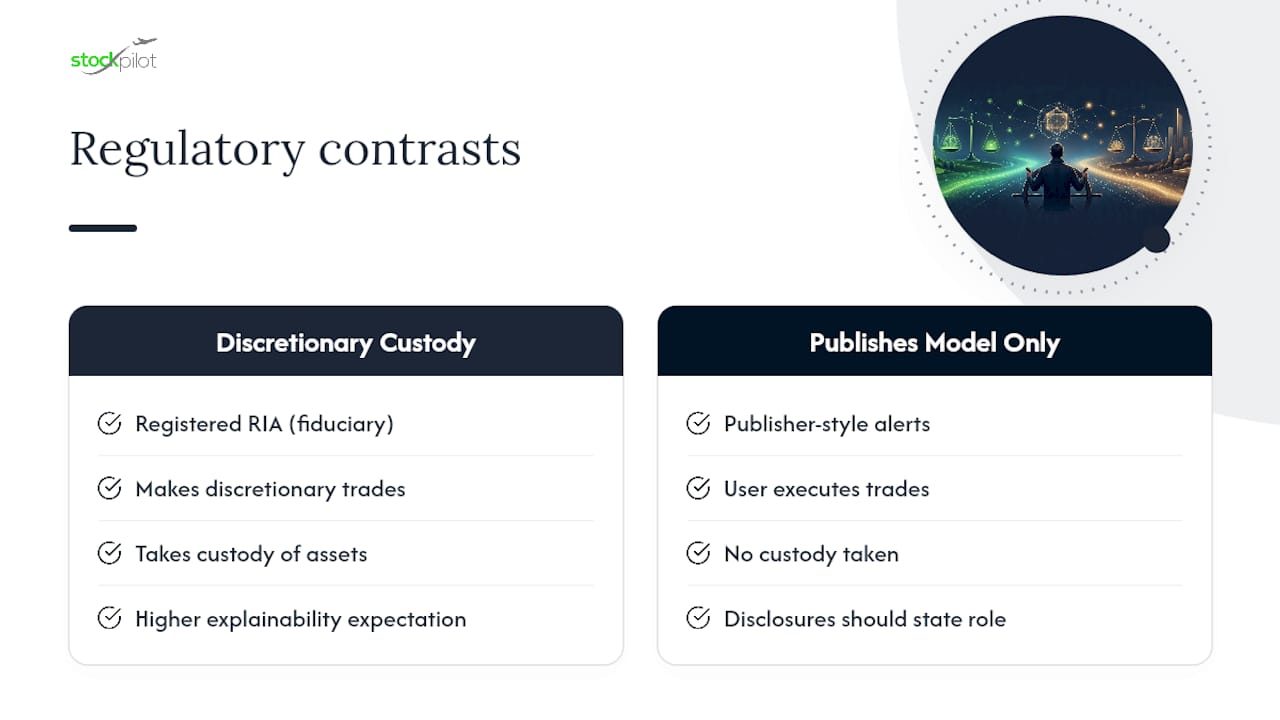
A system that takes custody of your assets and makes discretionary trading decisions functions differently, from a regulatory standpoint, than one that publishes a model portfolio and lets you execute trades yourself. The first typically operates as a registered investment adviser with fiduciary obligations. The second is closer to a publisher of informational alerts, and the disclosures should say so plainly.
Before trusting any platform with real capital, check its registration status directly through the SEC's public adviser database rather than relying on claims made in marketing copy. Legitimate providers make this easy to verify and typically link their own regulatory disclosures somewhere accessible, not buried in a support ticket response.
The AI layer itself introduces a newer compliance wrinkle: explainability. Regulators increasingly expect firms using algorithmic or ML-driven decisioning to demonstrate how a recommendation was generated, not just that it was generated. That's part of why deterministic, rule-based systems with traceable logic tend to hold up better under scrutiny than opaque black-box models or LLM outputs that can't show their work. If a platform can't explain a decision in terms of specific data inputs and rules, that's a compliance question worth asking before it's a legal one.
How Is AI Changing the Role of Portfolio Managers?
The portfolio manager's job hasn't disappeared. It's shifted upstream, from picking individual trades to designing and supervising the systems that pick them.
A decade ago, a big part of active management involved manually screening thousands of tickers and reacting to news in real time. Now, much of that screening gets automated, and the human role increasingly centers on setting risk parameters, validating model behavior, and deciding when a system's rules need revisiting. That's a meaningful shift in skill set: fewer analysts spending hours on spreadsheet-based valuation, more time spent on model governance and client communication.
For self-directed investors, the same shift is happening at a smaller scale. You're no longer the one scanning earnings reports every morning. You're the one deciding whether to trust a system's rules and checking that it's behaving the way it claims to. Robo-advisory services accelerated this trend at the retail level years ago by automating the "what should I buy" decision. AI-driven model portfolios extend it further by automating the ongoing "should anything change" decision too.
The industry trend line points toward hybrid setups: automated signal generation paired with human oversight of the rules themselves, rather than either fully automated black boxes or fully manual stock-picking. Firms that can show their model's logic, not just its returns, are the ones earning trust as this shift continues.
Real-World Examples: Where AI Portfolio Tools Succeed and Fail
The success stories tend to share one trait, a narrow, well-defined scope. Automated rebalancing tools that simply keep a portfolio's allocation within target bands have a strong track record because the problem they solve is mechanical and easy to verify. Automated investing platforms built around this kind of scoped automation, onboarding, strategy selection, rebalancing, and monitoring, have scaled to millions of accounts precisely because the logic is simple enough to audit.
The failures cluster around the opposite trait: overpromising on prediction. Models trained to forecast short-term price movements routinely perform well in backtests and then collapse in live trading because market conditions shift faster than the training data can capture. This is the overparameterization problem in practice, not theory. A model with hundreds of tuned parameters can look brilliant on five years of historical data and still lose money in the first volatile quarter it actually trades through.
There's also a sentiment-related failure pattern worth noting: models trained partly on social media or news sentiment can perform well in calm markets and then react erratically during volatility spikes, sometimes amplified by the broader effects algorithmic trading has on market volatility itself. When many automated systems respond to the same signals simultaneously, they can accelerate the very moves they're supposed to protect against.
The lesson isn't that AI fails at investing. It's that AI succeeds at bounded, auditable problems and struggles when asked to predict the unpredictable.
Who Actually Benefits From an AI-Driven Approach?
AI-driven portfolio tools tend to help two kinds of investors most: the busy professional who wants a disciplined process without daily monitoring, and the self-directed investor who trusts rules more than instinct during a downturn. Retirees managing a fixed income sleeve alongside growth exposure fit that second group well.
Where a human advisor still earns their fee is in situations no rule engine handles gracefully: complex tax situations, estate planning, or a life event that changes your entire risk tolerance overnight. The smartest setups treat AI signals as the operational engine and keep a human in charge of the bigger financial picture.
— David Elliot
Get Started With an AI-Managed Model Portfolio
The service provides a fully transparent model portfolio with multiple positions that users can see and verify before a single dollar moves. Income-producing positions are paired with AI-selected growth positions targeting performance ahead of the S&P 500, and buy or sell alerts are sent after hours, linked to predefined investment and risk criteria rather than speculation.
When conditions turn unfavorable, the system can shift capital toward Treasury ETFs as part of its risk management approach. Users retain full control of their brokerage accounts and trades. The service does not take custody of user assets. Full details on how risk is handled are available in the risk disclosure, with regulatory specifics on the compliance information page. Those interested in a rules-based, auditable approach to growth and income can join the waitlist.
Sources
- Financial machine learning survey (BFI Working Paper 2023)
- Capital Markets - AI-assisted broker portfolio management (Microsoft adoption library)
- Overcoming LLM hallucinations in regulated industries (AWS ML blog)
- Automated investing overview — Investopedia
FAQ
What Is the 30% Rule in AI Investing?
There's no universally recognized "30% rule" specific to AI portfolio management; the term shows up informally in different contexts, so treat any definition you see with caution and verify it against the specific platform's own documentation.
Which AI Tool Is Best for Managing a Portfolio?
It depends on what you want automated: full managed custody points toward a robo-advisor, while wanting to keep control of your brokerage account while following a transparent, rules-based model portfolio, like StockPilot's approach, points toward an alerts-based system instead.
How Much Do AI Financial Advisors Cost?
Costs vary by delivery model. Managed robo-advisors commonly charge a percentage of assets under management, while alerts-only or DIY-mirroring subscriptions typically charge a flat monthly fee instead.
Can ChatGPT Pick Stocks?
ChatGPT and similar large language models can discuss stocks and summarize information, but they aren't built for auditable trade decisioning and carry a real risk of hallucinated reasoning that isn't traceable to verified data, which is why deterministic systems are preferred for actual portfolio decisions.