

Buy sell signals, in this context, are after-hours, rules-based trade alerts issued for a 19-position model portfolio that subscribers mirror in their own brokerage accounts. When one lands in your inbox, the move is simple: verify the ticker, reason, and sizing, confirm your buying power and any tax implications, then execute during the recommended window. Delay only if you have a documented tax or wash-sale reason. These alerts are issued only when predefined criteria call for a change.
TL;DR:
- Alerts only recommend trades within the context of a 19-position model portfolio, excluding short-term trading signals or intraday patterns.
- Each alert specifies the ticker, reason, sizing, and a recommended execution window, emphasizing disciplined timing to avoid guesswork.
- The system's signals derive from multiple data categories and rules that are tested through backtesting and ongoing review to prevent breakdowns.
- When acting on alerts, verify details, confirm buying power, choose appropriate order types, and follow sizing guidance precisely, delaying only for documented or tax reasons.
- Risk-off moves trigger reallocations into Treasury ETFs based on specific conditions like volatility spikes; alerts clarify the amount, ETF involved, and re-entry triggers.
Table of Contents
- What Do Buy/Sell Alerts Cover, and What Do They Exclude?
- How Does the System Generate a Credible Signal?
- How Should You Act on an After-Hours Alert?
- What Are the Tax and Wash-Sale Rules for Mirroring Alerts?
- When Does the System Shift to Treasury ETFs?
- Why a Rules-Based Mirrored System Builds Confidence
- Rules Don't Remove Risk, but They Remove Guesswork
- How to Get Started With StockPilot's Alerts
- Sources
- FAQ
What Do Buy/Sell Alerts Cover, and What Do They Exclude?
These alerts are scoped tightly to one thing: changes inside a 19-position model portfolio. That covers new buys, outright sells, position replacements, and risk-off moves into Treasury ETFs when conditions warrant it. It does not cover intraday chart patterns, moving-average crossovers, or anything resembling a short-term swing trade. If you are hunting for a signal to day-trade around, this is the wrong tool.
Each alert is built to be actionable without a follow-up question. Expect it to include:
- The ticker symbol being bought, sold, or trimmed
- The reason the system flagged the change (fundamental shift, risk trigger, ranking update)
- The intended sizing adjustment, expressed as a target weight or share change
- A suggested execution window, typically the next trading session's open
That last point matters more than it sounds. An alert without a clear execution window forces you to guess timing, and guessing is exactly what a rules-based system exists to eliminate.
How Does the System Generate a Credible Signal?
Every alert traces back to five categories of input: market data, fundamentals, technicals, sentiment readings, and statistical patterns across the portfolio's universe of candidates. None of these run in isolation. The system weighs them against explicit rules, not gut calls.
Those rules do the heavy lifting. Thresholds determine when a position has drifted far enough from its target to warrant action. Ranking logic decides which candidate replaces an underperformer. Position limits cap how much any single name can dominate the portfolio, and risk overlays sit on top of everything, ready to override normal buy logic when broader conditions turn hostile.
Before any of that goes live, it gets tested. Backtesting against historical cycles and out-of-sample testing on data the model has never seen are standard practice for systematic, rules-based portfolio construction. Even well-tested rules break down eventually. Regime change, where market relationships shift, and crowding, where too many systems chase the same trade, are the two failure modes that show up most often in systematic investing research. Continuous review exists specifically to catch that drift before it compounds.
- Inputs: market, fundamental, technical, sentiment, statistical data
- Rule layer: thresholds, ranking, position limits, risk overlays
- Validation: backtesting, out-of-sample testing, ongoing review
Pro Tip: Read the rationale field before you touch your brokerage app. If an alert doesn't explain which rule fired, that's worth flagging, not just following.
How Should You Act on an After-Hours Alert?
Mirroring an alert accurately is a five-step habit, not a one-click reflex. Miss a step and you risk buying the wrong size, at the wrong price, or at the wrong moment relative to your own tax situation.
- Verify the alert details. Confirm the ticker, the action (buy, sell, or trim), the stated reason, and the recommended sizing before opening your brokerage app.
- Check your buying power. Confirm available cash or margin capacity, and understand your broker's cash-settlement rules if you just sold something to fund the buy.
- Choose the right order type. Alerts issued after hours are generally meant for execution at the next open, not in thin after-hours liquidity. A limit order near the prior close protects you from a gapped-open surprise; a market order works fine in liquid, large-cap names but can produce partial fills or worse pricing in thinner ones.
- Follow the sizing guidance exactly. If the alert calls for trimming a winner to fund a replacement, resist the urge to size it differently because you "like" the position you're being told to cut. The sizing logic accounts for portfolio-level balance, not just the single trade.
- Know when to delay. Legitimate reasons to hold off include an active tax-loss harvest you're managing manually, insufficient settled cash, or a documented personal override rule you've set for yourself. "I have a feeling" is not one of them.
Pro Tip: Set a recurring evening check for alerts rather than relying on push notifications alone. A missed notification during a busy week is the most common reason subscribers execute a day late.
What Are the Tax and Wash-Sale Rules for Mirroring Alerts?
Mirroring trades in your own brokerage account, rather than holding a commingled fund, keeps the tax-loss harvesting decision in your hands. That single structural difference is a big part of why mirrored model portfolios can be more tax-efficient than fund structures for taxable accounts.
The catch is the wash-sale rule: sell a position at a loss and buy a substantially identical security within 30 days before or after, and the IRS disallows the loss. A few practical points to keep in mind:
- If an alert would have you rebuy something you sold at a loss within the last 30 days, check the wash-sale window before executing.
- A near-identical replacement in the same sector can sometimes trigger scrutiny even if the ticker differs, so when in doubt, hold cash a few extra days rather than force the trade.
- In a tax-deferred account like an IRA, none of this applies. Wash-sale timing is irrelevant, so alerts can be executed on schedule without a second thought.
- Investors weighing more granular tax control sometimes compare model portfolios against direct indexing, which can harvest losses at the individual-lot level above certain account minimums.
For subscribers navigating more complex tax structures, including cross-border or trust-related holdings, a deeper look at capital gains triggers is worth a read before you assume a standard workaround applies.
When Does the System Shift to Treasury ETFs?
Risk-off moves are not random. They fire when specific conditions cross a threshold, and understanding those triggers helps you recognize a defensive alert for what it is rather than a mistake.
Common triggers include a portfolio drawdown crossing a predefined limit, a spike in market volatility, or macro signals that historically precede broader downturns. When one fires, the system doesn't liquidate into cash and wait. It reallocates growth exposure into Treasury ETFs, which carry far less volatility than equities and still generate a return while the system waits out unfavorable conditions.
The alert itself should tell you what to expect next. Check specifically for:
- How much growth exposure is being reduced, in percentage terms
- Which Treasury ETF is receiving the reallocated capital
- Any stated conditions for re-entry, so you know roughly what would trigger a move back into growth positions
Treat a risk-off alert as information about market conditions, not just a trade instruction.
Why a Rules-Based Mirrored System Builds Confidence
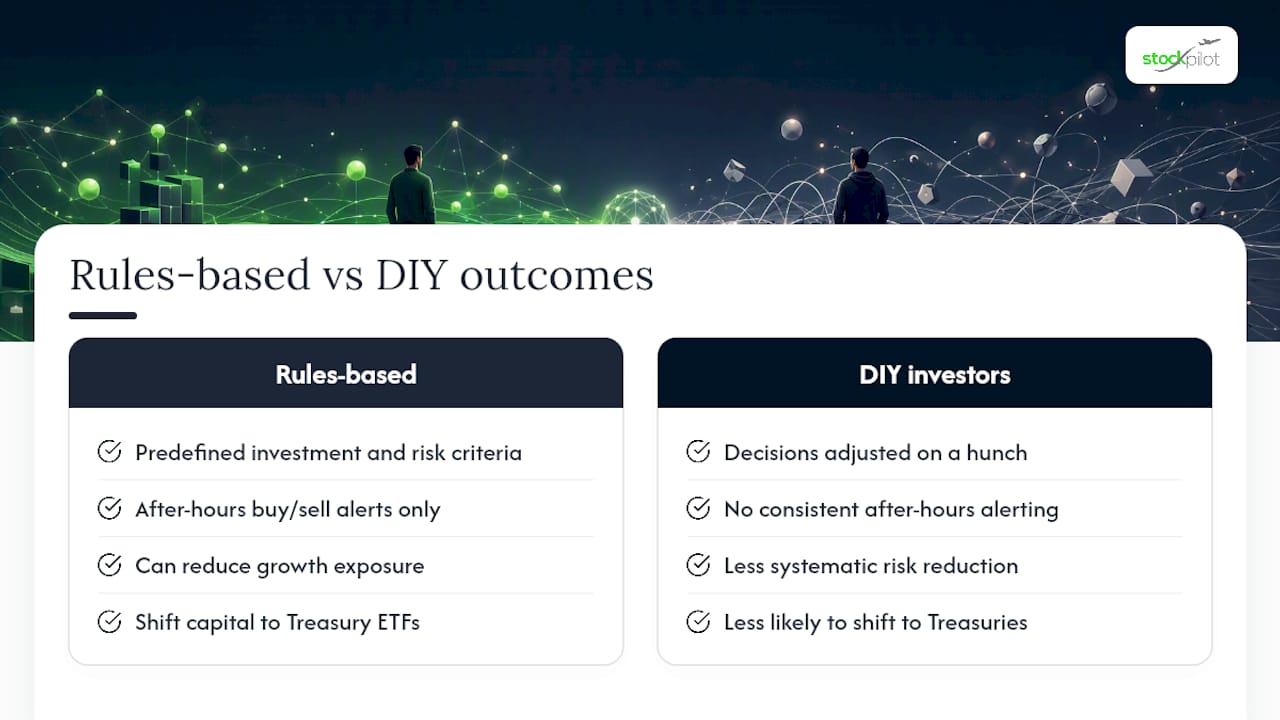
The system continuously evaluates market, fundamental, technical, sentiment, and statistical data, then issues after-hours buy and sell alerts only when predefined investment and risk criteria call for a portfolio change. That's the same rule architecture described above, applied consistently rather than adjusted on a hunch. During unfavorable conditions, the system can reduce growth exposure and shift capital toward Treasury ETFs, mirroring exactly the risk-management triggers covered earlier.
The behavioral payoff is real. Investors using automated, rules-based portfolios have tended to maintain their target allocations through sharp drawdowns far more consistently than DIY investors managing the same decisions manually, largely because the rules remove the moment of panic from the equation. This structure gives subscribers discipline, transparent sizing logic, and a risk overlay, while leaving full control of the account and every trade with the investor.
Rules Don't Remove Risk, but They Remove Guesswork
The value of a rules-based alert system isn't that it predicts markets better than you do. It's that it removes the moment where fear or excitement talks you out of your own plan. That's the behavioral edge, and it's a meaningful one, but it's not magic. A drawdown still hurts. A wrong-way sector rotation still shows up in your account balance.
What separates subscribers who benefit from this approach from those who don't is honest self-assessment: can you actually follow sizing guidance you disagree with in the moment? If the answer is usually no, no alert system fixes that on its own.
— David Elliot
How to Get Started With StockPilot's Alerts
This service provides disciplined, after-hours portfolio guidance instead of piecing together your own research each night. It runs a 19-position model portfolio that combines income-producing positions with AI-selected growth positions, and issues clear buy and sell alerts only when rules call for a change. During unfavorable conditions, the system shifts capital toward Treasury ETFs automatically, and every alert comes with the reasoning and sizing guidance covered throughout this piece.

New subscribers should expect their first alerts to arrive with full context: ticker, reason, sizing, and execution window, exactly as described above, so there's no ambiguity about what to do next. You keep full control of your brokerage account and every trade; the service never takes custody of your assets. If you want to see how the model portfolio and alert system work before committing, join the StockPilot waitlist for early access, or visit the product page to see the full portfolio structure firsthand.
Sources
- CFA Institute — topics: asset allocation models
- Mutualfunds
- Equicurious — Evaluating model portfolios vs DIY
This article is general information, not a substitute for advice from a qualified financial advisor. Consult a qualified financial professional about your own circumstances before acting on anything here.
FAQ
What Time Do Buy/Sell Alerts Usually Arrive?
Alerts are generated after market close once the day's data has been fully processed, typically in the evening, giving subscribers time to review before the next trading session opens.
Can I Execute an Alert the Next Day Instead of Right Away?
Yes, but delaying without a tax or funding reason risks entering at a worse price if the market moves overnight; StockPilot's recommended execution window is designed to minimize that gap.
What Happens if I Don't Have Enough Cash for a Buy Alert?
You should skip or partially execute the trade based on available buying power rather than using margin you're not comfortable with; the sizing guidance assumes you're funding from settled cash.
Do Alerts Ever Get Canceled or Reversed?
A follow-up alert can adjust or reverse a prior signal if new data shifts the system's rules-based assessment, which is why checking the rationale field on each alert matters.
Are These Alerts Suitable for a Retirement Account?
Yes, and tax-deferred accounts actually simplify execution since wash-sale timing doesn't apply, letting you follow the sizing guidance on schedule without tax-driven delays.