

Investing a lump sum immediately beats dollar-cost averaging in most historical periods, often by a meaningful margin, but DCA still wins for a specific type of investor. If a sudden market drop would push you to sell everything and walk away, spreading your cash out over a few months usually protects your long-term returns more than the math alone suggests.
TL;DR:
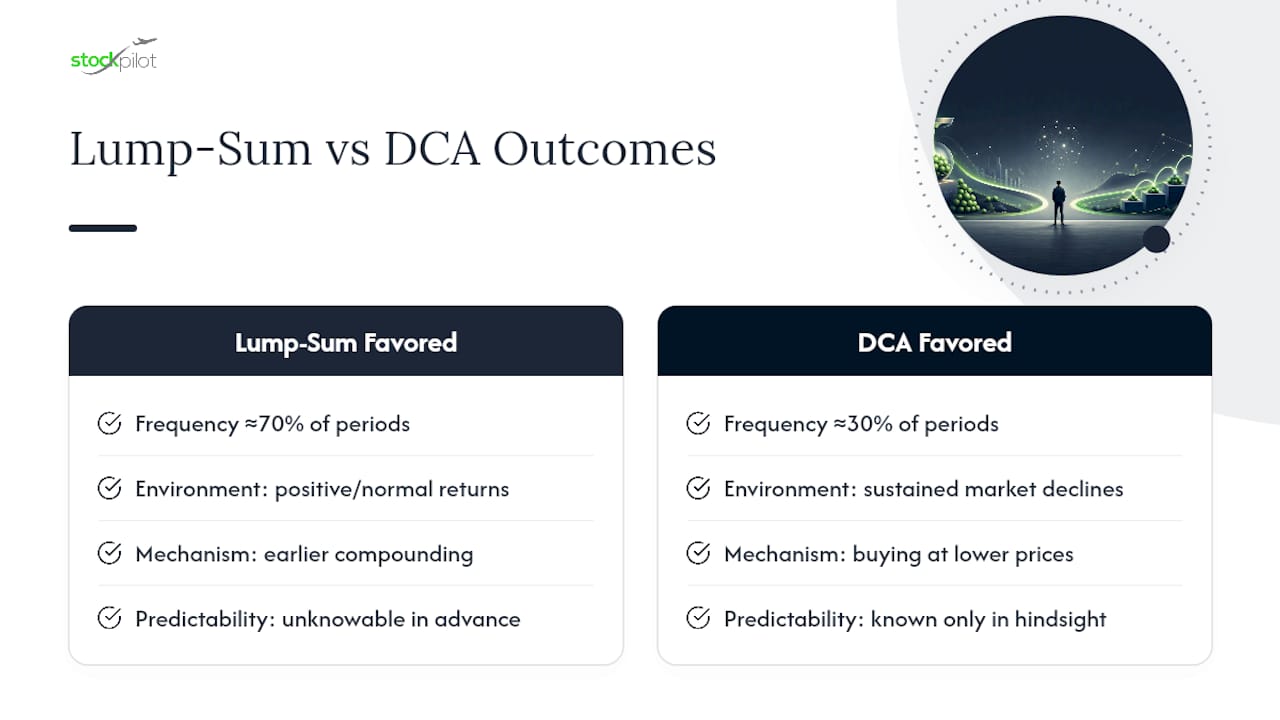
- Investing a lump sum generally outperforms dollar-cost averaging in about 70% of historical periods, with larger margins when the market rises steadily.
- DCA helps behavioral discipline but does not guarantee better long-term returns, especially in markets with consistent upward growth.
- The choice between strategies depends on your risk tolerance, investment horizon, and the size of the sum relative to your total assets, with hybrid approaches often balancing benefits.
- Market declines can favor DCA, but timing these periods in advance is impossible, making lump-sum more advantageous over the long run.
- Automating your chosen plan and preparing a clear rebalancing schedule improves execution and minimizes the impact of emotional decision-making.
Table of Contents
- Key Takeaways on DCA vs Lump-Sum Investing
- What Is Dollar-Cost Averaging?
- How Lump-Sum Investing Works
- What the Historical Data Actually Shows
- How to Choose Between DCA and Lump-Sum
- Building an Implementation Plan That Actually Works
- The Real Trade-Off Nobody Likes to Admit
- A Rules-Based Alternative for Deploying Your Cash
- Sources
- FAQ
Key Takeaways on DCA vs Lump-Sum Investing
Before diving into the mechanics, here's the shape of the evidence and the practical rule that falls out of it:
- Lump-sum investing has outperformed dollar-cost averaging in roughly 70% of rolling historical periods, according to AAII's backtest analysis.
- When lump-sum wins, it tends to win by a wider margin than DCA wins when the roles reverse, because early market exposure compounds longer.
- DCA earns its keep on the behavioral side: FINRA frames it as a tool for reducing regret and enforcing discipline, not a return booster.
- Rule of thumb: deploy a lump sum if you can tolerate a significant drawdown without selling; use DCA or a hybrid if you cannot honestly say that.
What Is Dollar-Cost Averaging?
Dollar-cost averaging means investing a fixed dollar amount on a set schedule, regardless of what the market is doing that week. Instead of putting $30,000 into the market on a Tuesday, you might invest $5,000 a month for six months, or $2,500 every two weeks. Investopedia's definition points to the most common real-world example most people already practice without thinking about it: 401(k) payroll contributions, where a portion of every paycheck buys shares automatically.
The appeal isn't mathematical. It's psychological. FINRA's investor guidance notes that DCA's real value lies in helping risk-averse investors stick to a plan and avoid the regret of investing everything right before a downturn. You buy more shares when prices are low and fewer when prices are high, which smooths your average cost basis, but that smoothing doesn't guarantee a better outcome than investing all at once.
The pitfalls are practical, not theoretical:
- Cash sitting on the sidelines waiting to be deployed earns little and misses whatever the market does during that window.
- Frequent small transactions can rack up fees depending on your brokerage, though most major platforms now offer commission-free trades.
- In a market that grinds steadily upward, as U.S. stocks have done in most decades, DCA systematically buys in at higher and higher prices.
Pro Tip: Match your DCA schedule to how the cash arrived. If it's a bonus or inheritance sitting in a savings account, a 3 to 6 month schedule balances discipline against opportunity cost. Stretching it past a year usually just adds unnecessary cash drag.
How Lump-Sum Investing Works
Lump-sum investing means putting the entire amount to work immediately, in your target allocation, on day one. No staging, no waiting for a "better entry point." The logic behind why it usually wins comes down to time in the market rather than timing the market.
Stocks have historically delivered positive returns more often than not, and that positive expected return, known as the equity risk premium, means every day your money sits in cash instead of stocks is a day of foregone growth. Morgan Stanley's analysis found lump-sum investing generated slightly higher annualized returns than DCA across its historical simulations, precisely because more capital was exposed to that premium for longer.
The catch is psychological, and it's a real one. Putting $100,000 into the market on a Monday and watching it drop 15% by Friday feels very different from watching that same drop happen to money you were planning to invest gradually anyway. That's when panic-selling happens, locking in a loss that a slower deployment might have avoided.
A few operational details matter too:
- Tax-lot management gets simpler with a single purchase date, since you're not tracking a dozen different cost bases.
- Rebalancing cadence should be set in advance, not decided emotionally after the first big swing.
- If the lump sum includes assets across stocks, bonds, and ETFs, the allocation decision matters more than the deployment timing decision.
What the Historical Data Actually Shows
The clearest evidence comes from rolling-period backtests, and the numbers are consistent enough to take seriously. AAII's long-run backtest summaries show lump-sum investing beating dollar-cost averaging in roughly 70% of historical rolling periods when both strategies are compared over the same horizon using U.S. equity returns.
The Number That Matters More Than the Win Rate: A 70% win rate sounds decisive, but the size of those wins is what actually moves your terminal wealth. Because lump-sum's advantage comes from extra time in the market compounding early, its winning margins tend to run larger than DCA's winning margins when DCA happens to come out ahead. A small annualized edge in year one can snowball into a large dollar gap by year twenty.
Morgan Stanley's own simulations reached a similar conclusion: lump-sum investing produced slightly higher annualized returns than DCA on average, while acknowledging that DCA reduces the risk of unlucky timing at the exact moment you invest.
DCA does win in specific, identifiable conditions. Sustained market declines, like extended bear markets, reward the investor who was still buying at progressively lower prices while the lump-sum investor already took the full hit up front. The problem is that nobody can identify these periods in advance. You only know after the fact whether a given starting date was a "DCA wins" scenario or a "lump-sum wins" scenario.
There are real limits to how far these backtests should be pushed. Most of the data draws heavily on U.S. large-cap equity indexes, so the 70% figure doesn't automatically transfer to a bond-heavy portfolio, an international allocation, or a single volatile stock. The specific asset allocation you choose changes the equity risk premium you're capturing, which changes the size of lump-sum's edge.
How to Choose Between DCA and Lump-Sum
The decision comes down to four factors: your time horizon, your emotional tolerance for drawdowns, how large the sum is relative to your total net worth, and how soon you might need the cash back.
- Check your time horizon first. If you're investing for a goal 15 or more years out, the extra time in the market from a lump sum has more room to compound. Shorter horizons shrink that advantage.
- Be honest about your drawdown tolerance. If a 20% drop in your portfolio's first month would make you sell everything, that panic-driven exit will cost you far more than DCA's opportunity cost ever would.
- Weigh the size of the sum against your total assets. A $10,000 windfall behaves differently than a $500,000 inheritance or retirement rollover. Larger sums amplify both the potential gain from lump-sum and the potential regret if timing goes wrong.
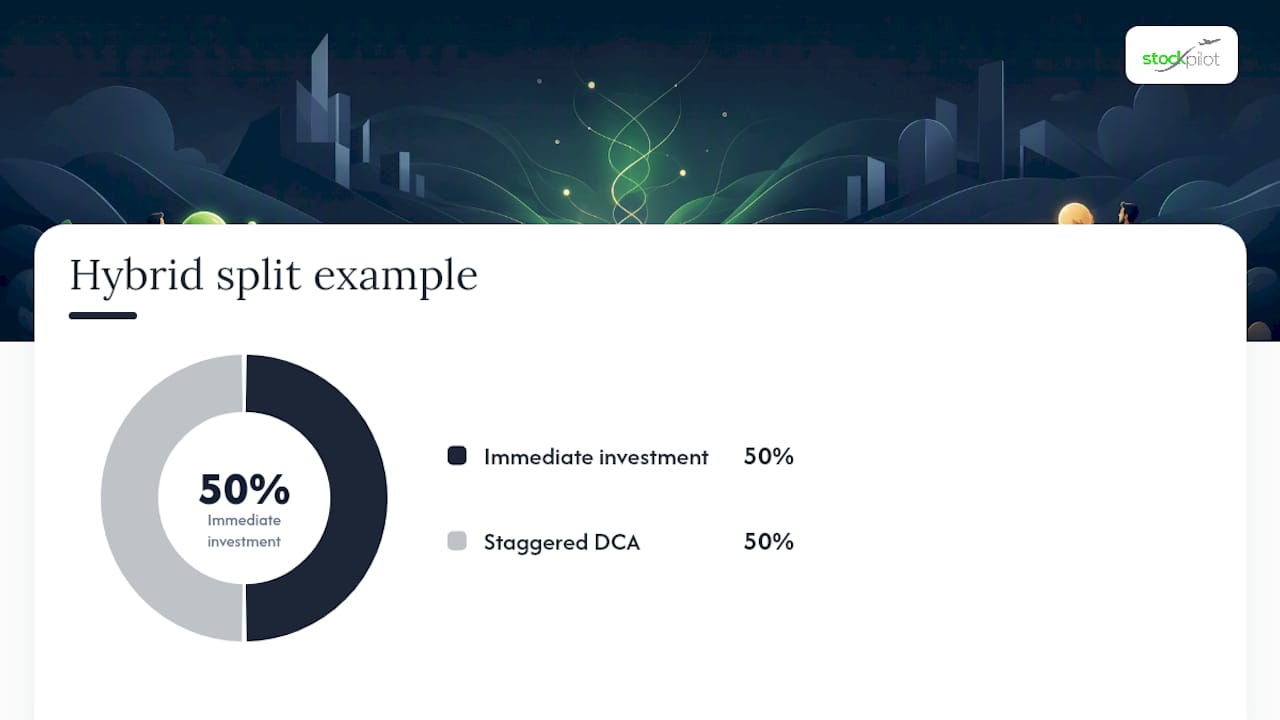
- Consider a hybrid. Deploying 50% immediately and spreading the remainder over the next 3 to 6 months captures much of lump-sum's edge while cutting the worst-case regret in half.
- Decide where uninvested cash sits during a DCA schedule. Short-term Treasury bills or a high-yield savings account beat letting cash sit idle in a checking account, and they measurably reduce the opportunity cost Morgan Stanley's research flags as DCA's biggest hidden drag.
Pro Tip: If you're torn, run the numbers on the hybrid split before defaulting to either extreme. Half now, half over six months, gives you most of lump-sum's compounding benefit with a real psychological cushion if the market drops right after you start.
Advanced variants exist too. AAII's research on momentum-enhanced DCA, where contribution size adjusts based on recent market direction, can modestly improve on plain DCA. It adds complexity, though, and only works if you set firm rules ahead of time instead of adjusting contributions on gut feeling.
Building an Implementation Plan That Actually Works
Once you've picked a strategy, the execution details are where good intentions fall apart. Here's a concrete framework for either path.
- For DCA, pick a fixed cadence and automate it. A 6-month schedule split into equal monthly transfers is a common middle ground. Set up recurring automatic transfers through your brokerage, the same mechanism that makes 401(k) payroll contributions work without anyone thinking about it twice.
- For lump-sum, lock in your allocation before you deploy. Decide the stock/bond/ETF split in advance, execute it in a single session, and set a rebalancing calendar (quarterly or annually) rather than reacting to headlines.
- Run the numbers on a real example. Say you have $60,000. Lump-sum buys your full target allocation on day one. A 6-month DCA plan invests $10,000 monthly. If the market rises steadily, lump-sum ends up owning more shares purchased at lower average prices than the DCA investor, who bought later months at higher prices.
- Watch the fee drag on frequent small trades. Per-trade fees are rare at major brokerages now, but bid-ask spreads on lower-volume ETFs can quietly erode a DCA plan with many small purchases more than a single large one.
The Real Trade-Off Nobody Likes to Admit
Most articles on this topic pretend the choice is purely mathematical, and that's a disservice. The math says lump-sum wins more often. The behavioral evidence says a lot of people can't actually execute lump-sum without sabotaging themselves the first time the market drops. Both things are true at once, and pretending otherwise is how investors end up making decisions they regret.
What gets underestimated is how much this decision has less to do with returns and more to do with whether you'll stay invested at all. A slightly lower-return strategy you actually stick with beats a higher-return strategy you abandon during a downturn. That's the entire case for a rules-based approach like StockPilot, which removes the moment-by-moment emotional decision from the equation by following predefined criteria for deployment and risk management.
— David Elliot
A Rules-Based Alternative for Deploying Your Cash
Choosing between DCA and lump-sum forces you to trust your own future self under stress, and that's exactly where most investors stumble. StockPilot sidesteps that problem by handing deployment and ongoing management to a rules-based system instead of a gut call.

A rules-based system can run a transparent 19-position model portfolio, combining income-producing positions with AI-selected growth positions, and issue clear after-hours buy and sell alerts when predefined criteria call for a change. During unfavorable market conditions, such systems may shift capital from growth positions into Treasury ETFs as part of built-in risk-management processes, providing drawdown protection that may be difficult to manage individually in the heat of the moment. Investors keep full control of their brokerage accounts and trades. If you'd rather follow a structured framework than second-guess your own timing decision, see how StockPilot's model portfolio works or join the waitlist for early access.
Sources
- The Benefits and Limitations of Dollar-Cost Averaging | FINRA
- Dollar-Cost Averaging Versus Lump-Sum Investing: Which Builds More Wealth? | AAII Insights
- Dollar-Cost Averaging or Lump-Sum Investing. Which is Right for You? | Morgan Stanley
- Dollar-cost averaging (DCA) — Investopedia
This article is general information, not a substitute for advice from a qualified financial advisor. Consult a qualified financial professional about your own circumstances before acting on anything here.
FAQ
What Does Warren Buffett Say About Dollar-Cost Averaging?
Buffett has generally favored buying quality businesses when they're available at a fair price rather than spreading purchases out on a fixed schedule. His broader philosophy leans toward deploying capital decisively when the opportunity is right, which aligns more closely with the lump-sum approach than a rigid DCA schedule.
What Is the 70/30 Rule in Investing?
There's no single, universally recognized "70/30 Buffett rule." The number that shows up consistently in the DCA versus lump-sum research is different: lump-sum investing has outperformed DCA in roughly 70% of historical rolling periods, which is likely the figure people are misremembering.
What Is the 70/20/10 Rule in Trading?
Definitions of this rule vary widely across different corners of personal finance and trading content, and it isn't tied to any standard backed by the dollar-cost averaging research this article covers. Treat any specific 70/20/10 framework you encounter with caution unless the source clearly defines its terms.
What Are the Disadvantages of Dollar-Cost Averaging?
The main drawback is opportunity cost: cash waiting to be deployed on a schedule sits out of the market and misses potential gains, which matters most in steadily rising markets. FINRA also notes that DCA doesn't guarantee better returns. It only helps some investors stay disciplined enough to invest at all.
Is a Hybrid Approach Better Than Choosing One Strategy?
For many investors, yes. Deploying roughly half a lump sum immediately and spreading the rest over 3 to 6 months captures much of lump-sum's return advantage while meaningfully reducing the regret risk of a bad entry point. It's a practical middle ground rather than a mathematically optimal one, but it tends to be easier to stick with.