

Check your allocation once or twice a year, and only trade when a position drifts more than 5 percentage points from its target (or 20 to 25% of its own value for smaller sleeves). That's the whole rule for most investors. Retirees and people with concentrated positions or big cash flows should look twice a year instead of once, and rebalance inside 401(k)s or IRAs before touching a taxable account.
TL;DR:
- Most investors should rebalance only when their asset allocation drifts more than 5 percentage points, with retirees and large cash flow investors checking twice a year.
- A hybrid rebalancing approach, combining scheduled reviews with threshold-based triggers, is generally recommended to balance discipline and cost efficiency.
- Rebalancing should prioritize tax-advantaged accounts first, using new contributions and dividends before selling in taxable accounts to minimize tax impacts.
- Automated tools like target-date funds or rules-based alerts can simplify maintaining allocation targets without constant manual oversight.
- Regular reviews are typically sufficient for simple portfolios, but concentrated positions may require quarterly attention to manage volatility risks effectively.
Table of Contents
- How Often to Rebalance: Matching Your Schedule to Your Portfolio
- Calendar Rules, Threshold Rules, and the Hybrid Approach Most Pros Use
- Your Rebalancing Checklist: The 5/25 Rule in Practice
- Why Account Type Should Drive Your Rebalancing Order
- Automatic Rebalancing, Target-Date Funds, and Rules-Based Alerts
- What Rebalancing Frequency Looks Like at Different Portfolio Sizes
- Applying These Rules in Real Life
- A Rules-Based Way to Keep Your Allocation on Track
- Sources
- FAQ
How Often to Rebalance: Matching Your Schedule to Your Portfolio
There's no universal clock here. Someone holding a simple two-fund portfolio in a Roth IRA has almost nothing in common with a retiree drawing income from a taxable brokerage account with a concentrated employer stock position. The right rebalancing frequency depends on how complicated your holdings are, how much cash moves in and out, and how much you're willing to pay in taxes and fees to stay precisely on target.
Vanguard's research on rebalancing found little difference in long-run returns between monthly, quarterly, and annual rebalancing, but a big difference in trading costs and tax drag as frequency increases. Investor.gov backs this up, recommending periodic checks every six to twelve months rather than constant monitoring.
Here's how that breaks down by situation:
- Broadly diversified stock and bond portfolios: annual checks are enough for most people.
- Retirees or investors with large, irregular withdrawals: semiannual reviews catch drift before it compounds.
- Concentrated positions (a single stock over 10% of the portfolio): semiannual or even quarterly attention makes sense.
- Quarterly or monthly rebalancing for a standard portfolio: rarely improves risk-adjusted returns and usually just adds trading costs and short-term tax exposure.
Calendar Rules, Threshold Rules, and the Hybrid Approach Most Pros Use
Every rebalancing rule boils down to one of three structures. Each has a distinct failure mode, and knowing which one you're using changes how often you should actually be trading.
- Calendar-based rebalancing. Pick a date, say every January 1 or the first trading day of each quarter, and rebalance back to target on that day regardless of how far things have drifted. It's simple, removes decision fatigue, and works well for investors who'd otherwise never get around to it. The weakness: you might rebalance on a day when nothing has actually drifted, generating unnecessary trades and taxes.
- Threshold-based rebalancing. You only trade when an allocation moves outside a pre-set band, commonly 5 percentage points for a major asset class. This ties trading directly to actual risk drift instead of the calendar, but it requires you to actually watch your allocation, which most people don't do consistently without a system.
- Hybrid rebalancing. You check on a schedule, annually or semiannually, but only trade if a threshold has been breached. Vanguard's own guidance leans toward this combination because it caps how often you're tempted to trade while still catching meaningful drift. It's the closest thing to a consensus best practice among the three.
Most individual investors do best with the hybrid model. It turns rebalancing into a twice-a-year appointment rather than a constant background worry.
Your Rebalancing Checklist: The 5/25 Rule in Practice
Turning "check periodically, act on drift" into something you'll actually follow takes a written process. Here's the sequence worth following every time you sit down to review your accounts.
- Write your target allocation down, with a one-line reason for each sleeve (why you own 60% stocks, why bonds are 30%, why the remaining 10% is in a satellite position). Without this, drift is invisible.
- Set your review dates: once or twice a year, tied to something memorable, like your birthday or tax season.
- Apply the 5/25 rule. Rebalance a major asset class (US stocks, bonds, international) once it's off target by 5 percentage points in absolute terms. For smaller sleeves, like a 5% allocation to emerging markets, use a 20 to 25% relative move instead, since 5 points of an already small position is a huge swing. Evidence-based summaries consistently point to these two thresholds as the sweet spot between staying disciplined and overtrading.
- Use cash flows first. Before selling anything, direct new contributions, dividends, and interest toward whichever sleeve has drifted below target. This alone resolves most minor drift without a single taxable sale.
- If you must sell, minimize the tax hit. Sell in tax-advantaged accounts first. In taxable accounts, favor tax-loss harvesting opportunities or shares with the smallest embedded gain, and write down what you sold and why.
Pro Tip: Keep a simple rebalancing log, even a basic spreadsheet with the date, what drifted, and what you did about it. Six months from now, that log is what stops you from second-guessing a decision you already made for good reasons.
Why Account Type Should Drive Your Rebalancing Order
The sequence in which you rebalance matters almost as much as how often. Selling a winner inside a 401(k) or IRA costs nothing in taxes. Selling that same winner in a taxable brokerage account can trigger a capital gains bill that erases a chunk of the benefit you were chasing.
A practical order looks like this:
- Rebalance inside tax-advantaged accounts first, since trades there are tax-free events.
- In taxable accounts, use new contributions and reinvested dividends to correct drift before selling anything.
- Weigh trading costs and your marginal tax rate before selling an appreciated position just to shave a percentage point off an allocation.
- Treat a small drift in a taxable account as a candidate to leave alone until the next scheduled review, rather than an emergency.
Morningstar's guidance on tax-aware rebalancing is direct on this point: concentrate your trading in sheltered accounts and use cash flows to do the rest. Institutional research generally favors less frequent trading precisely because taxes and transaction costs compound every time you touch a taxable position unnecessarily. The math rewards patience over precision.
Automatic Rebalancing, Target-Date Funds, and Rules-Based Alerts
Not everyone wants to run this checklist by hand twice a year, and that's a legitimate choice, not laziness. Several structures can maintain your allocation without you doing the math yourself.
- Brokerage auto-rebalancing tools reset your allocation on a schedule you set, removing the timing decision entirely.
- Target-date funds shift their own stock-to-bond mix automatically as you approach a set retirement year, which investor.gov describes as a built-in replacement for manual rebalancing in many retirement accounts.
- Automated rebalancing inside brokerage accounts can still trigger capital gains if the account is taxable, so knowing your account type before automating anything matters more than the automation itself.
- A rules-based alert system, StockPilot among them, can flag when a position has moved outside its target band and issue a specific action, which keeps the discipline without requiring you to watch the market daily.
Manual rebalancing gives you more control over tax lots and timing. Automation trades some of that control for consistency, which is usually the better trade for anyone who knows they won't stick to a manual schedule.
What Rebalancing Frequency Looks Like at Different Portfolio Sizes
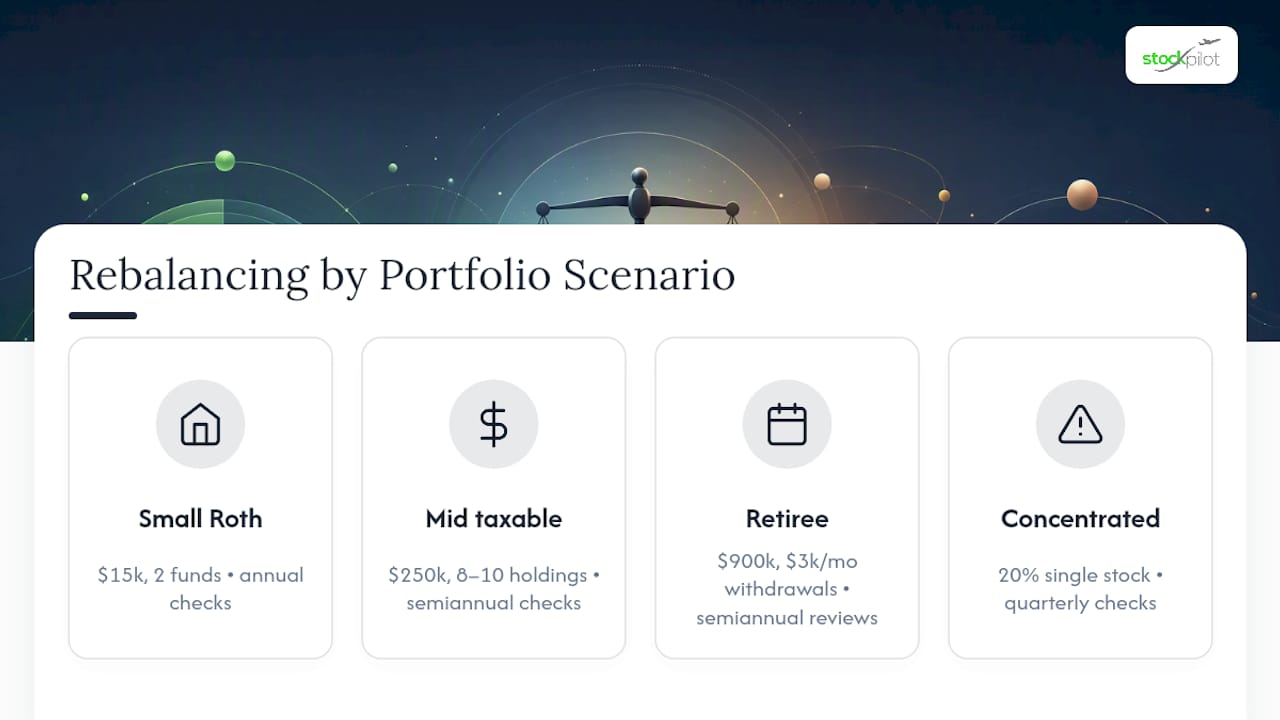
A $15,000 Roth IRA in two index funds barely needs attention. With only two positions, drift is easy to spot at a glance, and an annual check, maybe timed to a birthday, catches anything that matters. There's rarely a reason to trade more than once a year here.
A $250,000 taxable brokerage account with eight to ten holdings is a different animal. Dividends and periodic contributions create more opportunities for quiet drift, and a semiannual check paired with the 5% threshold catches problems before they become expensive to fix. This is where the hybrid method earns its keep.
A retiree drawing $3,000 a month from a $900,000 portfolio across a taxable account and an IRA needs the tightest attention of the three, not because the rules change, but because withdrawals themselves shift the allocation every month. Semiannual reviews, with withdrawals drawn preferentially from overweight sleeves, keep the portfolio aligned without constant intervention.
A concentrated position, say 20% of a portfolio sitting in one employer's stock after years of vesting, breaks the standard cadence entirely. That position alone might justify quarterly attention regardless of what the rest of the portfolio looks like, since a single stock swinging 30% in a quarter changes your risk profile faster than any diversified sleeve would.
Applying These Rules in Real Life
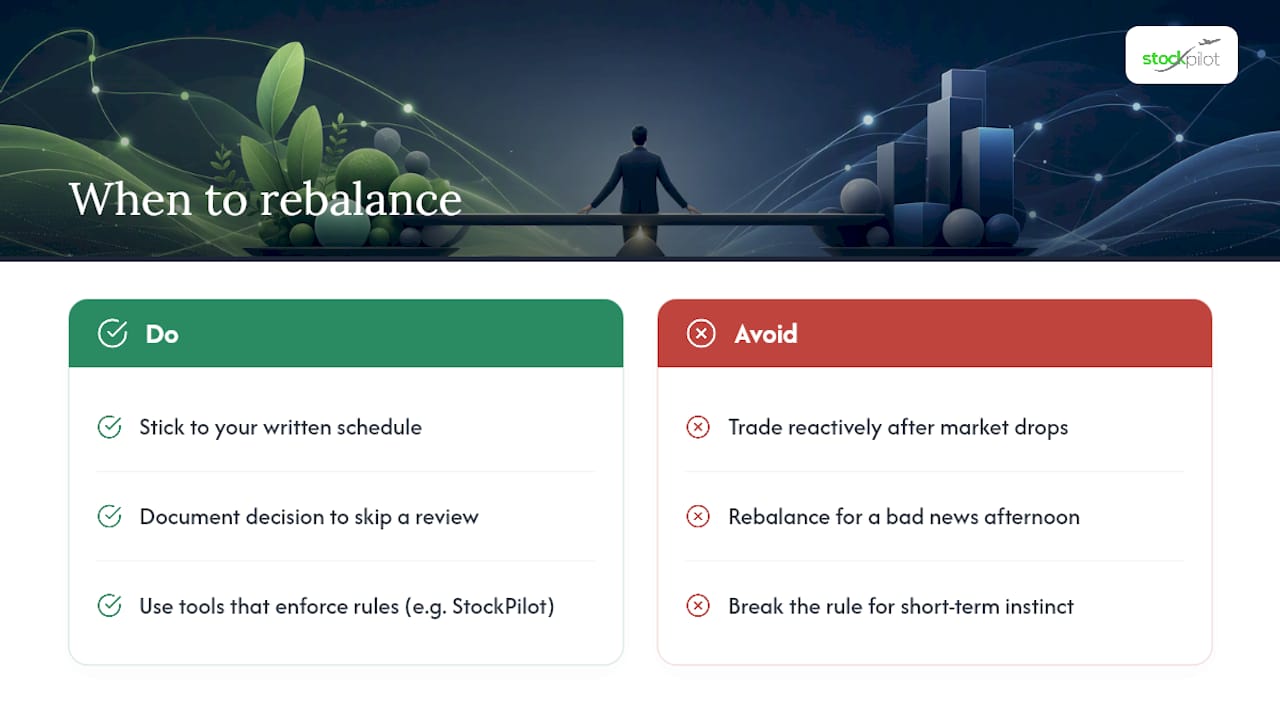
The 5/25 rule and annual checks work beautifully on paper. In practice, the hardest part isn't knowing the rule, it's not breaking it the week the market drops 15% and every instinct says to do something. That's exactly the moment to stick to your written schedule rather than react.
Large life events change the math legitimately: an inheritance, a job loss, a concentrated stock grant vesting all at once. Those are real reasons to rebalance off-schedule. A bad afternoon on financial news is not. I'd rather see someone document a decision to skip a review during a volatile month than trade reactively and regret it later. Tools that enforce a rule set, StockPilot included, exist precisely because most investors are better at building good rules than following them under stress.
— David Elliot
A Rules-Based Way to Keep Your Allocation on Track
StockPilot exists for investors who want the discipline of a written rebalancing plan without doing the tracking by hand every quarter. The system runs a transparent 19-position model portfolio, six income positions and 13 AI-selected growth positions, and issues after-hours buy and sell alerts only when its predefined criteria call for a change, not on a whim or a headline.

That structure maps directly onto the checklist above. StockPilot documents every trade it recommends, applies risk-management shifts toward Treasury ETFs when conditions turn unfavorable, and gives you position sizing guidance instead of a raw stock tip. You keep full control of your brokerage account and execute every trade yourself. If you've read this far and know you won't run a semiannual review with a spreadsheet, StockPilot Premium costs $147 a month and replaces that manual process with structured alerts. Visit the StockPilot product page for details, or join the waitlist for early access and new-subscriber offers.
This article is general information, not a substitute for advice from a qualified financial advisor. Consult a qualified financial professional about your own circumstances before acting on anything here.
Sources
- Rebalancing your portfolio: How to rebalance - Vanguard
- Investor
- How often to rebalance | Summitward
- How to Rebalance Your Portfolio Before 2026 | Morningstar
FAQ
What Is the 5/25 Rule for Rebalancing?
Evidence-based guidance treats this as the standard trigger for most diversified portfolios.
How Often Should You Automatically Rebalance a 401(k)?
Most 401(k) plans that offer auto-rebalancing let you set it to run quarterly, semiannually, or annually. Semiannual or annual is generally sufficient, since target-date funds and similar automated structures already smooth allocation shifts over time without frequent manual intervention.
Does Warren Buffett Rebalance His Portfolio?
Buffett has historically favored long-term holding over frequent trading, preferring to let winning positions run rather than trimming them back to fixed percentages on a schedule. That approach differs from the standard threshold-based rebalancing most individual investors use, since Berkshire Hathaway's concentrated style tolerates far more drift than a typical diversified portfolio would.
What Is Warren Buffett's 90/10 Rule?
It's a static allocation suggestion rather than a rebalancing schedule, though anyone following it would still want to check the split annually and correct meaningful drift using the same 5% threshold used elsewhere.
Can a Tool Like StockPilot Handle Rebalancing Decisions for Me?
StockPilot issues after-hours buy and sell alerts when its predefined criteria are met, which enforces a consistent rule set without requiring you to track allocation drift manually. You still execute every trade in your own brokerage account, so it functions as a structured guide rather than a fully hands-off substitute for a target-date fund.