
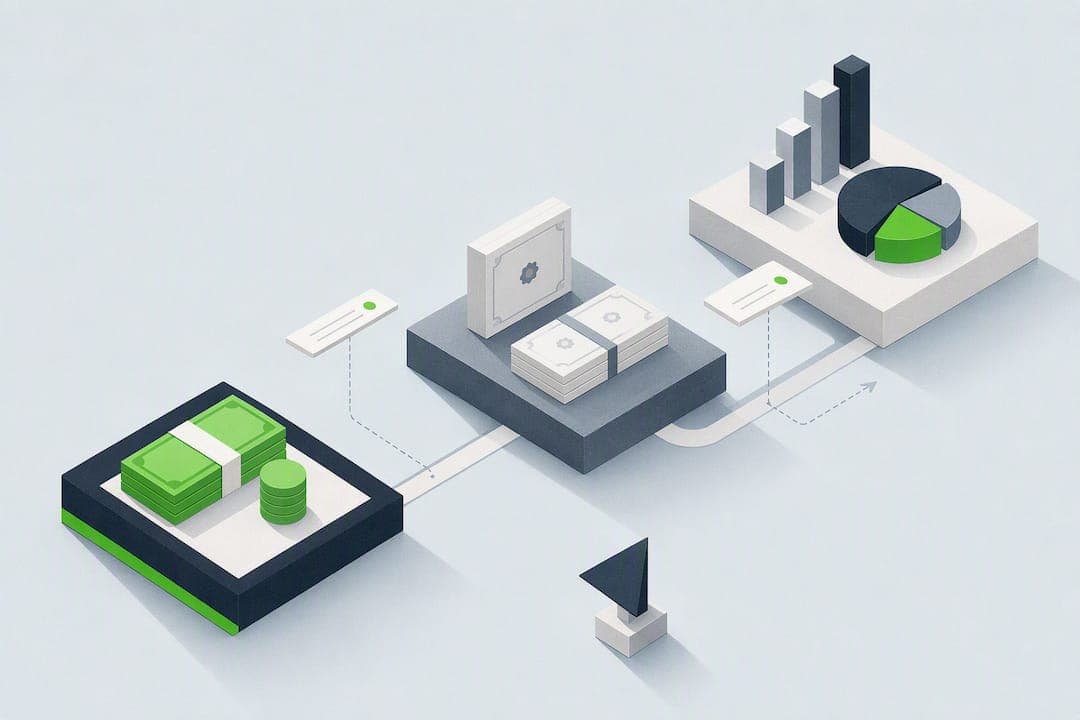
A bucketed, tax-aware model portfolio, cash for 6 to 24 months, quality bonds for 3 to 10 years, and diversified equities for the long stretch beyond that, is the practical starting point for most retirees. A conservative retiree might run 40% stocks, 50% bonds, 10% cash; a moderate retiree closer to 50/40/10; an aggressive one nearer 60/32/8. From there, the real work is sizing the cash buffer, placing assets in the right accounts for tax purposes, and building a system that keeps you from selling stocks at the worst possible moment.
TL;DR:
- Retirees should allocate roughly 6 to 24 months' cash, 3 to 10 years of bonds, and long-term stocks, adjusting based on income sources and goals.
- The bucket approach prevents the need to sell stocks during market crashes and relies on flowing dividends and interest to refill the cash buffer.
- Asset placement across tax-advantaged and taxable accounts significantly impacts after-tax income, with bonds and REITs in tax-deferred accounts and high-growth equities in Roth IRAs.
- About 3.5% to 5% of the portfolio is a common withdrawal rate, adjusted for guaranteed income, liquidity needs, and market performance, with disciplined rebalancing crucial.
- Using a rules-based system like StockPilot simplifies maintaining a bucketed, tax-aware portfolio, reducing emotional mistakes and supporting disciplined investment decisions.
Table of Contents
- What a Model Portfolio for Retirees Actually Means
- The Bucket Approach: What Goes Where and Why
- Sample Retirement Allocations: Three Starting Points
- Placing Assets for Taxes: Where Each Holding Should Live
- Setting Your Withdrawal Rate and Managing the Portfolio
- How StockPilot Implements These Principles in Practice
- Risk Management for Retirees: Longevity and Inflation
- Planning for Healthcare Costs and the Unexpected
- Coordinating Social Security and Pensions With Portfolio Withdrawals
- Annuities and Guaranteed Income Products: Where They Fit
- Behavioral Mistakes That Wreck Good Retirement Plans
- Why Discipline Beats Prediction in Retirement Investing
- Getting Started With a Rules-Based Retirement Portfolio
- Sources
What a Model Portfolio for Retirees Actually Means
A model portfolio for retirees isn't one fixed pie chart. It's a framework for matching your money to when you'll need it, and three main archetypes cover most situations.
The bucketed decumulation model splits assets by time horizon: near-term cash, intermediate bonds, and long-term stocks. It's built for retirees who want a visual, common-sense way to avoid panic selling. The income-first model leans on dividends, bond coupons, and guaranteed sources like Social Security or a pension to cover living costs, with less concern for total portfolio growth. The total-return model ignores income labels entirely and simply withdraws a set percentage each year from a globally diversified mix, rebalancing as needed.
Which one fits depends on a few things:
- How much of your essential spending is already covered by guaranteed income
- How you'd react, emotionally and financially, to a 25% drop in your portfolio
- Whether you're retiring at 62 with a 30-year horizon or at 70 with a shorter one
- Whether leaving money to heirs matters as much as funding your own retirement
None of these models is a finished answer. Financial planners increasingly frame retirement assets as a set of income streams rather than one pool of money, and that framing is what makes a model portfolio useful. It's scaffolding you adjust to your own numbers, not a formula you copy exactly.
The Bucket Approach: What Goes Where and Why
Morningstar strategist Christine Benz popularized the version of bucketing most retirees encounter, and it holds up because it solves a specific problem: never being forced to sell stocks during a crash to pay this month's bills.
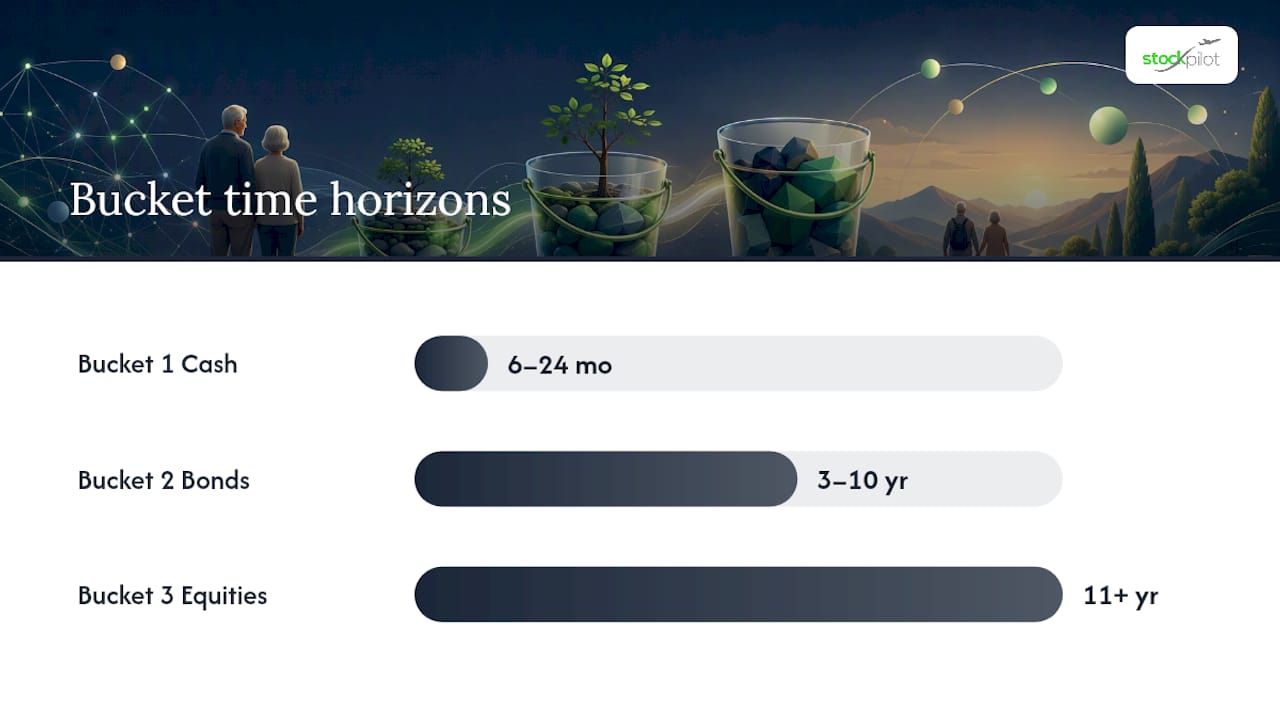
- Bucket 1: Cash and cash equivalents (roughly 6 to 24 months of living expenses). This covers checking accounts, high-yield savings, money-market funds, and short CDs, which help provide essential valiutų likvidumas to avoid forced selling in market declines. Its only job is liquidity.
- Bucket 2: Short and intermediate bonds (typically 3 to 10 years of spending). Think Treasury ETFs, investment-grade corporate bond funds, and for taxable accounts, municipal bond funds. Benz's own bucket examples put a significant portion of a retiree portfolio in this tier (https://www.morningstar.com/portfolios/an-introduction-christine-benzs-model-portfolios-3), depending on how conservative the investor wants to be.
- Bucket 3: Diversified equities (11 years and beyond). This is where growth happens, since it has the time to recover from downturns.
The mechanics matter more than the labels. Dividends, interest, and required minimum distributions flow into Bucket 1 first. When Bucket 2 matures or gets rebalanced, it refills Bucket 1. When equities have a strong year, you trim gains and push them down the chain, too. That flow is what protects you from sequence-of-returns risk, the danger of a market crash hitting right when you start withdrawing.
Pro Tip: Build Bucket 1 as a rolling ladder of CDs or Treasury bills instead of one static savings account. You capture slightly more yield without giving up access to cash when you need it.
Sample Retirement Allocations: Three Starting Points
Numbers make this concrete. These three mixes are starting points, not prescriptions, but they map cleanly to how most retirees actually live.
- Conservative: 40% stocks / 50% bonds / 10% cash. Fits a retiree who relies heavily on guaranteed income, like a full pension plus Social Security, and mainly needs the portfolio to preserve value and cover discretionary spending.
- Moderate: 50% stocks / 40% bonds / 10% cash. A common fit for someone with partial pension income or a solid Social Security benefit, who still needs the portfolio to grow to outpace inflation over a 20 to 30 year retirement.
- Aggressive: 60% stocks / 32% bonds / 8% cash. This mirrors Morningstar's own aggressive bucket example and tends to suit retirees whose income comes almost entirely from their portfolio, who have a longer time horizon, or who care about leaving a larger legacy.
An early retiree in their late 50s carries different risk than someone retiring at 70. A longer horizon can justify leaning aggressive even without much guaranteed income, since there's more time for equities to compound and recover. On the other side, someone with major anticipated healthcare costs or a strong desire to leave money to grandchildren might shift 5 to 10 percentage points toward bonds or, conversely, toward stocks for growth, depending on which goal weighs heavier.
None of these three splits accounts for your specific tax situation, account mix, or Social Security claiming strategy. Those layers come next, and skipping them is where a lot of otherwise sound allocations lose real money to avoidable taxes.
Placing Assets for Taxes: Where Each Holding Should Live
The same allocation split across a taxable brokerage account, a traditional IRA, and a Roth IRA can produce wildly different after-tax income. Asset location, not just asset allocation, is where retirees leave money on the table.
- Hold tax-inefficient assets, like bond funds and REITs that throw off ordinary income, inside tax-deferred accounts (traditional IRA, 401(k)) where that income isn't taxed until withdrawal.
- Put high-growth equities in a Roth IRA when you have room there, since qualified withdrawals are tax-free, and you want the biggest gains compounding somewhere the IRS never touches.
- Favor municipal bond funds in taxable accounts if you're in a higher bracket, since their interest is typically exempt from federal tax.
Withdrawal sequencing complicates this further. Required minimum distributions from traditional IRAs start at a set age and can push you into a higher bracket or trigger higher Medicare premiums through IRMAA if you're not careful about timing other income and Roth conversions around them.
A simple annual checklist helps: review which account holds which asset class, check whether this year's income (including RMDs) is approaching an IRMAA threshold, and confirm your bond ladders inside tax-deferred accounts still match your Bucket 2 needs. If your accounts are complex or your income varies year to year, this is worth a session with a tax professional rather than a guess.
Setting Your Withdrawal Rate and Managing the Portfolio
Most retirees start somewhere between 3.5% and 5% of the portfolio annually, then adjust based on portfolio size, other guaranteed income, and how markets actually perform. There's no single correct number. A retiree with a pension covering most fixed costs can safely pull more from the portfolio for discretionary spending than someone relying on the portfolio for groceries and rent.
- Set the withdrawal rate against your full income picture, not the portfolio in isolation. Guaranteed income should ideally cover your essential "floor" expenses, so portfolio withdrawals mainly fund discretionary spending and can flex in bad years.
- Size your liquidity buffer to your risk exposure. Six months might work if you have strong guaranteed income; retirees who retired near a market peak, or who lack much guaranteed income, often benefit from a much larger buffer of 18 to 24 months.
- Rebalance on a schedule, not on emotion. Once or twice a year, or when an allocation drifts more than 5 percentage points from target, trim what's overweight and refill Bucket 1.
Readers who want to model this out with their own numbers, pensions, Social Security timing, RMDs, and all, can work through the Bogleheads Retiree Portfolio Model, a free spreadsheet built for exactly this kind of projection.
Pro Tip: Don't wait for a crash to test your rebalancing plan. Write down your exact rebalancing triggers now, in a calm market, so you're not making the decision emotionally when your equity bucket has dropped 30%.
How StockPilot Implements These Principles in Practice
Building and maintaining a bucketed, tax-aware portfolio by hand is doable, but it's also where a lot of retirees lose discipline. This is a place where a rules-based system earns its keep rather than adding complexity.
StockPilot runs a transparent 19-position model portfolio that blends six income-producing holdings with 13 AI-selected growth positions, built to size positions according to predefined rules rather than gut feel. When market, fundamental, technical, and sentiment signals turn unfavorable, the risk-management process can reduce growth exposure and rotate capital toward Treasury ETFs, reflecting a defensive approach similar to Bucket 2 in a manual bucket strategy.
A retiree following this approach receives after-hours buy and sell alerts and mirrors the trades directly in their own brokerage account; the system does not take custody of funds.
The point isn't to predict the next downturn. It's to have predefined criteria that decide, in advance, what happens to your allocation when conditions change, so you're not deciding that under stress.
Anyone considering this route should still confirm their own broker's protections, including SIPC coverage, and review how position sizing and replacement rules work before mirroring any trade.
Risk Management for Retirees: Longevity and Inflation
Two risks matter more in retirement than almost any other phase of investing, and both get underestimated.
Longevity risk is the risk of outliving your money. A 65-year-old today has a real chance of living into their 90s, which means a portfolio built to last 20 years might actually need to last 30. The instinct to get conservative immediately at retirement can backfire here. Shifting entirely to cash and short bonds at 65 protects against a crash next year but leaves you exposed to running out of growth 25 years later. This is part of why even conservative model portfolios still hold 40% or more in equities. The stock allocation isn't for next year's spending. It's for the spending you'll need in year 20.
Inflation risk compounds the problem quietly. Fixed pensions and bonds with static coupons lose real value every year inflation runs above their yield.
The bucket structure actually manages both risks simultaneously. The cash and short-bond buckets protect near-term spending from market drops, addressing the fear that dominates most retirees' decisions. Meanwhile the equity bucket, given enough runway, does the job of outpacing inflation and extending the portfolio's life. Treating these as separate problems, rather than one blended "risk tolerance" number, is what makes the model genuinely useful rather than just reassuring.
Planning for Healthcare Costs and the Unexpected
Healthcare spending in retirement rarely behaves like other budget lines. It's lumpy, often deferred for years and then arriving all at once with a diagnosis, a hospitalization, or a long-term care need.
Medicare covers a lot, but not everything. Premiums, deductibles, and coinsurance still add up, and Medicare doesn't cover long-term custodial care, which is one of the largest uninsured risks retirees face. A retiree building a model portfolio should treat healthcare as its own line item rather than folding it into general discretionary spending.
Practically, this affects the bucket structure in two ways. First, the liquidity buffer (Bucket 1) should be sized with an eye toward absorbing a mid-size unplanned expense, a hospital deductible, a dental emergency, a home health aide, without forcing an early withdrawal from equities. Second, some retirees choose to hold a separate reserve, sometimes called a health emergency fund, layered on top of the standard cash bucket specifically for these irregular hits.
Long-term care is the bigger question mark. Some retirees self-insure by keeping a larger equity allocation to fund potential care costs decades out; others buy long-term care insurance or a hybrid life/long-term-care policy to cap the downside. Neither answer is universally right. It depends on family health history, the size of the portfolio, and how much risk you're willing to carry unhedged. What matters is deciding deliberately rather than discovering the gap after a diagnosis, when options and pricing are far worse.
Coordinating Social Security and Pensions With Portfolio Withdrawals
Guaranteed income should shape your withdrawal strategy, not sit next to it as an afterthought. When Social Security and a pension already cover your essential expenses, food, housing, utilities, insurance, the portfolio's job shifts from survival to growth and discretionary spending, which supports a more aggressive allocation than most retirees assume they're allowed to take.
Claiming timing matters more than most people give it credit for. Retirees with enough portfolio assets to bridge the gap sometimes delay claiming specifically to lock in that larger, permanent benefit, drawing down the portfolio slightly more in the early years to make it happen.
Pension structure adds another layer. A pension with a cost-of-living adjustment behaves very differently from a fixed-payment pension that loses purchasing power every year. Retirees with fixed pensions need more inflation protection elsewhere in the portfolio, typically through equities, since the guaranteed income side isn't providing it.
The practical move is to map your guaranteed income against your essential spending first, then treat the gap, not your entire lifestyle, as what the portfolio needs to fund. That gap is usually smaller than retirees fear, and sizing withdrawals against it rather than total spending tends to produce a far more sustainable rate.
Annuities and Guaranteed Income Products: Where They Fit
Annuities carry a mixed reputation, often deserved given how some are sold, but the underlying concept, converting a portion of savings into a guaranteed income stream, solves a real problem that a pure investment portfolio can't.
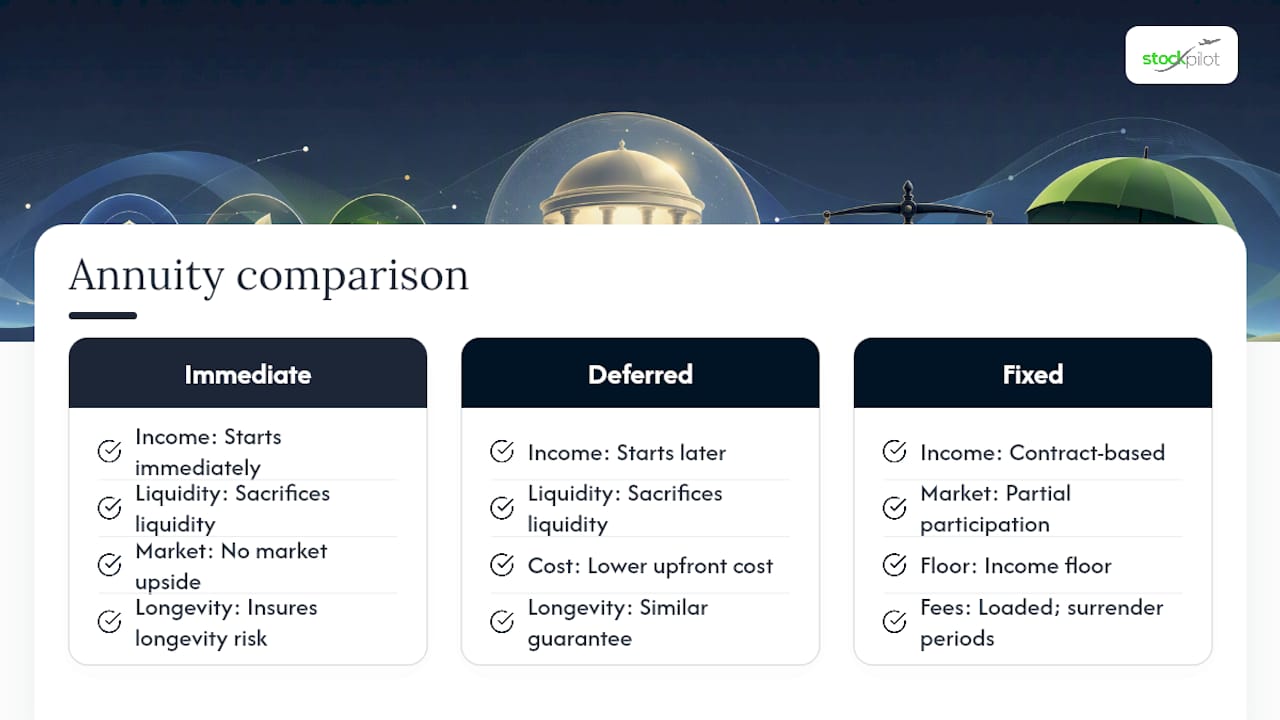
Fidelity groups retirement income approaches into guaranteed income, total-return investing, and hybrid strategies that blend the two, and each carries real trade-offs. A single-premium immediate annuity converts a lump sum into income for life, insuring against longevity risk directly, but it sacrifices liquidity and, in most cases, any upside if markets do well. A deferred income annuity offers a similar guarantee starting later, at a lower upfront cost. Fixed and fixed-indexed annuities offer partial market participation with a income floor, but they come loaded with fees and surrender periods that need careful reading.
For most retirees, annuities work best as a partial solution rather than a full replacement for a market portfolio. Annuitizing enough to cover the gap between guaranteed income and essential expenses, then investing the rest in a standard bucketed portfolio, gives you both the floor and the growth.
The math only makes sense with real numbers from your own accounts and health situation, so this is a decision worth running past a fee-only financial planner before signing, particularly for indexed or variable products with complex fee structures.
Behavioral Mistakes That Wreck Good Retirement Plans
The allocation on paper rarely fails a retiree. The reaction to a bad quarter usually does.
The single most damaging behavior is panic selling equities during a downturn, exactly the scenario the bucket structure exists to prevent. A retiree with a properly funded cash bucket has no financial reason to sell stocks at a low, but fear doesn't check the spreadsheet first. This is where having a written, pre-decided rebalancing rule matters more than any specific allocation number, since it removes the decision from the moment you're least equipped to make it well.
The second common mistake runs the opposite direction: staying too conservative for too long out of a desire to "just be safe," which quietly starves the portfolio of the growth needed to outpace inflation over a 25 or 30 year retirement. Recency bias drives both errors, weighting the last few months of market news far more heavily than decades of data.
Overspending in strong market years and underspending in weak ones creates a third failure mode, one that a fixed percentage withdrawal rule, adjusted only occasionally, tends to correct. And a fourth, more subtle mistake is holding onto a legacy allocation from the working years, heavy in a single employer's stock, or a portfolio built entirely for accumulation, well into retirement, when the actual job of the money has fundamentally changed. A model portfolio review isn't a one-time event. It deserves a real look whenever your income sources, health, or spending needs shift meaningfully.
Why Discipline Beats Prediction in Retirement Investing
The bucket structure works less because of the specific percentages and more because it takes the emotional decision out of a moment when your judgment is least reliable. Tax-aware placement is where a lot of quietly lost income actually gets recovered, often more than any clever stock pick ever will.
What holds retirees back usually isn't the allocation itself. It's inconsistency, panic selling in one bad quarter, ignoring rebalancing in a good one. A rules-based system, whether it's a spreadsheet you check monthly or an automated tool, removes some of that inconsistency.
Start with one of the three sample mixes above, adjust it to your actual income sources and tax accounts, and talk to a tax professional if RMDs, Roth conversions, or estate goals complicate the picture.
— David Elliot
Getting Started With a Rules-Based Retirement Portfolio
If building and monitoring a bucketed, tax-aware portfolio by hand sounds like more ongoing work than you want in retirement, StockPilot offers a transparent alternative: a 19-position model you mirror in your own brokerage account, with defensive shifts toward Treasury ETFs already built into the system's rules rather than left to your own timing under stress.

This fits retirees who want the discipline of a bucket strategy, income-producing positions paired with growth exposure, without personally tracking every signal or rebalancing trigger. You keep full control of your account and every trade; StockPilot issues the after-hours alerts, and you decide whether to act.
Before mirroring anything, read the risk disclosure and regulatory disclaimer in full, and consider a conversation with your own advisor if your tax situation or account structure is complex. If the approach fits how you want to manage retirement income, you can join the waitlist or review the full model portfolio to see how the positions and alerts work in practice.
This article is general information, not a substitute for advice from a qualified financial advisor. Consult a qualified financial professional about your own circumstances before acting on anything here.