

Most individual investors do best holding a moderate number of stocks, though the right number depends on how much time you can spend monitoring positions and how much conviction you have in each pick. Separately, the total number of stocks that exist depends entirely on what you're counting: the SEC tracks roughly 3,600 U.S.-domiciled reporting companies on major exchanges, while broader counts that include OTC issuers and foreign-domiciled listings run much higher.
TL;DR:
- Holding 20 to 50 stocks strikes the best balance for most investors, offering diversification without becoming unmanageable or too costly to monitor.
- The total number of available stocks varies greatly depending on source but is roughly 3,600 U.S.-domiciled companies on major exchanges, with many more when OTC and foreign listings are included.
- Market concentration has increased, making 20 to 30 stocks less independent today, but maintaining a well-structured, disciplined portfolio can still reduce risk effectively.
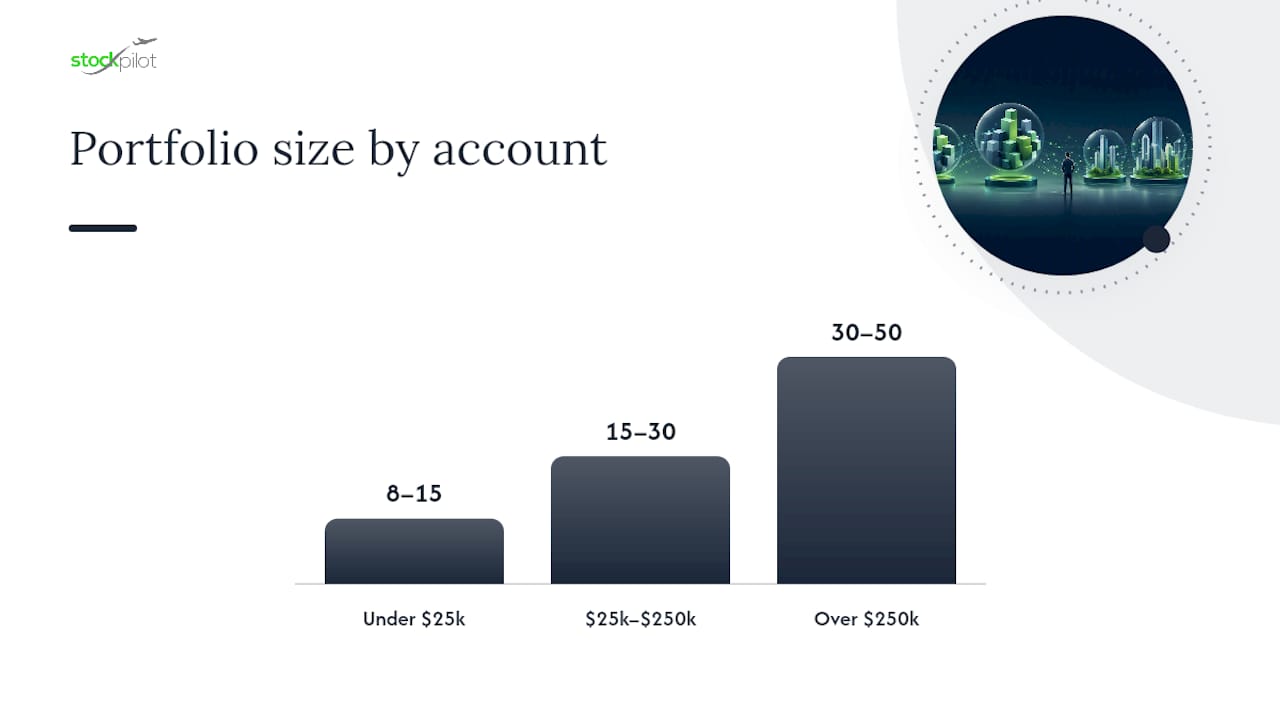
- Investors with smaller portfolios under $25,000 should aim for 8 to 15 positions, while those with over $250,000 can consider 30 to 50 stocks or blend stocks with ETFs for broader exposure.
- Automated, rules-based models like StockPilot’s 19-position portfolio can provide disciplined diversification, especially for investors lacking time to manage a larger, individual-stock portfolio.
Table of Contents
- What's the Right Number of Stocks to Hold?
- How Many Stocks Actually Exist in the Market?
- How Do You Decide the Right Number for Your Own Portfolio?
- Where Did the "20 Stocks" Rule Come From, and Is It Still True?
- What Do Real Portfolio Templates Look Like?
- Why I Think Fewer, Well-Chosen Positions Beat a Sprawling List
- A Disciplined Alternative to Picking Stocks One by One
- Primary Sources Used in This Article
- Sources
- FAQ
What's the Right Number of Stocks to Hold?
There's no single correct answer, but there are clear patterns that work depending on your situation. Academic and practitioner research consistently points to three practical bands.
- 5 to 30 stocks (concentrated to moderate): This fits investors with strong conviction in specific companies and enough time to track earnings reports, competitive shifts, and management changes. You get more control and potentially higher returns if your picks are right, but a single bad call can meaningfully dent your portfolio.
- 20 to 50 stocks (moderately diversified): This is the sweet spot for most self-directed investors who want real diversification without turning portfolio management into a part-time job. It smooths out company-specific risk while still letting individual winners move the needle.
- 50 to 200+ stocks (broad diversification, often via funds): Once you're past 50 individual names, you're better off owning index funds or ETFs than trying to track that many companies yourself. Beyond this point, added diversification benefit is real but small, and monitoring becomes impractical for a solo investor.
Here's how to think about picking your range:
- Portfolio size matters. A $5,000 account spread across 40 stocks means trivial dollar amounts in each position, and transaction costs or bid-ask spreads eat into returns disproportionately.
- Time to monitor matters more than most people admit. If you can't read a quarterly earnings call transcript for each holding, you probably own too many stocks.
- Conviction should drive position count. If you can articulate a clear thesis for why you own something, that's a sign you're in "quality over quantity" territory. If you can't, that's usually a sign your count has crept too high.
- Tax sensitivity favors fewer, longer-held positions. Frequent rebalancing across dozens of names generates taxable events that a tighter portfolio avoids.
The tradeoff is straightforward: more names lowers single-stock risk but raises the odds your portfolio just mirrors the market, at which point you're paying yourself in research hours for returns you could get from a low-cost index fund.
How Many Stocks Actually Exist in the Market?
The honest answer is that it depends on what you're counting, and the differences between sources are large enough to confuse most investors. The SEC's reporting-issuer data puts the number of U.S.-domiciled companies listed on major exchanges at roughly 3,600, with additional foreign-domiciled exchange-listed companies and OTC or foreign-domiciled listings tax considerations layered on top depending on how a source defines the universe.
Total U.S.-listed securities have shrunk substantially since their 1997 peak, according to CRSP's longitudinal count data, even as the market's total value has grown enormously. That contraction is one of the least understood facts in modern investing: there are fewer public companies to choose from today than there were almost 30 years ago, even though the stock market as a whole is worth far more.
Different sources define "stock" differently, and that's why headline numbers diverge so much:
| Source | Scope | Approximate count |
|---|---|---|
| CRSP historical count | Down nearly 50% from 1997 peak | Down nearly 50% from 1997 peak |
| S&P 500 | Fixed index membership | Exactly 500 by design |
| Market data vendors (Benzinga, others) | Exchange-listed plus OTC/pink-sheet names | Several thousand more when OTC is included |
The S&P 500's exact count of 500 is a useful contrast. Index membership is a fixed rule, not an estimate, which is why it's one of the few "stock counts" you can state with total precision.
None of these totals equal your actual investable universe. Once you filter for liquidity, minimum market capitalization, and reliable trading volume, the practical list of stocks worth considering for an individual portfolio is a fraction of any headline figure. That filtering step matters more than the raw count itself.
How Do You Decide the Right Number for Your Own Portfolio?
Start with four questions rather than a fixed target: how much money you're investing, how much time you can give it, how strongly you believe in each pick, and how correlated your holdings are with each other. A portfolio of 25 stocks that are all tech companies isn't diversified in any meaningful sense, no matter how the count looks on paper.
Portfolio size sets a natural ceiling. Here's a rough framework by account size:
- Under $25,000: 8 to 15 positions, sized so each trade isn't dominated by commissions or spreads.
- $25,000 to $250,000: 15 to 30 positions, which is enough for real diversification while keeping each holding large enough to matter.
- Over $250,000: 30 to 50 individual names, or a core of individual stocks paired with ETFs for broader sector or geographic exposure.
For position sizing, you generally have two choices. Equal-weighting puts the same dollar amount in every position, which is simple and prevents any single stock from dominating your results. Risk-weighting sizes positions inversely to volatility, so a stable utility stock gets a bigger allocation than a speculative biotech name. Most individual investors do better with equal-weighting because it's easier to maintain without constant recalculation.
Rebalance on a schedule, not on emotion. Quarterly or semiannual rebalancing catches drift without generating excessive trading activity. And if you find yourself unable to name a clear reason for owning more than 30 to 40 individual stocks, that's usually a sign to shift some of that exposure into a broad-market ETF instead.
Pro Tip: Track your holdings by sector exposure, not just by stock count. Twenty stocks across ten sectors diversifies risk far better than forty stocks concentrated in three.
Where Did the "20 Stocks" Rule Come From, and Is It Still True?
The 20 to 30 stock rule traces back to older diversification research showing that most of the benefit of adding positions to a portfolio shows up early, then tapers off fast. Once you own around 20 uncorrelated stocks, adding a 21st does very little to reduce your portfolio's volatility.
That research still holds up broadly, but two things have changed. First, market concentration has increased substantially, with a small number of mega-cap companies now representing a disproportionate share of total market value, based on CRSP's concentration data. That means 20 stocks today can behave less independently than 20 stocks did decades ago if several of them are large-cap names that move together. Second, pushing your count toward 100 or more does materially reduce the odds that a single unlucky pick wrecks your results, which is why index investing remains a reasonable default for investors who don't want to manage individual position risk at all.
The practical takeaway: 20 to 30 is a reasonable starting range, not a magic number. Adjust based on how correlated your actual holdings are, not just how many tickers you own.
What Do Real Portfolio Templates Look Like?
Theory is one thing. Here's how the numeric ranges above translate into structures you can actually build.
- Core-satellite template. Hold 5 to 8 broad ETFs as your "core" for market exposure, then add 10 to 15 individual stocks as "satellites" for names you have specific conviction in. Total count: roughly 15 to 25 positions.
- Broad diversified template. Build a 50 to 100 stock portfolio using screens for market capitalization and average daily trading volume to keep every holding liquid enough to exit without slippage. Rebalance quarterly and cap any single position at 3 to 4% of total value.
- Rules-based small portfolio. A tighter model might use around 19 positions, splitting exposure between income-generating holdings and growth-oriented names selected against a consistent set of criteria, then shifting toward Treasury ETFs when risk signals turn unfavorable. This kind of structure trades some diversification breadth for discipline and clarity about why each position exists.
Whatever template you choose, screen every candidate for liquidity and market cap before it enters your portfolio, set a rebalancing cadence in advance, and favor tax-aware selling (harvesting losses, holding winners past the one-year mark) over reactive trading.
Why I Think Fewer, Well-Chosen Positions Beat a Sprawling List
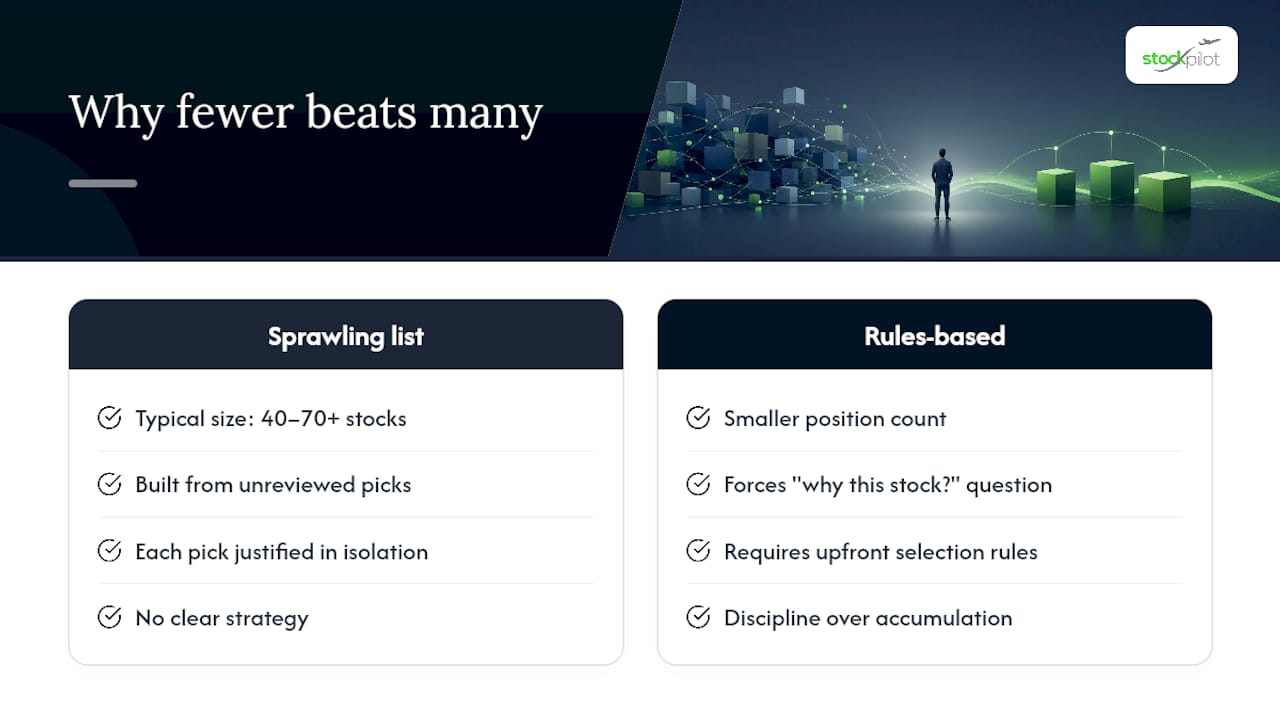
Most retail portfolios I've seen written about drift toward 40, 50, even 70 stocks not because of a strategy, but because of accumulated decisions nobody revisited. Each new pick felt justified in isolation. The aggregate result is a portfolio nobody can actually explain.
A smaller, rules-based portfolio forces you to answer a harder question upfront: why does each position deserve to be here? That discipline, not the stock count itself, is what tends to separate portfolios that perform from portfolios that just accumulate.
— David Elliot
A Disciplined Alternative to Picking Stocks One by One
If building and maintaining a 20 to 50 stock portfolio on your own sounds like more monitoring than you have time for, StockPilot offers a different route to the same goal: a transparent, rules-based portfolio you can mirror without handing over custody of your account.

StockPilot runs a 19-position model portfolio that combines six income-producing positions with 13 AI-selected growth positions built to outperform the S&P 500. The system evaluates market, fundamental, technical, sentiment, and statistical data continuously, then issues after-hours buy and sell alerts only when its predefined criteria call for a change. In unfavorable conditions, it can shift capital toward Treasury ETFs rather than leave you fully exposed. You keep complete control of your brokerage account and every trade; StockPilot simply tells you when to make one. This fits self-directed investors who want disciplined execution without the burden of tracking dozens of individual names on their own. Review the risk disclosure for a full picture of how the system manages downside, and join the waitlist for early access.
Primary Sources Used in This Article
- CRSP count history — verifies the decline in listed securities since 1997.
- Bloomberg ETF coverage — verifies ETF count growth relative to stocks.
- S&P Dow Jones Indices — verifies the fixed 500-company index count.
FAQ
How Many Total Stocks Are There?
The SEC counts roughly 3,600 U.S.-domiciled companies listed on major exchanges, but totals rise into the several thousands once OTC issuers and foreign-domiciled listings are included, since different data vendors apply different inclusion rules.
What Percentage of Americans Have Over $100,000 in the Stock Market?
Ownership concentration in U.S. equities is heavily skewed toward wealthier households, and exact shares vary by survey year and methodology, so check a current Federal Reserve Survey of Consumer Finances release for the latest figure.
What Is Warren Buffett's 70/30 Rule?
Buffett has described allocating around 90% of assets to a low-cost S&P 500 index fund and 10% to short-term government bonds for his estate, a rule sometimes loosely cited as a 70/30 or 90/10 split depending on the version referenced; there's no single universally documented "70/30 rule" attributed to him.
Who Currently Owns the Majority of the US Stock Market?
Institutional investors, including mutual funds, pension funds, and other large asset managers, hold the majority of U.S. equity market value, with direct household ownership concentrated among higher-income and older investors.
Is a 19-Position Portfolio Too Concentrated?
Not necessarily. A tight, rules-based structure like StockPilot's 19-position model can work well when positions are deliberately split between income and growth and each holding follows a defined selection process rather than ad hoc picking.