

Quantamental investing is the disciplined practice of encoding fundamental investment logic as testable, auditable quantitative rules, using AI and alternative data to scale fundamental judgment across a wider universe than any analyst could cover alone. The goal is a more consistent, repeatable version of stock selection rather than a lucky string of picks. What follows covers the pipeline behind that process, the data and AI decisions that make or break it, the risks worth building controls around, and a checklist for putting it into practice.
TL;DR:
- Quantamental investing combines fundamental analysis with quantitative rules, using AI and alternative data to scale investment judgment across many more stocks.
- The process relies on five disciplined stages: score, rank, select, hold, and measure, with strict controls on data timing, rebalancing, and execution assumptions.
- AI's role is to process large-scale unstructured data like filings and news sentiment, but it cannot replace the need for transparent, explainable models and rigorous validation.
- Risks include model overfitting, regime shifts, and data inconsistencies, making out-of-sample testing and continuous monitoring essential for reliability.
- Building or evaluating a quantamental program demands clear objectives, a point-in-time data pipeline, coded theses, realistic backtests, and thorough documentation to ensure compliance and performance.
Table of Contents
- What Is Quantamental Investing, and When Should You Use It?
- How Does the Quantamental Pipeline Actually Work?
- What Role Do AI and Alternative Data Play?
- What Are the Benefits and Risks of Quantamental Investing?
- How Do You Build or Evaluate a Quantamental Program?
- Regulatory and Compliance Considerations for Quantamental Strategies
- Why Is Combining Quant and Fundamental Data So Hard?
- How Does Quantamental Performance Compare to Pure Quant or Pure Fundamental Investing?
- Why Human Judgment Still Anchors the Best Quantamental Systems
- A Rules-Based Path for Investors Who Want Quantamental Discipline Without Building It Themselves
- Sources
What Is Quantamental Investing, and When Should You Use It?
Pure quantitative strategies trade on factors like value, momentum, or quality across thousands of names, with no analyst ever reading a 10-K. Pure fundamental strategies go deep on a handful of businesses, built on judgment that doesn't scale past thirty or forty holdings. Quantamental investing sits between the two: it takes the kind of thesis a fundamental analyst would write and turns it into a rule a computer can apply to a much larger universe.
The approach is best understood as translating fundamental insight into explicit, testable math rather than replacing it, according to Emerj's analysis of quantamental methods. In practice, that shows up in a few recognizable variants:
- Factor-enhanced stock selection. Standard factor models (value, quality, momentum) get a fundamental overlay, like an earnings-quality filter, before names make the final cut.
- ML-augmented fundamentals. Machine learning extracts signals from filings, transcripts, or supply-chain data, then a human or rules engine still makes the final valuation call.
- Thesis-as-code implementations. An analyst's investment thesis gets written directly into a scoring function, so the same logic runs consistently across hundreds of tickers.
Long-only, multi-factor setups tend to suit investors chasing steadier, benchmark-relative returns. Event-driven quantamental methods fit better when the edge comes from reacting fast to earnings surprises, guidance changes, or filing anomalies.
How Does the Quantamental Pipeline Actually Work?
Every credible quantamental strategy runs through the same five stages: score, rank, select, hold, measure. Skip a stage, or fake the discipline at any one of them, and the whole system becomes a black box you can't defend when it underperforms.
Scoring starts with a fundamental thesis, something like "companies improving gross margins while cutting debt tend to outperform," and turns it into a formula that outputs a number for every stock in the universe. Ranking sorts the universe by that score. Selection applies filters (market cap, liquidity, sector caps) and picks the top names. Holding means sticking to a rebalance cadence, whether that's monthly, quarterly, or event-triggered, instead of trading on impulse. Measurement closes the loop, checking whether the score actually predicted what it claimed to.
Three structural choices separate a serious quantamental process from a toy model:
- Universe filters that exclude illiquid or hard-to-trade names before scoring, not after.
- A rebalance cadence and position-sizing rule set that's fixed in advance, not adjusted after seeing results.
- Execution and cost assumptions built into the backtest, since slippage and spread can erase a paper edge entirely.
Backtesting only means something if it uses point-in-time data, meaning every input is stamped to the date it was actually known, not adjusted with hindsight. Best-practice pipelines pair that with reproducible code, validation gates, and separate reporting for trade-level statistics versus fund-level compounded returns, according to a quantamental trading framework from AlphaEdge. A strategy that looks brilliant on paper but can't separate per-trade win rate from portfolio-level drawdown is hiding something.
Pro Tip: Ask any quantamental vendor for their trade-level hit rate separately from their fund-level return. If they can only give you one number, the backtest probably isn't point-in-time clean.
What Role Do AI and Alternative Data Play?
AI's real job in quantamental investing is processing scale, not replacing judgment. Machine learning models can scan filings, earnings call transcripts, and supply-chain data to surface patterns a human analyst would take weeks to find manually, according to research on quantamental risk management from Columbia's School of Professional Studies.
Traditional fundamentals versus alternative data:
- Traditional inputs: income statements, balance sheets, guidance, analyst estimates.
- Alternative inputs: filings NLP (parsing legal and risk language for tone shifts), news sentiment scoring, supply-chain shipment data, satellite imagery of retail parking lots or industrial activity.
Where machine learning earns its keep: feature engineering (turning raw text into usable numeric signals), signal extraction from unstructured data, and regime detection (flagging when market conditions have shifted enough that old rules stop applying). Where it gets dangerous is treating the model as an unexplainable black box that spits out a buy or sell with no traceable logic.
AI models can process millions of documents and social signals in seconds, functioning like an analyst who never sleeps and never misses a filing, per Columbia SPS.
The practical limits are less glamorous than the technology: alternative data is expensive to license, often arrives with latency that breaks point-in-time discipline, and every signal needs an audit trail or it's unusable in a real portfolio.
What Are the Benefits and Risks of Quantamental Investing?
The case for quantamental investing rests on scale and reproducibility. A single analyst can deeply research a few dozen companies a year; a well-built scoring function can apply that same logic to thousands of names every quarter, and it applies it the same way every time. Morgan Stanley's research notes that factor exposures explain a large share of relative manager returns, which means the remaining share comes down to stock-specific selection, exactly the layer quantamental blending is designed to strengthen, per Morgan Stanley's quantamental investing analysis.
The risks are just as real. Model risk shows up when the scoring function reflects a flawed assumption nobody caught. Overfitting happens when a backtest is tuned so precisely to historical data that it fails the moment markets shift. Regime changes can quietly break a model built entirely on data from a bull market. And automation cuts both ways: a bad thesis coded into a rule doesn't just fail once, it fails at scale, across every position simultaneously.
- Run out-of-sample testing before trusting any backtest result.
- Set hard validation gates so unvetted signals can't reach live capital.
- Build in stop rules and continuous monitoring, not annual reviews.
Pro Tip: A quantamental system should refuse to run on stale data by design. If your platform lacks a freshness gate, it can quietly publish decisions based on outdated inputs without anyone noticing.
How Do You Build or Evaluate a Quantamental Program?
Whether you're designing a pilot yourself or vetting an outside manager, the sequence matters more than any single tool choice.
- Define objectives and success metrics first. Decide whether you're optimizing for alpha, capping volatility, or holding to a maximum drawdown, and write the number down before building anything.
- Assemble a point-in-time data pipeline. Every fundamental and alternative input needs a timestamp matching when it was actually known, not when it was cleaned up later.
- Write the thesis as code. Convert the fundamental logic, margin trends, debt reduction, earnings quality, into an explicit scoring formula, drawing on standard techniques like reading 10-Ks and applying at least two valuation methods, as outlined in Basis Report's fundamental analysis framework.
- Backtest with real costs. Include slippage, spread, and realistic rebalance frequency, not idealized fills.
- Set gating rules before going live. Decide in advance what triggers a pause, a position cut, or a full stop.
- Pilot with tight risk limits. Start small, cap position sizes, and treat the first six to twelve months as a live test, not a victory lap.
- Keep a trial registry. Log every rule change and why it was made, so you can trace performance drift back to a specific decision later.
Position sizing deserves its own line item here: conviction and margin of safety should scale allocation size, not just inclusion or exclusion from the portfolio.
Regulatory and Compliance Considerations for Quantamental Strategies
Quantamental strategies don't sit in a separate regulatory category from other advisory or portfolio-management products, but the automation layer raises specific compliance questions that firms need to answer directly. Registered investment advisers running rules-based, AI-influenced portfolios still owe clients the standard fiduciary and disclosure obligations under U.S. securities law, and a model's complexity doesn't reduce that duty.
The clearest compliance risk is opacity. If a scoring function drives buy and sell decisions, regulators and clients alike will eventually ask how it works, what data it uses, and what happens when it fails. Firms that can't explain their own model in plain language, or that lack a paper trail showing when and why a rule changed, are exposed both to regulatory scrutiny and to client mistrust.
A few practical obligations stand out for any quantamental manager or product:
- Publish a clear risk disclosure describing what the model does and does not control for.
- Maintain a regulatory disclaimer that's specific to the strategy, not boilerplate borrowed from a generic advisory template.
- Keep model artifacts (the actual scoring logic and version history) available for internal audit, even if not made fully public.
- Document every material rule change with a timestamp and rationale.
None of this is exotic. It's the same governance discipline that separates a firm you'd trust with real capital from one running an unverifiable algorithm behind a marketing page.
Why Is Combining Quant and Fundamental Data So Hard?
The theory behind quantamental investing is simple. Merging the data is not. Fundamental inputs, filings, earnings calls, footnotes, are messy, inconsistently formatted, and often ambiguous in ways a spreadsheet cell can't capture. Quantitative inputs are clean and structured but strip away the nuance a human analyst would catch instantly, like a one-time charge that inflates a margin figure for a single quarter.
The integration problem shows up in three recurring places. First, timing mismatches: fundamental data (a 10-Q filing) and market data (a price tick) update on completely different schedules, and lining them up without hindsight bias takes real engineering discipline. Second, definitional drift: what counts as "revenue" or "adjusted earnings" can shift between reporting periods or companies, and a scoring function that doesn't account for that will misrank names based on accounting quirks rather than business quality. Third, alternative data adds a layer of its own: satellite imagery or supply-chain feeds rarely arrive pre-cleaned, and licensing terms can restrict how the data gets stored or reused.

None of these problems are solved by better algorithms alone. They're solved by treating data engineering as seriously as model design, with the same point-in-time stamping and validation gating that applies to the scoring function itself. A firm that skips this step usually finds out the hard way, when a backtest that looked clean in isolation falls apart under live trading conditions.
How Does Quantamental Performance Compare to Pure Quant or Pure Fundamental Investing?
There's no universal performance number that settles this debate, and any source claiming one probably oversimplified something. What the available research does support is a structural argument: factor-based quantitative approaches explain a large share of relative returns, and supplementing that with fundamental, stock-specific selection targets the portion those factor models leave on the table, per Morgan Stanley's investment insights research.
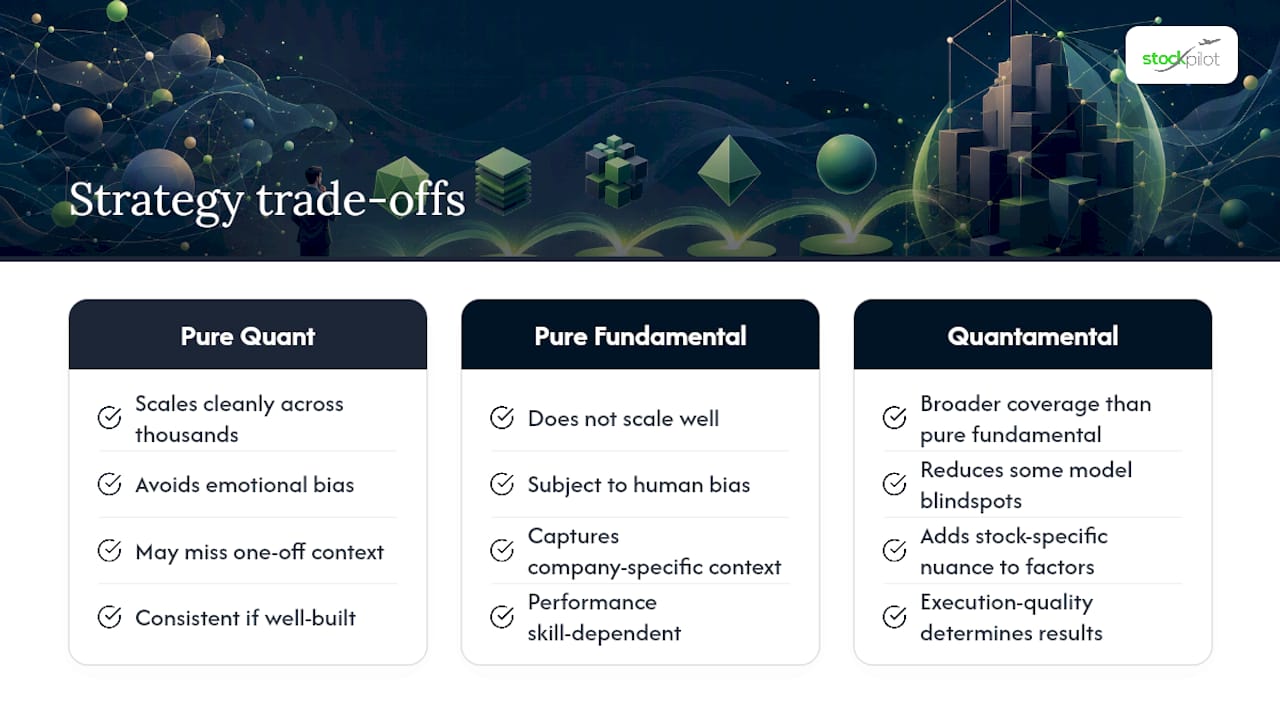
Pure quant strategies tend to scale cleanly and avoid emotional bias, but they can miss context a human would catch immediately, a one-off accounting adjustment, a management change, a lawsuit buried in a footnote. Pure fundamental strategies capture that context well but don't scale, and performance depends heavily on the skill of whoever is doing the analysis, which makes consistency hard to guarantee across market cycles.
Quantamental approaches aim to split the difference: broader coverage than a fundamental-only shop, more nuance than a factor-only model. Morgan Stanley's research notes that factor-based quant strategies have grown to a substantial asset scale, a scale pure fundamental stock-picking has never approached, precisely because rules can run across thousands of names at once. Whether that blend actually outperforms either pure approach over a full cycle depends heavily on execution quality, not the label on the strategy. A poorly built quantamental model will underperform a well-run pure quant fund every time; the hybrid label is not a performance guarantee on its own.
Why Human Judgment Still Anchors the Best Quantamental Systems
The most common mistake I see in how people talk about quantamental investing is treating it as a spectrum with "more AI" on one end and "better returns" on the other. That's backward. The firms getting this right treat AI as an extension of analyst judgment, not a replacement for it. Business school research out of Hong Kong frames this well: humans own the "why," the economic narrative behind a thesis, while AI handles the "how," the scale and speed of applying that logic, according to HKU Business School's commentary on AI-era quantamental investing.
What StockPilot's design illustrates, whatever you think of any individual product in this space, is what that partnership looks like in practice: a transparent 19-position model portfolio combining six income-producing positions with 13 AI-selected growth positions, evaluated continuously against fundamental, technical, sentiment, and statistical inputs, with automated risk reduction during unfavorable conditions. The governance artifacts worth demanding from any manager mirror that structure: a published risk disclosure, a clear rationale behind every model change, and reporting that separates individual trade performance from blended portfolio results. Ask for those four things before trusting any quantamental claim, no exceptions.
— David Elliot
A Rules-Based Path for Investors Who Want Quantamental Discipline Without Building It Themselves
Everything above assumes you have the time, data access, and engineering resources to build a scoring function, backtest it honestly, and monitor it daily. Most self-directed investors don't, and that's the gap StockPilot was built to close.

An AI-powered system can run the quantamental process described in this article on your behalf: a transparent 19-position model portfolio blending income-producing positions with AI-selected growth positions, continuously scored against multiple data types including market, fundamental, technical, sentiment, and statistical. When conditions turn unfavorable, the system can shift capital toward Treasury ETFs as part of its risk management process. You receive after-hours buy and sell alerts only when predefined criteria call for a change, and trades occur in your own brokerage account under your control.
If the pipeline in this article sounds like the discipline you want behind your portfolio, see how StockPilot's model works and review the regulatory disclaimer before you start mirroring trades.
Sources
- AI and alternative data for quantamental investing — Emerj
- Quantamental risk management: seeking new alpha — Columbia SPS
- Quantamental investing — Morgan Stanley (investment insights)
- Quantamental trading introduction — AlphaEdge
- How to do fundamental analysis — Basis Report