

The simplest starting point is a three-sleeve retirement income portfolio: a cash buffer, an income sleeve, and a growth sleeve, sized so withdrawals stay near a conservative withdrawal rate of savings after counting Social Security and any pension. Calculate what your guaranteed income covers first, then figure the gap your portfolio has to fill. A tool like StockPilot can help run that structure once it's built.
TL;DR:
- A three-sleeve retirement portfolio should be balanced to maintain a conservative withdrawal rate of around 3.5% to 4%, adjusting for guaranteed income gaps.
- Rebalancing should occur annually or when allocations shift more than five percentage points, with cash and bond interest used to fund withdrawals during downturns.
- A diversified toolkit with income ETFs, dividend-growth funds, bond ladders, and potentially annuities helps manage risk and sustain income over long retirements.
- Carefully estimate healthcare and long-term care costs in advance, incorporating them into withdrawal plans instead of treating them as separate future issues.
- Running the bucket approach with automation tools like StockPilot can improve discipline, ensuring systematic rebalancing and risk management tailored to market conditions.
Table of Contents
- What Does a Model Retirement Income Portfolio Look Like?
- How Do You Build the Bucket Approach?
- Which Income-Producing Investments Actually Work Together?
- How Do You Calculate a Sustainable Withdrawal Rate?
- How Do You Manage Sequence-of-Returns Risk?
- How Does StockPilot Fit Into This Framework?
- Don't Forget Healthcare and Long-Term Care Costs
- What I've Learned Watching Retirees Manage This Year After Year
- Ready to Put This Into Practice?
- Sources
What Does a Model Retirement Income Portfolio Look Like?
There's no single right allocation, but three model portfolios cover most situations. Morningstar's bucket-style examples split holdings by time horizon rather than by generic risk labels, which is a more useful way to think about your own mix.
- Conservative (65 or older, low risk tolerance, limited guaranteed income): mostly cash, bonds, and equities in a balanced manner. Think short-term Treasury or money-market funds, intermediate bond funds, and dividend-growth ETFs for the equity sleeve.
- Moderate (typical new retiree with Social Security plus savings): a mixed allocation of cash, bonds, and equities, tilted toward dividend-growth and broad-market index funds.
- Aggressive (early retiree with a long horizon or legacy goals): a portfolio weighted more heavily toward equities and growth-oriented investments.
A surviving spouse usually needs slightly more in the income sleeve, since one Social Security check disappears at death. Early retirees without Medicare yet should hold extra cash to cover health premiums before 65. If you're investing for heirs as much as yourself, shift the growth sleeve higher and let the cash bucket run lean. Place bond funds and income ETFs in your IRA or 401(k) where possible, since interest and non-qualified dividends are taxed as ordinary income; keep tax-efficient growth funds in taxable accounts.
How Do You Build the Bucket Approach?
The bucket method turns an allocation into a spending plan. Each bucket has a job, and knowing the job tells you what belongs in it.
- Bucket 1, cash reserve. Hold an emergency cash reserve covering several months of expenses not covered by guaranteed income, in high-yield savings, short CDs, or money-market funds. Kiplinger's guidance points to about a year of spending as a common baseline.
- Bucket 2, income. Intermediate-term bond funds or a laddered bond portfolio, with maturities staggered so something matures every year or two. This bucket refills Bucket 1 on a schedule.
- Bucket 3, growth. Dividend-growth ETFs and total-market funds for inflation protection and long-run returns, left alone during downturns.
Rebalance once a year, or when an allocation drifts more than five percentage points from target. Refill cash from bond interest and dividends first; only trim equities if the market has been kind that year.
Pro Tip: Set a calendar reminder for the same week every year, tax season works well, to rebalance and refill cash. Doing it on a schedule instead of a whim removes emotion from the decision.
Which Income-Producing Investments Actually Work Together?
No single fund does everything, which is why a toolkit beats a single high-yield pick. A three-ETF approach assigns each fund a distinct job: an income anchor for current yield, a dividend-growth compounder for rising payouts, and a broad diversifier to smooth out sector risk. Coverage from Yahoo Finance on dividend ETFs describes this barbell structure, pairing higher current yield with funds built for payout growth over time.
Dividend ETFs have had a strong run. Some large dividend funds posted double-digit gains in 2026 while continuing regular distributions, according to Morningstar's review of high-dividend ETFs, and running multiple funds together cuts single-stock and sector concentration versus owning one dividend fund alone.
- Bond ladders and short/intermediate bond funds offer predictable cash flow with lower volatility than equities, though longer durations carry more interest-rate risk.
- Income annuities make sense for retirees worried about outliving savings or lacking a pension; the trade-off is giving up liquidity and upside for a guarantee.
- REITs add real-asset income but generate mostly ordinary-income distributions, so they usually belong in tax-sheltered accounts.
Don't chase yield alone. A portfolio stacked entirely with high-yield funds and no growth sleeve tends to lose purchasing power over a 20 or 30-year retirement.
How Do You Calculate a Sustainable Withdrawal Rate?
Start with expenses, not with a percentage. Vanguard's retirement-income research reframes planning around income you can sustain rather than a lump-sum target, which changes how the math works.
- Add up annual expenses, including irregular costs like travel or home repairs.
- Subtract guaranteed income (Social Security, pensions, annuity payments).
- What's left is your portfolio-funded need.
- Divide that number by your investable balance, excluding any separate emergency fund.
- Compare the result to the 3.5% to 4% baseline Vanguard's analysis supports for a 30-year horizon.
Early retirees planning for 35 or more years should start below 3.5%. Anyone with strong legacy goals should do the same. Stress-test the plan against a bad first five years, and adjust the rate upward slowly if markets cooperate rather than locking in a number and ignoring performance.
How Do You Manage Sequence-of-Returns Risk?
A retiree who withdraws steadily through a market drop in year one or two of retirement can permanently damage a portfolio, even if average returns over 30 years look fine. Selling depreciated shares to fund withdrawals locks in losses that gains later can't fully undo. This is sequence-of-returns risk, and it hits hardest right at the start of retirement.
The fix is procedural, not predictive. Morningstar's research on defending against sequence risk recommends drawing from cash and bond interest first during downturns and leaving equities alone until they recover.
- Rebalance on a fixed schedule or when allocations drift past your bands, not based on headlines.
- Avoid selling equities at a loss unless the cash and income buckets are genuinely exhausted.
- Cut discretionary spending, travel, gifts, before touching the growth sleeve, when markets are down.
Pro Tip: Keep a written rule for what triggers a spending cut, tied to your cash bucket balance, so you're not deciding in the middle of a bad month.
How Does StockPilot Fit Into This Framework?
Running the bucket approach by hand means tracking allocations, rebalancing bands, and income yields across a dozen or more positions, which is where most retirees lose discipline. The system builds a transparent 19-position model portfolio combining income-producing positions with AI-selected growth positions, structured around the same logic covered above.
- After-hours buy and sell alerts inform users when the system's criteria call for a change, and trades are executed in the user's own brokerage account.
- During unfavorable market conditions, the system can shift capital from growth positions toward Treasury ETFs, echoing the cash-first discipline that limits sequence-of-returns risk.
- Position sizing and portfolio construction follow a fixed framework rather than reacting to headlines or predictions.
Users keep full control of their accounts and every trade; the system never takes custody. For a deeper look at implementation, the StockPilot Investor Insights blog covers dividend strategy and cash-flow tactics in more depth.
Don't Forget Healthcare and Long-Term Care Costs
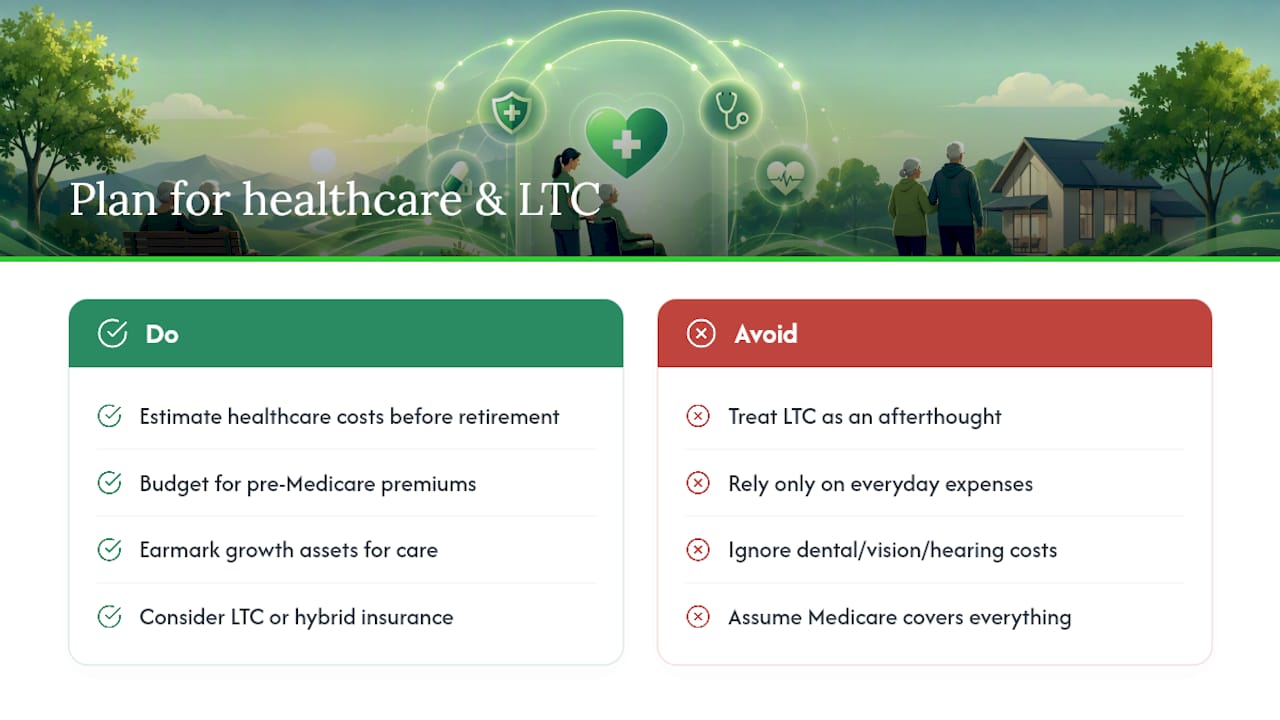
Healthcare is usually the biggest unplanned drag on a retirement income portfolio, and it rarely gets its own line item. Between 65 and Medicare eligibility, premiums alone can force early retirees to lean harder on the cash bucket than they'd planned. Once Medicare starts, Part B and D premiums, Medigap or Advantage plan costs, and out-of-pocket expenses for dental, vision, and hearing still add up every year.
Long-term care is the bigger risk. A multi-year stay in assisted living or a nursing facility can consume a growth sleeve faster than any market downturn, and it often arrives with little warning. Some retirees self-insure by holding extra assets in the growth bucket earmarked specifically for care costs. Others buy long-term care insurance or a hybrid life/long-term-care policy to cap the downside. Either way, build a rough estimate of potential care costs into your withdrawal math now, rather than treating it as a separate problem to solve later. A portfolio built only around everyday living expenses can look sustainable right up until a health event proves otherwise.
What I've Learned Watching Retirees Manage This Year After Year
The retirees who stay on track treat this as an annual maintenance job, not a one-time setup. Once a year: recalculate the withdrawal rate against actual expenses, check whether guaranteed income has changed, rebalance the three sleeves, review the tax bill, and top off the cash bucket.
The bigger threat isn't market volatility. It's reacting to headlines, selling growth positions during a scary week, or freezing withdrawals out of fear when the plan never called for it. A written rule, checked once a year, beats a gut reaction every time.
— David
Ready to Put This Into Practice?
Everything above works whether you build it by hand or hand the mechanics to a system. StockPilot exists for retirees who want the bucket-and-toolkit approach covered here without spending Saturday mornings rebalancing spreadsheets. You get a transparent 19-position model blending six income holdings with 13 AI-selected growth positions, after-hours alerts when the criteria call for a change, and a risk process that shifts toward Treasury ETFs when conditions turn unfavorable.

You still place every trade yourself, in your own brokerage account, with full visibility into what's changing and why. Before subscribing, review the risk disclosure so you know exactly what the system does and doesn't guarantee. If the model above matches how you want to run your income portfolio, take a look at the StockPilot model portfolio and see how it maps to your own numbers.
Sources
- Vanguard’s Principles for Retirement Income
- Our Best Investment Portfolio Examples for Savers and Retirees | Morningstar
- 3 dividend ETFs to buy for retirement income in August | Yahoo Finance
This article is general information, not a substitute for advice from a qualified financial advisor. Consult a qualified financial professional about your own circumstances before acting on anything here.