

Rules-based investing uses predefined, documented triggers to decide when to buy, sell, or hold, so decisions repeat the same way every time regardless of mood or headlines. The main payoff isn't beating the market. It's removing the emotional guesswork that causes most investors to underperform their own holdings. This guide covers the construction steps, common rule types, real risks, and a checklist for putting a system into practice.
TL;DR:
- Systematic investing relies on evidence-based rules, not intuition, to remove emotional biases and improve decision consistency over market timing.
- Building a rules-based portfolio involves defining the universe, applying filters, selecting holdings, determining weights, and choosing rebalancing triggers that suit your goals.
- Common strategies include rebalancing, dollar-cost averaging, trend-following, and factor tilts, often layered for more robust performance and risk management.
- True rules-based investing mainly offers behavioral benefits; actual outperformance over active management is modest and vulnerable to overfitting and regime changes.
- StockPilot exemplifies rules-based principles by offering a transparent, automated model portfolio that triggers trades based on predefined criteria, without custody of your funds.
Table of Contents
- What Does Rules-Based Investing Actually Mean?
- How Do You Build a Rules-Based Portfolio Step by Step?
- What Are the Most Common Rules-Based Strategy Types?
- Does Rules-Based Investing Actually Outperform?
- How Do You Actually Implement a Rules-Based Strategy?
- How Does StockPilot Apply These Rules-Based Principles?
- Who Actually Benefits From This Kind of Discipline?
- A Practical Way to Put These Rules to Work
- Sources
- FAQ
What Does Rules-Based Investing Actually Mean?
Rules-based investing is not the same thing as artificial intelligence, high-frequency trading, or passive indexing, even though marketing copy blurs the lines constantly. A hedge fund running millisecond trades is systematic in a technical sense, but it has almost nothing in common with an individual investor rebalancing a portfolio once a quarter. Passive indexing follows rules too, but those rules exist to track a benchmark, not to express a specific investment view.
Genuine systematic investing rests on three components: an economic hypothesis, historical evidence that tests it, and disciplined implementation that follows through regardless of how the investor feels that week. Systematic investing pairs a testable idea, such as "stocks trading below their historical earnings multiple tend to outperform over five years," with data that either supports or kills the idea, then commits to acting on it without second-guessing.
You'll see several near-synonyms used interchangeably in this space:
- Systematic investing — decisions driven by a repeatable, documented process rather than case-by-case judgment.
- Quantitative investing — rules built primarily from numerical data and statistical relationships.
- Mechanical trading — a stricter subset where every input and output is fully automated, with no manual override.
They overlap more than they differ. What separates all three from ordinary discretionary investing is the absence of a decision made in the moment.
How Do You Build a Rules-Based Portfolio Step by Step?
Turning a rule into a live portfolio requires five sequential decisions, and skipping any one of them is how good ideas fail in practice.
- Set the universe. Define which securities are even eligible. A common approach limits the universe to stocks above a minimum market capitalization and average daily trading volume, so the strategy never gets stuck trying to buy or sell something illiquid.
- Apply filters and ranking signals. Score every eligible name on measurable criteria such as valuation (price-to-earnings, price-to-book), momentum (12-month price trend), or quality (return on equity, debt levels). Institutional systematic processes score thousands of securities this way, combining several signals into one composite rank rather than relying on a single metric.
- Select holdings. Decide how many positions the portfolio holds and set a concentration cap, for example no single stock above 8% of assets, so one bad pick can't sink the whole account.
- Weight the positions. Choose equal weighting, rank weighting (higher-ranked names get larger allocations), or risk-parity weighting based on volatility.
- Set the rebalancing cadence. Decide on calendar rebalancing (monthly, quarterly, annual) or band rebalancing, where a position only gets trimmed once it drifts a set percentage from its target.
Pro Tip: Combine a calendar check with a band trigger. Review the portfolio regularly, but only trade if a position has drifted noticeably from its target weight. This cuts unnecessary turnover while still catching real drift.
Three concrete examples show how this plays out. An annual ranked-selection strategy might re-score the entire universe every January and swap out the bottom 20% of holdings for higher-ranked replacements. A monthly band-rebalancing approach checks weights every 30 days but only trades positions that have moved outside a 5% band. A trend-following allocation might shift between stocks and cash whenever the 50-day moving average crosses the 200-day moving average, a signal practitioners commonly document as a trigger for tactical exposure changes.
What Are the Most Common Rules-Based Strategy Types?
Most systematic portfolios are built from a small set of well-tested building blocks, then combined to fit a specific goal.
- Rebalancing rules bring a portfolio back to its target allocation, either on a fixed calendar schedule or when a position drifts past a set band, forcing you to sell winners and buy laggards rather than let one asset dominate.
- Dollar-cost averaging invests a fixed dollar amount on a fixed schedule, regardless of price, which smooths out the timing risk of putting a lump sum in at the wrong moment.
- Trend-following rules use moving averages or similar signals to shift between growth assets and defensive positions like Treasuries when the trend turns down.
- Factor tilts systematically overweight characteristics such as momentum, value, low volatility, or quality, based on decades of academic evidence that these traits carry a persistent, if inconsistent, return premium.
Few serious systems rely on just one of these. A multi-signal strategy might use a quality-and-value filter to build the universe, a momentum rule to rank candidates, band rebalancing to manage drift, and a trend-following overlay to reduce equity exposure during a downturn. Layering signals this way is standard practice at the institutional level and scales down reasonably well for individual portfolios, provided the rules stay simple enough to follow.
Does Rules-Based Investing Actually Outperform?
The strongest case for a systematic approach isn't return enhancement. It's behavioral. Investors who buy high out of excitement and sell low out of panic create a gap between what their investments earn and what they personally realize, and that gap has been documented for decades.
The behavioral cost is real and measurable. Morningstar's "Mind the Gap" research has repeatedly found that the average investor's realized returns tend to trail the very funds they hold, largely because of poorly timed buying and selling. Rules exist specifically to help close that gap.
That said, the evidence on outperformance is more modest than most pitches suggest. Comparisons between systematic and discretionary approaches generally find similar risk-adjusted results over time. What rules reliably deliver is consistency and auditability, not a guaranteed edge.
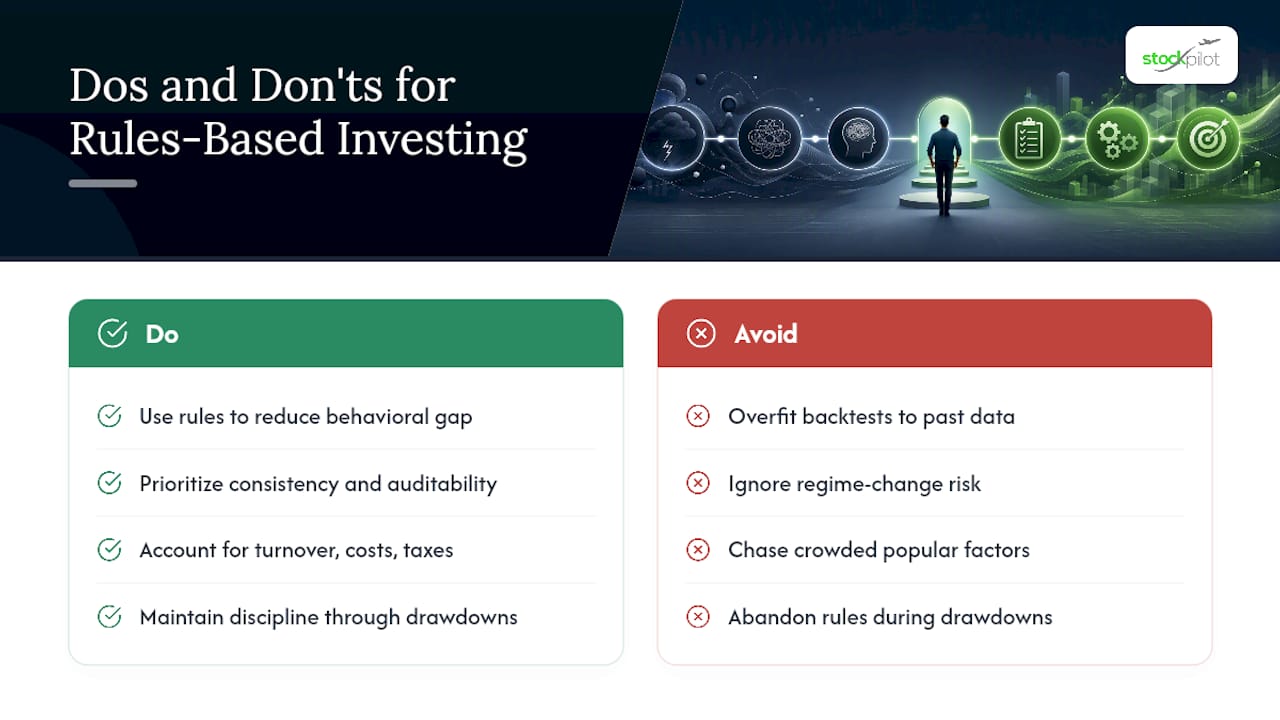
The real risks sit in the mechanics. Backtest overfitting happens when a rule gets tuned so precisely to past data that it stops working the moment conditions change. Regime change can break a rule that worked beautifully for a decade but assumed a world that no longer exists. Popular factors get crowded once enough money chases them, compressing the very edge that made them attractive. And the most common failure of all is abandonment: investors quit the rule during a drawdown, right when discipline mattered most. Turnover, transaction costs, and taxes from frequent trading also erode returns quietly, often more than investors expect going in.
How Do You Actually Implement a Rules-Based Strategy?
Building the system on paper and running it for real are two different exercises. Here's the sequence that keeps them aligned.
- Define your objective and time horizon. Growth, income, or a blend, and whether you're investing for five years or twenty five, changes which rules make sense.
- Choose your universe and signals. Decide what's eligible and what data drives selection, using measurable, repeatable criteria rather than a gut feeling dressed up as a rule.
- Set position sizing and rebalancing mechanics. Fix your maximum position weight, your rebalancing trigger, and estimate the resulting annual turnover before you commit real money.
- Test it properly. Split your data into an in-sample period for building the rule and an out-of-sample period for checking it. Walk-forward testing and sensitivity checks across different market regimes catch overfitting before it costs you money.
- Write it down and govern it. Date the rule, commit to a no-tampering policy during normal volatility, and schedule a fixed review date, quarterly or annually, rather than reviewing whenever the market makes you nervous.
Pro Tip: Before adjusting any rule, ask whether the market moved or whether your rule was simply wrong from the start. Changing a rule because of one bad month is how discipline quietly turns into discretion.
A related question worth asking early: how concentrated do you want to be? A primer on portfolio diversification is a useful reference when you're setting position limits and deciding how many names your universe actually needs.
How Does StockPilot Apply These Rules-Based Principles?
StockPilot runs a transparent 19-position model portfolio, six income-producing holdings paired with 13 AI-selected growth positions, evaluated continuously against market, fundamental, technical, sentiment, and statistical data. Alerts go out after hours, only when predefined criteria call for a change, and during unfavorable conditions the system can rotate capital into Treasury ETFs. You retain full control, mirroring every trade in your own brokerage account, and can review the risk disclosure before committing capital.
Who Actually Benefits From This Kind of Discipline?
Busy professionals, retirees, and disciplined self-directed investors gain the most; anyone with a short horizon or zero tolerance for drawdowns should think twice. Test small, measure results, and scale only once the evidence backs it up.
— David Elliot
A Practical Way to Put These Rules to Work
If reading through universe filters, ranking signals, and rebalancing bands sounds like exactly the discipline you want but not the spreadsheet you want to build yourself, that's the gap this service is built to close. It provides self-directed investors a documented, glass-box model portfolio with income and growth positions, with after-hours buy and sell alerts issued only when predefined criteria trigger a change, and automatic risk reduction into Treasury ETFs when conditions turn unfavorable.

You still hold your own brokerage account and execute every trade yourself. StockPilot never takes custody of your money. Before subscribing, review the regulatory disclaimer and the risk disclosure so you know exactly what the system does and doesn't promise, then check the waitlist page for current access and subscriber offers if you want to see the live model portfolio in action.
Sources
FAQ
What Are the 7 Rules of Investing?
There's no single official list, but the version that circulates most often covers setting clear goals, starting early, diversifying, controlling costs, rebalancing regularly, avoiding emotional trading, and reviewing performance on a fixed schedule rather than reacting to headlines.
How Much Money Do I Need to Invest to Make $3,000 a Month?
The exact figure depends entirely on your expected return and mix of income and growth assets, so there's no fixed dollar answer. A rules-based framework helps here mainly by defining, in advance, how much of your portfolio produces income versus growth, which is the actual variable driving that outcome.
What Is Warren Buffett's 70/30 Rule?
This isn't a documented Buffett principle; the phrase is often confused with general asset-allocation guidelines that split a portfolio roughly 70% growth assets and 30% defensive holdings. Treat it as a popular shorthand rather than a rule Buffett himself has stated.
What Is the 7/7/7 Rule for Money?
Definitions of this rule vary widely across personal finance sources, and no consistent, authoritative version exists. Rather than repeat an unverified formula, the more reliable approach is picking your own documented savings, investing, and spending percentages and sticking to them consistently.
Does StockPilot Follow a True Rules-Based Approach?
Yes. StockPilot issues buy and sell alerts based on predefined investment and risk criteria rather than discretionary calls, and it documents its 19-position model portfolio structure so subscribers can see exactly why each alert was triggered.