

Sell when your original thesis breaks, when a winner outgrows its slot in the portfolio, or when it crosses a pre-set profit target — those three triggers cover most situations. Everything else is refinement: rebalancing thresholds, tiered profit-taking, trailing stops, and tax timing that determine how you execute the sell once the trigger fires. The rules below vary by goal and temperament, but the discipline of having them written down beforehand matters more than which specific numbers you pick.
TL;DR:
- Sell when a core thesis no longer holds, especially if revenue or margins show consecutive decline or market share drops significantly.
- Use rebalancing to trim holdings surpassing their target weight, typically beyond 8-10% of the portfolio, to manage concentration risk.
- Adopt tiered profit-taking strategies, such as selling 20% at 40% gains, to lock in profits gradually rather than risking a top guess.
- Implement trailing stops around 15-20% below recent highs for momentum trades, and set hard stop-losses of 15-25% for high-risk speculative stocks.
- Document your reasons for buying and review them when fundamentals change, delaying sales during ambiguous signals for two to four weeks if needed.
Table of Contents
- Sell Rules for Stocks: The Core Playbook
- When Should You Sell Because the Thesis Changed?
- How Do You Use Rebalancing to Manage Risk?
- Getting the Execution Right: Sizing, Orders, and Timing
- Why Do Investors Panic Sell, and How Do You Avoid It?
- How a Rules-Based System Applies These Sell Rules
- Choosing the Right Mix of Sell Rules for Your Goals
- A Disciplined Way to Put These Sell Rules Into Practice
- Where These Sell Rules Come From
- Sources
- FAQ
Sell Rules for Stocks: The Core Playbook
Most investors never write their sell rules down, which is exactly why they end up making the decision in the worst possible moment, mid panic, staring at a red screen. A short list of rules fixes that. Here are the ones worth adopting, in roughly the order most self-directed investors should consider them.
- Sell when the thesis breaks. If you bought a company because of a specific growth driver, a margin story, or a competitive edge, and that reason no longer holds, the stock has failed the only test that mattered when you bought it. This applies regardless of price.
- Rebalance when a position grows past its target weight. If a stock was meant to be 5% of your portfolio and a rally pushes it to 12%, trim it back. That's not a judgment on the company. It's math protecting you from concentration risk and diversification rationale.
- Sell-half when a stock doubles. Selling half a position after a 100% gain returns your original capital while letting the rest ride for free. It's psychologically easier than trying to time a top, and it works whether the stock keeps climbing or gives back gains.
- Use tiered profit-taking. Fidelity's guidance on managing positions suggests selling roughly 20% as a stock rises 40%, then another 20% at the next 40% move, locking in gains in stages rather than betting everything on one exit point.
- Set trailing stops for shorter-term or momentum positions. A trailing stop set 15% to 20% below the recent high protects gains on a swing trade without capping the upside if the stock keeps running.
- Use hard stop-losses for risk control on speculative names. A stop-loss at 15% to 25% below your entry price limits the damage from a thesis that's wrong from day one, especially on small-cap or early-stage growth stocks where the downside can be brutal.
- Apply the "sell to sleep" rule. If a position's volatility is costing you actual sleep, that's data. Trim it to a size where you can tolerate the swings, regardless of what the spreadsheet says about expected return.
Each of these fits a different investor. The sell-half rule suits growth investors who want to stay invested in a winner without risking the whole gain. Trailing stops fit traders and momentum investors more than long-term holders. The sleep rule matters most for retirees and anyone within five years of needing the money. Stop-losses protect newer investors who haven't yet learned to distinguish a bad quarter from a broken business.
The tradeoff running through all of it: lock in a gain and you cap the upside, and possibly trigger a tax bill or trading costs you didn't need to take yet. Say a stock you bought at $50 hits $100. Sell-half at that point banks $50 in gains per original share and leaves the rest exposed to further upside, but it's a taxable event if the shares are held in a regular brokerage account. Holding everything keeps the tax deferred and the full position exposed. Neither is right. The rule you pick should match the account type and your ability to tolerate giving back gains.
When Should You Sell Because the Thesis Changed?
Price alone rarely tells you a company has gone wrong. Fundamentals do. The investors who avoid the worst losses aren't the ones who watch the ticker closest, they're the ones who check whether the reasons they bought are still true.
- Revisit your original reason for buying. Write it down when you buy, not after. If you can't articulate why you owned the stock in one sentence, that's already a signal.
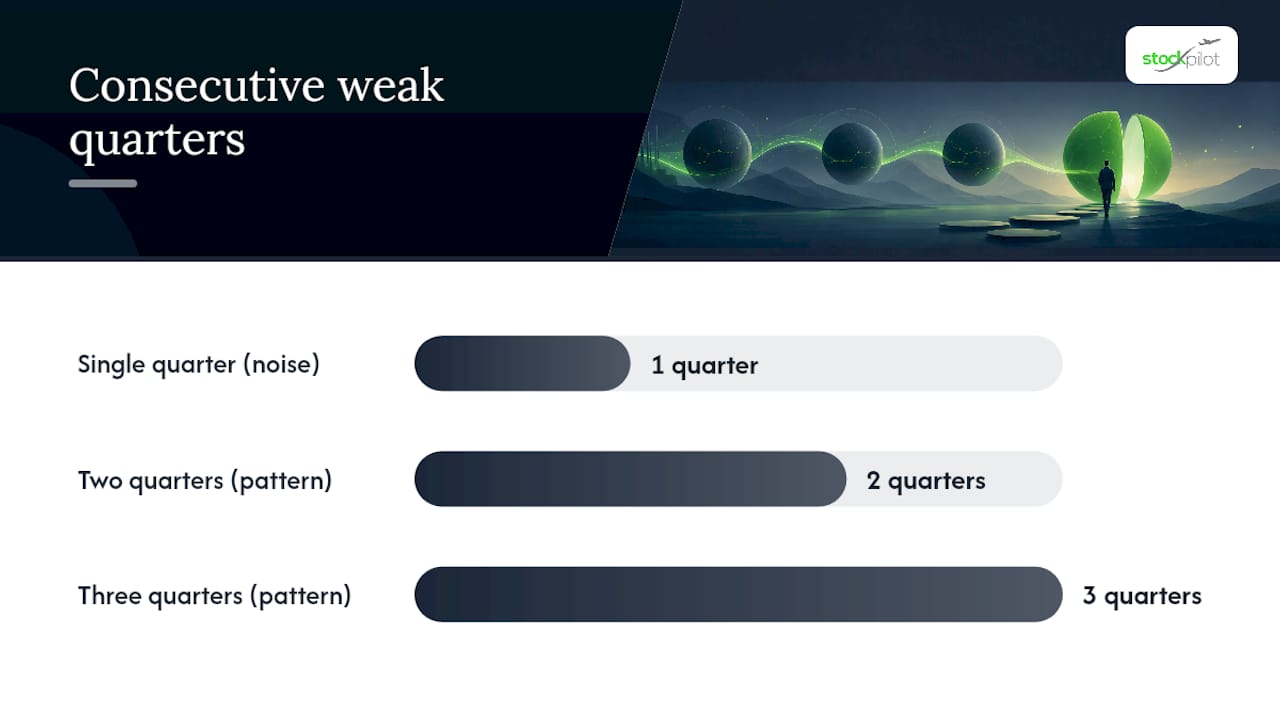
- Check for revenue or margin erosion. A single soft quarter is noise. Two or three consecutive quarters of shrinking margins or decelerating revenue growth is a pattern.
- Watch for market share loss to a competitor. A company losing share consistently is telling you its competitive edge, the reason you bought it, is eroding.
- Note material management changes. A founder or CEO departure, especially an unplanned one, changes the calculus even when the numbers still look fine on paper.
- Track regulatory or structural shifts. New regulation, a lost patent, or a changed tax treatment can quietly invalidate a thesis built on the old rules.
- Distinguish signal from noise. One bad headline is not a trend. Ask whether the same issue would still worry you in two quarters.
Kiplinger's guidance on selling frames this well: sell when the upside from your original thesis is fading, when a clearly better opportunity exists elsewhere, or when you need the cash for something more pressing. None of those require a stock to be down.
Pro Tip: Keep a one-line "reason I bought this" note for every position when you open it. Reread it every time something changes. If the note no longer matches reality, you have your answer without needing to guess.
If the signal is ambiguous, give yourself a short review window, two to four weeks, rather than deciding in the moment. Document what you're watching for. Selling can wait a few weeks. Selling on a rumor usually can't be undone.
How Do You Use Rebalancing to Manage Risk?
Portfolio drift happens quietly. A stock that started as 4% of your holdings can become 15% after a strong run, and suddenly one company is driving most of your risk without you deciding that on purpose. Fidelity's rebalancing guidance treats this as a legitimate, non-price reason to sell, separate from anything wrong with the company itself.
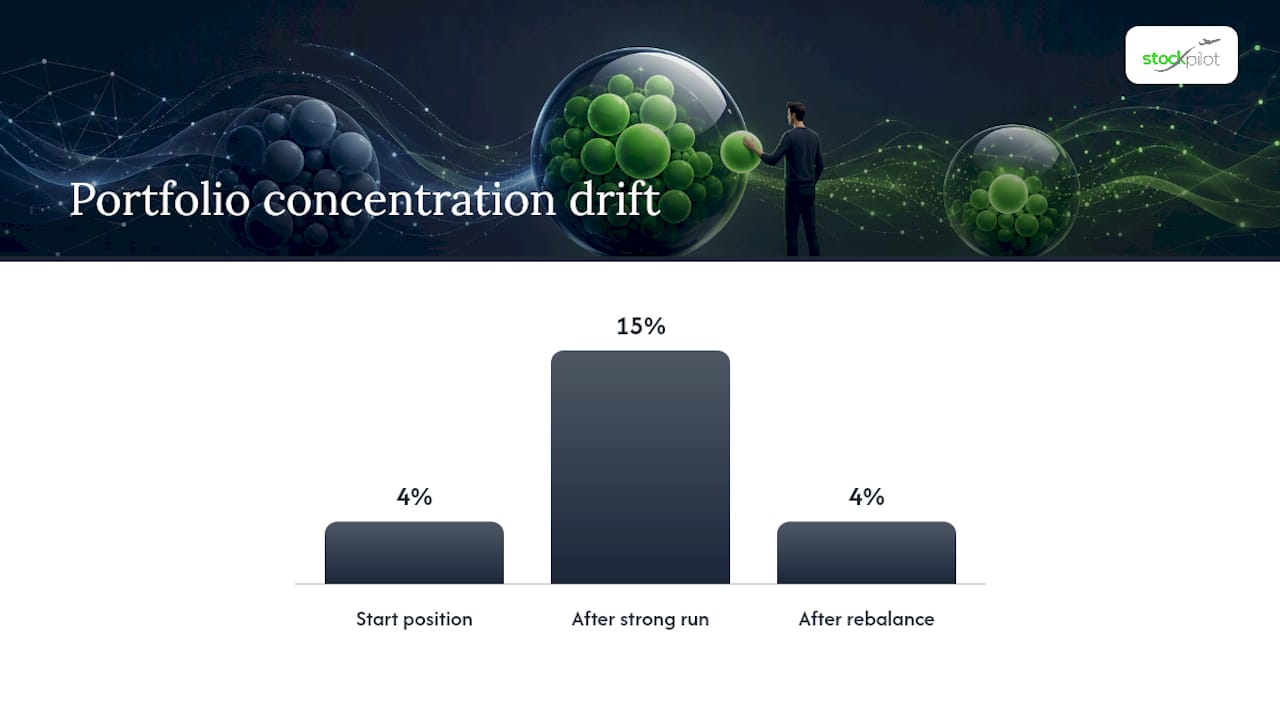
A workable threshold: trim any single stock that grows beyond 8% to 10% of a diversified portfolio back toward its original target weight. Fidelity has flagged single-stock concentration above a low single-digit percentage as worth watching closely for investors who want tighter risk control.
The mechanics are simple once you commit to them:
- Measure your current allocation against your target, not against your gut feeling.
- Decide the percentage to trim, usually enough to bring the position back to its target weight rather than an arbitrary round number.
- Execute in two or three tranches instead of one large sale, which smooths out the price you get.
- Write down why you sold and what target weight you're restoring, so the next drift decision is faster.
Rebalancing as risk management: Trimming an outsized winner back to its target weight isn't a bet against the company. It's a mechanical reset that keeps one position from dictating your entire portfolio's fate.
Tax-aware investors should run rebalancing trims through tax-deferred accounts, an IRA or 401(k), whenever possible, since trims there don't trigger capital gains. In taxable accounts, pair a trim with tax-loss harvesting elsewhere in the portfolio to offset some of the gain.
Getting the Execution Right: Sizing, Orders, and Timing
A good sell rule means nothing if the execution is sloppy. This is where position sizing and order type turn a decision into a clean trade.
For sell-half or tiered exits, size the trim as a percentage of your original share count, not your current dollar value, so the math stays consistent as the price moves.
Order types matter more than most new investors realize:
- Limit orders for controlled exits when you want a specific price and don't mind waiting.
- Stop-loss or stop-limit orders to cap downside automatically if a stock falls through a level you've set in advance.
- Trailing stops to lock in gains on a rising stock while leaving room for further upside.
Tax timing deserves its own line item. Shares held more than one year qualify for long-term capital gains rates, generally lower than short-term rates, which apply to anything held a year or less. If a position is close to that one-year mark and nothing urgent forces a sale, waiting a few weeks can meaningfully change the tax bill. Watch for the wash-sale rule too: if you sell a stock at a loss and buy the same or a substantially identical security within 30 days before or after, the IRS disallows the loss for tax purposes that year. Investors who want to stay exposed to a stock's price movement without an outright sale sometimes look at a stock replacement strategy using deep in-the-money calls, though that approach carries its own options risk and gives up any dividend.
Pro Tip: Before placing any sell order, write down the trigger, the order type, and the tax lot you're selling. That thirty-second habit prevents the two most common execution mistakes: selling the wrong lot and forgetting why you sold at all.
Why Do Investors Panic Sell, and How Do You Avoid It?
The most expensive sell decisions aren't the wrong ones on paper, they're the ones made for the wrong reason. Panic selling during a drawdown, dumping a winner too early out of fear it'll reverse, chasing a stock that's already run because everyone else is buying it, these all come from the same place: the need to do something when the better move is often to do nothing.
Fidelity's research on market discipline makes the point plainly: rules-based approaches that separate the decision from the emotion of the moment lead to better long-term outcomes than reactive trading.
- Write your sell rules before you own the stock, not while you're watching it fall.
- Schedule portfolio reviews quarterly instead of checking triggers daily.
- Use alerts or trailing stops to automate the parts of the decision that don't need your judgment in real time.
- If you're near retirement, apply a "sleeping point" ceiling on volatility regardless of upside potential.
Pro Tip: Keep your disconfirming signals in writing, the specific facts that would prove your thesis wrong. When a stock drops, check that list before you check the price. Most panic sells happen because the investor never wrote down what would actually justify selling.
How a Rules-Based System Applies These Sell Rules
StockPilot runs on the same principles laid out above, just automated. The system maintains a transparent 19-position model portfolio, combining six income-producing positions with 13 AI-selected growth positions, and evaluates market, fundamental, technical, sentiment, and statistical data continuously rather than on a quarterly glance.
- After-hours buy and sell alerts fire only when predefined investment and risk criteria are actually met, not on a hunch or a headline.
- Position-sizing guidance keeps individual holdings from drifting into concentration risk the way an unmanaged portfolio can.
- During unfavorable market conditions, the system can shift capital from growth positions into Treasury ETFs as a defined risk-management step, rather than leaving that call to emotion in the moment.
A rules-based alert system removes the moment of hesitation where most bad sell decisions happen. It's worth comparing StockPilot's alert triggers against your own written rules to see where they align and where your temperament might call for something more conservative or more aggressive. Readers evaluating the service can review the regulatory disclaimer and risk disclosure for the specifics.
Choosing the Right Mix of Sell Rules for Your Goals
The right combination depends on time horizon more than personality. A younger growth investor can lean on thesis checks and tiered profit-taking, letting winners run longer between trims. Someone closer to retirement should weight rebalancing and a conservative core more heavily, with a firmer sleeping-point ceiling on volatility. Whatever mix you land on, test it on a small slice of your portfolio before applying it everywhere. A rule that sounds right on paper sometimes behaves differently once real money and real fear are involved.
— David Elliot
A Disciplined Way to Put These Sell Rules Into Practice
Writing your own sell rules is the right first step. Following them consistently, quarter after quarter, without an emotional override, is the part most investors struggle with. StockPilot is built specifically for that gap: instead of a checklist you're supposed to remember to consult, it's a system that watches the same fundamental, technical, and sentiment signals discussed throughout this article and issues after-hours alerts only when its predefined criteria call for a change.

The model portfolio combines six income-producing positions with 13 AI-selected growth positions, applies position-sizing discipline automatically, and can rotate capital toward Treasury ETFs when conditions turn unfavorable, the same rebalancing and risk-management logic covered above, just codified into rules that don't wait for you to feel calm enough to act on them. You keep full control of your brokerage account and every trade; StockPilot never takes custody of your money.
If you want to see how these triggers compare with the rules you've just read, visit StockPilot Premium for $147 per month, or check the waitlist page for current enrollment details.
Where These Sell Rules Come From
- Fidelity: Managing positions for tiered profit-taking guidance.
- Fidelity: Rebalance for concentration and drift thresholds.
- Kiplinger: Four signs it's time to sell for thesis-based sell signals.
- Investopedia: Stock replacement strategy for alternatives to an outright sale.
- Investor for order execution basics.
This article is general information, not a substitute for advice from a qualified financial advisor. Consult a qualified financial professional about your own circumstances before acting on anything here.
Sources
- Managing positions: When to cut and run, when to take profits — Fidelity
- Rebalance — Fidelity
- Four signs it's time to sell a stock — Kiplinger
- Stock replacement strategy — Investopedia
FAQ
How Much Stock Can I Sell Without Paying Tax?
There's no blanket amount that's tax-free. What you owe depends on your gain, your income bracket, and how long you held the shares, with long-term holdings (over one year) taxed at lower rates than short-term ones. Selling within a tax-advantaged account like an IRA avoids immediate capital gains tax entirely.
What Is the 7% Rule for Selling Stocks?
The 7% rule is a stop-loss guideline popularized in growth-investing circles, suggesting you sell if a stock falls 7% to 8% below your purchase price to limit downside. It's a stricter version of the general stop-loss principle covered above and suits shorter-term, momentum-driven positions more than long-term holdings.
How Long Do You Have to Hold a Stock Before You Can Sell It?
There's no minimum holding period required to sell a stock you own outright; you can sell the moment it settles after purchase. Holding it more than one year, however, qualifies any gain for the lower long-term capital gains tax rate instead of the short-term rate.
What Happens if You Sell a Stock but No One Buys It?
A market order almost always executes because it fills at the best available price, but a limit order set above the current market price can sit unfilled until a buyer meets it. In very thin or illiquid stocks, an order can also fill only partially, a basic mechanic of how markets and order matching work.