

Tactical asset allocation is the practice of temporarily shifting portfolio weights away from your long-term targets to exploit a short-term market opportunity or dodge a near-term risk. The tilt is deliberate, bounded, and reversible, typically running 3 to 18 months before reverting to baseline. Most tilts stay in the 5% to 10% range of a given asset class, and the technique belongs mainly to active portfolio managers, institutional allocators, and experienced self-directed investors who already have a strategic plan worth deviating from.
TL;DR:
- Tactical asset allocation typically stays within 5% to 10% deviation range from a baseline, with reversion triggers fixed before entering the tilt.
- The strategy relies on signals from valuation, momentum, macro indicators, and volatility, usually checked weekly or monthly through liquid instruments like ETFs.
- Most tactical funds struggle to outperform balanced benchmarks after fees, taxes, and turnover costs, with success hinging on correct timing and quick reversion.
- It is best suited for experienced, disciplined investors or institutions capable of rigorous monitoring and strict adherence to rules.
- Systematic approaches offer consistency but face risks such as model overfitting, abandonment of exit rules, and data snooping, making clear guardrails essential.
Table of Contents
- How Tactical Asset Allocation Works in Practice
- Tactical vs. Strategic vs. Dynamic Allocation: What's the Difference?
- Discretionary vs. Systematic Tactical Approaches
- Building an Implementation Checklist for TAA
- What the Evidence Says About TAA Risk and Performance
- When Tactical Allocation Makes Sense (and When It Doesn't)
- How StockPilot Applies Tactical Discipline in Practice
- Historical Examples of TAA in Action
- Running Tactical Tilts Without Fooling Yourself
- Get StockPilot's Tactical Framework Without Building It Yourself
- Sources
How Tactical Asset Allocation Works in Practice
Everything starts with a strategic asset allocation, the long-term mix of stocks, bonds, and cash you'd hold with no market opinion at all. Tactical asset allocation layers a temporary deviation on top of that baseline when a specific signal justifies it, then reverts once the opportunity fades or the risk passes.
The signals driving that decision generally fall into four buckets:
- Valuation signals flag when an asset class is statistically cheap or expensive relative to its own history.
- Momentum and relative strength track which asset classes are outperforming and whether that trend has legs.
- Macro indicators cover things like yield curve shape, inflation surprises, and credit spreads widening.
- Volatility measures, including the VIX and realized volatility, flag regime shifts before they show up in price.
Execution usually runs through low-cost, liquid instruments. Broad market ETFs handle the core equity and bond tilts, Treasury ETFs act as the defensive parking spot during risk-off shifts, and some managers layer in commodity ETFs or a cash overlay for inflation hedges. Monitoring is rarely daily. Most systematic and discretionary approaches alike check signals weekly or monthly, with explicit reversion rules that force the tilt back to baseline once a price target, time limit, or signal reversal triggers.
Tactical vs. Strategic vs. Dynamic Allocation: What's the Difference?
Strategic asset allocation (SAA) is the policy portfolio, the fixed long-term mix built around your goals, time horizon, and risk tolerance. It doesn't move because the market had a bad week.
Tactical asset allocation (TAA) is the temporary deviation from that policy portfolio, designed to revert once the opportunity or risk it responded to has passed. Dynamic asset allocation sits in a different category entirely: rather than making episodic, bounded tilts, it continuously recalibrates weights as market conditions evolve, without a defined reversion point.
A few distinctions matter for implementation:
- SAA answers "what should I own for the next decade," TAA answers "what should I own for the next quarter or two."
- Dynamic allocation adjusts continuously; TAA moves in discrete, time-boxed steps.
- Core-satellite portfolio construction is where TAA usually lives operationally, with the core holding the strategic mix and a smaller satellite sleeve executing the tactical tilts.
Discretionary vs. Systematic Tactical Approaches
Discretionary TAA relies on a portfolio manager's judgment, often built around a macro thesis, a Fed policy read, or a valuation call that a model wouldn't capture on its own. The upside is flexibility. It can respond to a genuinely unprecedented event a backtest never saw. The downside is behavioral: confirmation bias, recency bias, and simple inconsistency creep in when there's no rule forcing a decision.
Systematic TAA replaces judgment with rules-based signals like momentum, relative strength, and valuation z-scores, run through a model that outputs the same answer every time given the same inputs. That consistency is backtestable and disciplined, but it carries model risk and a real danger of overfitting parameters to a specific historical period that won't repeat.
Three failure modes show up repeatedly regardless of approach:
- Abandoning exit rules when a tilt is losing money and hope replaces the plan.
- Overtrading on every signal wobble instead of waiting for genuine conviction.
- Data snooping, or curve-fitting a model until it looks perfect on the exact data it was built from.
Pro Tip: Write your exit rule down before you enter the tilt, not after. If you can't state the reversion trigger in one sentence, you don't have a systematic approach, you have a hunch with extra steps.
Building an Implementation Checklist for TAA
Adding tactical asset allocation to a portfolio or mandate starts with paperwork, not trades. Your investor policy statement needs an explicit tactical mandate: the objective, the allowed deviation ranges, who has approval authority to trigger a tilt, and how often results get reported. This is not a formality, it's what separates disciplined TAA from ad hoc guessing.
From there, set concrete guardrails:
- Cap each tilt at a defined band, commonly ±5% to ±10% per asset class.
- Define the reversion trigger up front, whether that's a price target, a calendar date, or a signal reversal.
- Route execution through low-cost, liquid instruments like broad index ETFs, with Treasury ETFs as the default defensive shift.
- Size trades to keep transaction costs and bid/ask spread from eating the expected edge.
A quick gut check on net benefit: run the math before you trade. Expected excess return multiplied by tilt size, minus expected implementation cost, minus expected tax drag. If that number is negative, skip the trade regardless of how convinced you are.
Tax treatment deserves its own line item. Frequent tactical trades in a taxable account risk short-term capital gains taxed at ordinary income rates, and any tax-loss harvesting around a tilt needs to respect the wash-sale rule.
What the Evidence Says About TAA Risk and Performance
Tactical asset allocation carries three risks that don't show up on a glossy pitch deck: market-timing risk (being wrong about direction or timing), turnover-driven fee leakage, and tracking error against the strategic benchmark you're deviating from.
The historical record is sobering. Industry analyses have found that only a minority of tactical funds have managed to outperform simple balanced benchmarks once fees are factored in, which means the tilt has to be right often enough, and by enough margin, to cover its own costs before it adds anything.
The honest framing for TAA isn't "does it beat the market," it's "does the frequency and size of correct calls exceed the drag from fees, turnover, and taxes." For most tactical mandates historically, the answer has been no.
Track these metrics rather than raw returns alone:
- Sharpe ratio relative to the strategic benchmark, not in isolation.
- Maximum drawdown during the tilt period versus what the baseline portfolio would have experienced.
- Turnover as a percentage of assets, since that number drives both fees and tax drag.
When Tactical Allocation Makes Sense (and When It Doesn't)
TAA suits investors with the resources and discipline to run it properly: institutional allocators with dedicated research staff, experienced portfolio managers who've built and tested a signal framework, and well-capitalized self-directed investors who treat it as a satellite sleeve, not the whole portfolio.
It's the wrong tool for anyone who can't commit to the monitoring cadence or who'll abandon the exit rule the first time a tilt goes against them. A passive strategic allocation, or a continuously adapting dynamic approach, tends to serve smaller accounts and less experienced investors better.
Three structural options for those who do proceed:
- Overlay, where TAA adjusts derivative or futures exposure without touching the underlying core holdings.
- Core-satellite, where a small percentage of the portfolio is carved out specifically for tactical bets.
- Full mandate, where an entire account or fund is run tactically, appropriate mainly for specialized institutional strategies.
How StockPilot Applies Tactical Discipline in Practice
Most of the guardrails above (an explicit mandate, tilt caps, defensive reversion into safer assets) sound straightforward on paper and fall apart under real market pressure. StockPilot was built around that exact gap.
The system runs a model portfolio with multiple income-producing positions and AI-selected growth positions. When market, fundamental, technical, sentiment, and statistical data cross predefined risk thresholds, it issues after-hours buy and sell alerts and can shift capital toward Treasury ETFs, mirroring the defensive tilt this article describes as a core TAA guardrail.
A few things worth checking against your own IPS before mirroring any rules-based system:
- Does the provider publish clear risk disclosures covering drawdown scenarios and limitations?
- Are the tilt rules and reversion logic documented, or do they change without explanation?
- Does the system retain your custody and trade control, or does it require handing over your account?
StockPilot's blog publishes ongoing methodology notes, which is where to look if you want to see the reasoning behind a given alert before deciding whether it fits your own mandate.
Historical Examples of TAA in Action
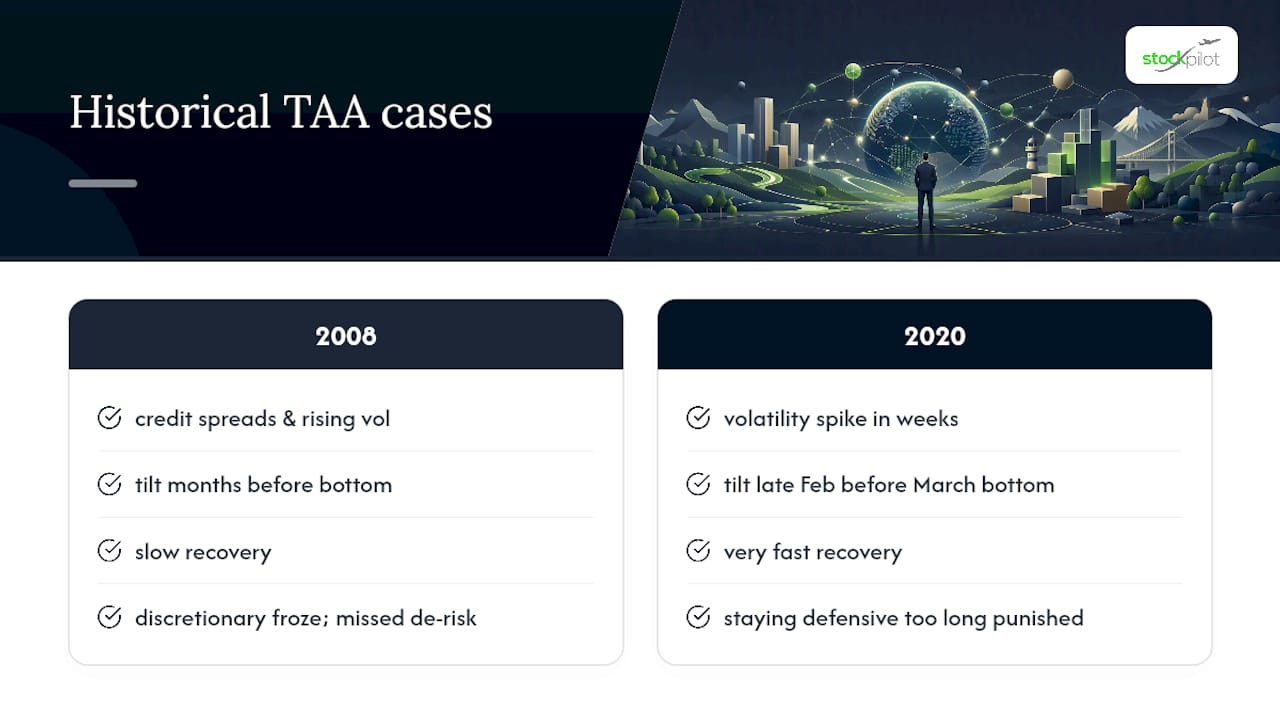
The 2008 financial crisis remains the clearest real-world test of tactical discipline. Managers running systematic TAA models that flagged deteriorating credit spreads and spiking volatility in mid-2008 had a rules-based trigger to shift toward Treasuries months before the broader market bottomed in March 2009. Discretionary managers without that trigger often froze, waiting for confirmation that never arrived cleanly, and many missed the window to de-risk before the worst of the drawdown.
The 2020 COVID crash offers a sharper, faster case. Volatility spiked in a matter of weeks rather than months, and any tactical model keyed to volatility regime shifts would have triggered a defensive tilt in late February, well ahead of the March bottom. The recovery that followed was equally fast, which punished managers who held the defensive tilt too long after the reversion trigger should have fired.
Both episodes point to the same lesson: the value of tactical asset allocation shows up less in the initial tilt and more in whether the reversion rule actually executes on schedule. A model that correctly calls the risk-off shift but fails to revert into the recovery gives back most of its edge. That's consistent with the broader performance data showing that a minority of tactical funds outperform simple balanced benchmarks once turnover and fee drag from repeated, poorly timed shifts are included.
Running Tactical Tilts Without Fooling Yourself
The single biggest mistake I see in tactical mandates isn't a bad signal, it's a good signal followed by no exit plan. Lock your reversion rule before you enter the tilt, not after the position starts moving against you. Once you're holding a loser, every instinct pushes toward "just a bit longer," and that's exactly when discretionary judgment turns into wishful thinking.
Before executing anything, run the net-benefit math: expected excess return times tilt size, minus transaction costs, minus tax drag. If it's negative, the trade isn't worth the paperwork.
Review the mandate itself quarterly, not the individual tilts. A framework that stops working needs replacing faster than any single position needs adjusting.
— David Elliot
Get StockPilot's Tactical Framework Without Building It Yourself
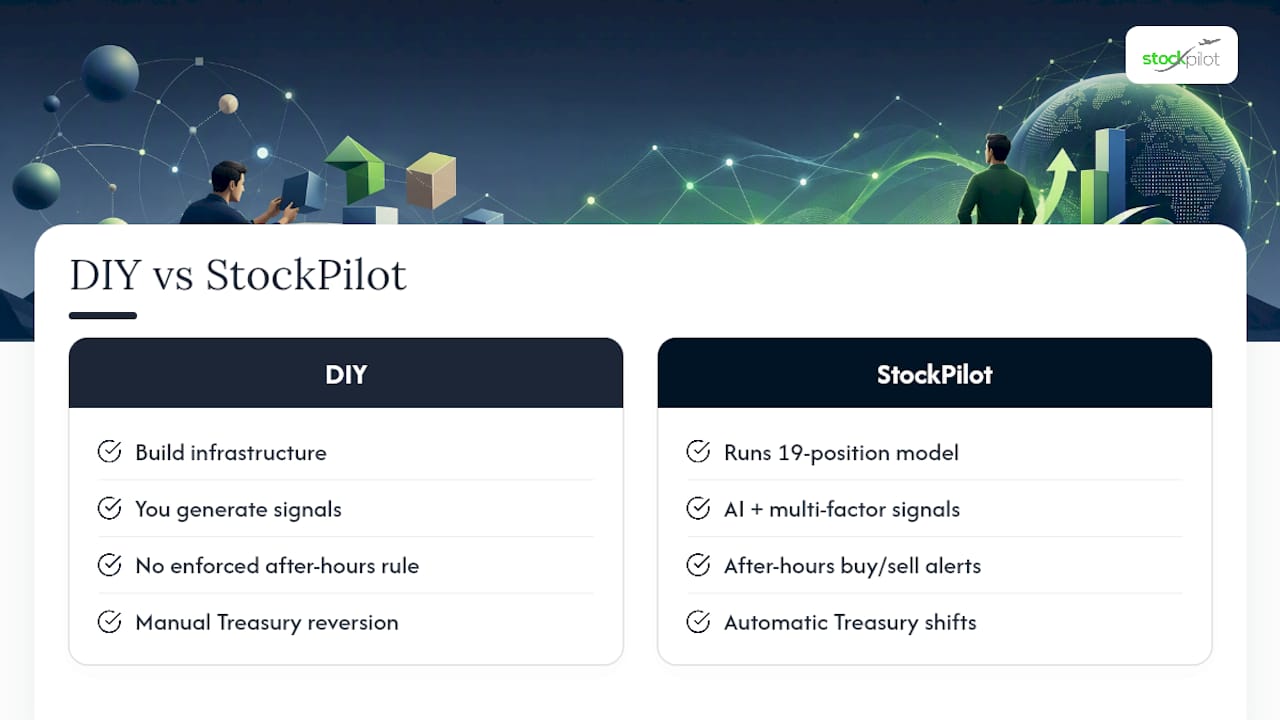
Everything this article just walked through, the IPS-style guardrails, the tilt caps, the Treasury ETF reversion trigger, the after-hours discipline to avoid emotional overtrading, takes real infrastructure to build and maintain on your own. StockPilot runs that framework for you.

Subscribers mirror a transparent 19-position model portfolio directly in their own brokerage accounts, combining income-producing positions with AI-selected growth positions. The system evaluates market, fundamental, technical, sentiment, and statistical data, and issues clear after-hours buy and sell alerts only when predefined risk criteria call for a change. During unfavorable conditions, it can shift capital toward Treasury ETFs automatically, rather than leaving that reversion decision to a stressed investor watching a red screen.
If you're an experienced self-directed investor who wants tactical discipline without building the signal infrastructure yourself, review StockPilot's risk disclosures and join the waitlist to see how the model portfolio fits your own investment policy.
This article is general information, not a substitute for advice from a qualified financial advisor. Consult a qualified financial professional about your own circumstances before acting on anything here.
Sources
- Global Tactical Asset Allocation | BlackRock
- Tactical Asset Allocation (Investopedia)
- Tactical asset allocation — Wikipedia