

Tax-loss harvesting lets you sell losing positions to offset capital gains and up to $3,000 of ordinary income per year, with unused losses carrying forward indefinitely. The catch is the wash-sale rule: if you buy back a "substantially identical" security within 30 days before or after the sale, the IRS disallows the loss. Trades also need to settle by December 31 to count for that tax year, so timing matters as much as the trade itself.
TL;DR:
- Harvesting short-term losses to offset short-term gains provides the most significant tax benefit because both are taxed at higher ordinary income rates.
- The wash-sale rule applies across all accounts, including spousal and retirement accounts, disallowing losses if the same or substantially identical security is repurchased within 61 days.
- Trades must settle by December 31 to count for that tax year, requiring early planning and confirmation of settlement dates to avoid losing deductions.
- Excess losses beyond capital gains up to $3,000 can offset ordinary income annually, with remaining losses carried forward indefinitely for future use.
- Using a rules-based system or careful recordkeeping helps prevent wash-sale mistakes that can turn a tax-saving strategy into a costly error.
Table of Contents
- What Tax-Loss Harvesting Actually Does
- How Losses Offset Gains: The Ordering Rules and the $3,000 Cap
- The Wash-Sale Rule Explained: 61 Days, Substantially Identical, and the Traps Nobody Warns You About
- Timing and Settlement: Why December 31 Isn't Actually Your Deadline
- How Harvested Losses Show Up on Your Tax Return
- Worked Examples: The Math Behind Offsets and Wash Sales
- Common Pitfalls and What to Check Before You Harvest
- How a Rules-Based Alert System Handles Harvesting Without the Guesswork
- Primary Sources Worth Bookmarking
- The Part of This Strategy Everyone Oversimplifies
- Sources
- FAQ
What Tax-Loss Harvesting Actually Does
Tax-loss harvesting means selling an investment at a loss on purpose, then using that loss to reduce your tax bill. It sounds counterintuitive. Nobody wants to lose money on a stock. But once a position is down, the loss itself becomes an asset you can put to work against gains elsewhere in your portfolio.
The mechanics are straightforward: realized losses offset realized gains dollar for dollar, and if losses exceed gains, up to $3,000 per year offsets ordinary income ($1,500 if you're married filing separately). Anything left over doesn't disappear. It carries forward to future tax years for as long as you have gains or income to apply it against.
Harvesting tends to pay off most in a few specific situations:
- You have large realized gains this year (from a stock sale, a business sale, or a big fund distribution) and want to soften the tax hit.
- You're rebalancing after a market downturn and some positions are underwater anyway, so selling accomplishes two goals at once.
- You're holding short-term losses that can offset short-term gains, which are taxed at your ordinary income rate and therefore worth more to eliminate than long-term gains.
Harvesting is usually not worth the trouble when trading costs eat the benefit, when the position you'd sell is core to your long-term allocation, or when you'd need to sit in cash or a mismatched substitute for a month just to dodge the wash-sale rule. Chasing a few hundred dollars in tax savings while drifting from your actual investment plan is a bad trade, even if the math on the tax side looks fine.
How Losses Offset Gains: The Ordering Rules and the $3,000 Cap
The IRS doesn't let you offset gains and losses randomly. There's a required sequence, and understanding it changes which losses you should harvest first.
- Short-term losses offset short-term gains first. Both are taxed at ordinary income rates, so this pairing usually delivers the biggest tax benefit per dollar of loss.
- Long-term losses offset long-term gains first. These are taxed at the lower capital gains rates (0%, 15%, or 20% for most investors), so the dollar-for-dollar benefit is smaller.
- Leftover losses cross categories. If you have more short-term losses than short-term gains, the excess offsets long-term gains, and vice versa.
- Net losses beyond that offset ordinary income, capped at $3,000 per year ($1,500 married filing separately), with the remainder carried forward indefinitely to future returns.
The $3,000 ceiling hasn't moved in decades. It's the same limit whether you're netting a $500 loss or a $500,000 loss, which is exactly why the carryforward provision matters so much for investors who harvest aggressively in a down year.
Fidelity notes that harvesters often prioritize short-term losses precisely because they offset the higher-taxed short-term gains first. If you're only sitting on long-term losses and long-term gains, the strategy still works, just at a lower marginal benefit.
There's a secondary wrinkle worth knowing if you're a high earner: the net investment income tax can push your effective rate on gains higher, which means harvesting losses to offset those gains is worth more in dollar terms than it would be for someone below the NIIT thresholds. State tax treatment adds another layer. Most states that tax capital gains follow the federal ordering rules, but a handful tax gains as ordinary income with no preferential rate for long-term holdings, which changes the math on how much a harvested loss is actually worth to you.
The Wash-Sale Rule Explained: 61 Days, Substantially Identical, and the Traps Nobody Warns You About
The wash-sale rule is where most DIY harvesting attempts go wrong, usually because investors only think about the 30 days after a sale and forget the 30 days before it.
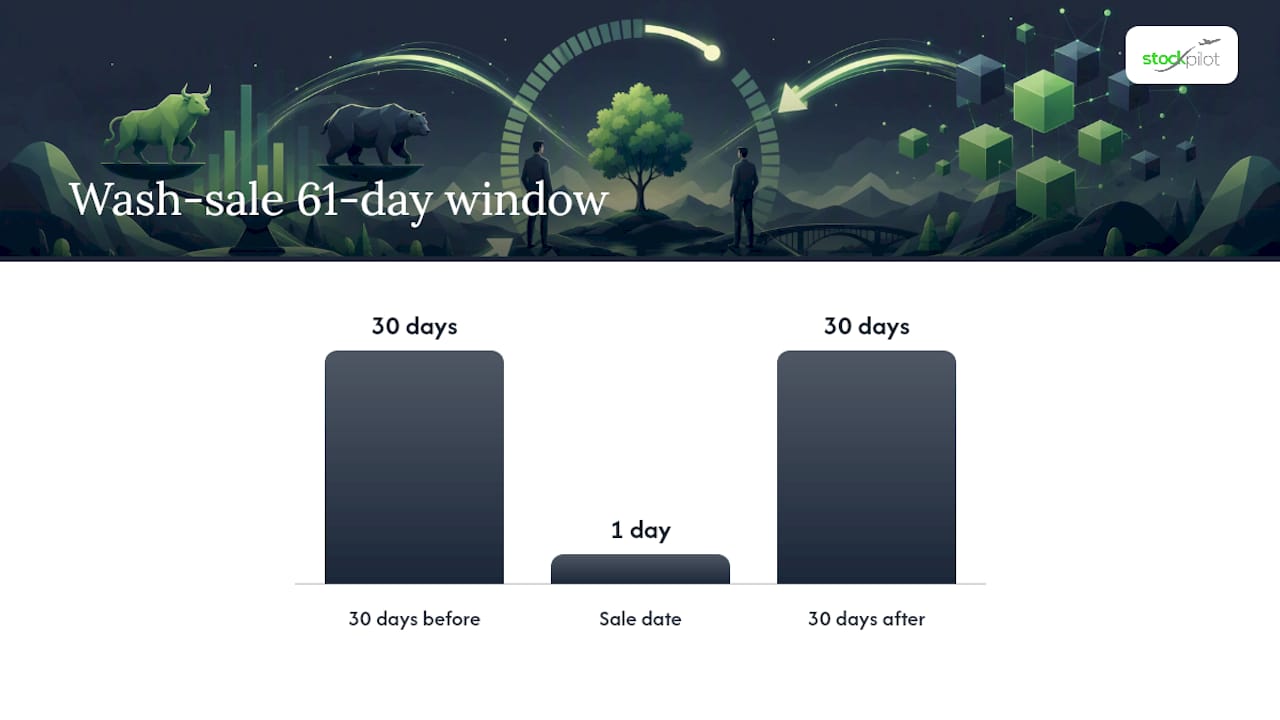
The rule spans 61 days total: 30 days before the sale, the sale date itself, and 30 days after. Buy back a "substantially identical" security anywhere in that window, and the loss gets disallowed. This trips people up constantly, because a lot of harvesting strategies involve pre-planned buys. If you set up an automatic dividend reinvestment 10 days before you sell the same stock at a loss, that reinvestment counts, even though you never "meant" to buy it back.
"Substantially identical" isn't formally defined with a bright-line test, but a few patterns are treated as risky by practice and IRS guidance:
- Selling a stock at a loss and buying the same stock back, even in a different account.
- Selling one share class or buying an option or convertible bond tied to the same underlying company.
- Selling a narrow, single-index ETF and immediately buying another ETF tracking the identical index from a different provider.
Safe replacements generally look different enough in construction and holdings that they aren't "identical," even if they're similar in spirit. Swapping a single tech stock for a broad, diversified technology sector fund is a commonly used workaround, since substituting a diversified ETF for an individual holding maintains market exposure without triggering the substantially identical test.
Cross-account traps are the part investors miss most often. The wash-sale rule applies across every account you control, not just the one where you made the sale. Buy the same stock in your IRA while you're harvesting a loss in your taxable brokerage account, and the wash sale still applies. Worse, if the repurchase happens inside an IRA or Roth IRA, the disallowed loss can be permanently forfeited rather than added to a new cost basis, because IRAs don't track cost basis the way taxable accounts do. Spousal accounts count too. A joint reading of the rule treats purchases by your spouse the same as purchases by you.
Brokers report wash sales on your 1099-B, but that report only covers your activity at that one broker. It won't catch a repurchase in a different account, a spouse's account, or an automatic dividend reinvestment plan running in the background. Broker reporting doesn't guarantee full identification, so tracking this yourself across every account you touch is not optional if you're harvesting seriously.
Pro Tip: A disallowed wash-sale loss isn't gone forever, it's added to the cost basis of your replacement shares. That means you'll owe less tax when you eventually sell the replacement, but only if you actually remember to adjust your records. Miss that basis bump and you'll overpay taxes down the road.
Timing and Settlement: Why December 31 Isn't Actually Your Deadline
The trade date isn't what counts for tax purposes. The settlement date is, and that distinction catches a surprising number of investors off guard every December.
Most stocks and ETFs settle on a T+2 basis, meaning the trade finalizes two business days after you place it. Sell a position on December 30, and it likely won't settle until January, which pushes the loss into the following tax year. If December 31 falls on a weekend or holiday, the real cutoff moves to the last business day before it.
A practical December checklist keeps this from becoming a problem:
- Confirm your broker's settlement schedule for the specific security type you're selling, since some fixed-income and thinly traded instruments settle slower than T+2.
- Execute harvesting trades by mid-December, not the last week of the year, to build in a buffer against holidays, weekends, and any processing delays.
- Avoid replacement purchases inside the 61-day wash-sale window, which for a mid-December sale extends into late January of the following year.
- Save your trade confirmations and account statements documenting the sale date, settlement date, and any subsequent purchases, in case you need to reconstruct the timeline later.
Executing early doesn't just protect the current year's deduction. It also gives you room to fix a mistake, like an accidental wash sale, while there's still time left in the calendar year to correct course.
How Harvested Losses Show Up on Your Tax Return
Every harvested loss eventually has to reconcile against IRS paperwork, and the process is more mechanical than most investors expect.
Sales get reported on Form 8949, where you list each transaction: the security, dates acquired and sold, proceeds, cost basis, and any adjustment codes. Wash sales get their own adjustment code (code "W") right there on the form. The totals from Form 8949 then flow into Schedule D, which nets everything into your final short-term and long-term capital gain or loss figures for the year.
Your broker's role here is bigger than most people realize:
- Brokers report wash-sale disallowances in box 1g of Form 1099-B, which shows the disallowed loss amount for covered securities.
- That 1099-B figure only reflects activity within that one brokerage account, so it misses cross-account wash sales entirely.
- Publication 550 walks through the reporting requirements in detail, including how basis adjustments from disallowed losses should be tracked.
Before filing, reconcile your own trade log against every 1099-B you receive. Check that the wash-sale amounts in box 1g match what you expected based on your own tracking, especially if you hold the same or similar securities across a taxable account, an IRA, and a spouse's accounts. Mismatches here are a common source of amended returns the following spring, and they're almost always avoidable with a spreadsheet and ten minutes of attention in early tax season.
Worked Examples: The Math Behind Offsets and Wash Sales
Numbers make this concrete. Here's how three common harvesting scenarios actually play out on a tax return.
In the first case, an investor with a $20,000 long-term gain from selling appreciated shares harvests $20,000 in losses from underperforming positions elsewhere in the portfolio. The two net to zero. No capital gains tax due on that piece of the return, and no losses left over to carry forward.
In the second, an investor with no gains at all harvests a $10,000 loss. The full $3,000 deducts against ordinary income this year, and the remaining $7,000 carries forward. Next year, that carryforward loss offsets gains first, then ordinary income again if there's anything left after that, up to the same $3,000 annual cap.
The third example is the one people get wrong. An investor sells a stock at a $250 loss, then buys back a substantially identical position 12 days later, inside the wash-sale window. The $250 loss is disallowed for this year, but it isn't lost. It gets added to the cost basis of the replacement shares. If those replacement shares were bought for $5,000, the adjusted basis becomes $5,250. Sell them later for $6,000, and the taxable gain is $750 instead of $1,000, because that earlier disallowed loss quietly reduced it.

Common Pitfalls and What to Check Before You Harvest
Most harvesting mistakes aren't about misunderstanding the rules. They're about skipping a step under time pressure in late December.
The behavioral cost gets underestimated constantly. Selling a position purely for a tax benefit can pull you away from your actual investment thesis, and the trading costs plus bid-ask spread on the trade sometimes exceed the tax savings, especially on smaller positions. There's also a quieter cost: if you sell a dividend-paying stock and rebuy too close to the ex-dividend date, you can lose qualified dividend treatment on that position for a stretch of time, which raises your tax bill in a different place than the one you were trying to fix.
The tax traps worth double-checking before every harvest:
- Confirm no purchases of the same or a similar security happened in any account, including a spouse's account, in the 30 days before the sale.
- Check whether a dividend reinvestment plan (DRIP) is set to buy shares automatically inside the wash-sale window.
- Verify your broker's 1099-B wash-sale figures actually match your own records across all accounts, not just the one where you sold.
Before pulling the trigger, run through a short checklist: your marginal tax rate (harvesting matters more the higher your bracket), the actual trading costs relative to the tax benefit, your state's specific capital gains treatment, and how much recordkeeping burden you're willing to take on to track wash sales across accounts.
Pro Tip: If tracking wash sales across multiple accounts sounds like more spreadsheet work than you want, that's usually the signal that a rules-based system built to flag this automatically is worth more to you than doing it by hand every December.
How a Rules-Based Alert System Handles Harvesting Without the Guesswork
Most wash-sale mistakes happen because an investor loses track of what they bought in a different account, or panics and rebuys a position too soon out of habit. A disciplined, rules-based framework removes a lot of that risk simply by not relying on memory.
A transparent 19-position model portfolio combining income-producing positions with AI-selected growth positions issues after-hours buy and sell alerts only when predefined criteria call for a change. Investors mirror every trade themselves and retain full control of their brokerage accounts.
That structure matters for harvesting in a few concrete ways:
- Alerts are issued on a defined schedule, giving a documented timeline to check against the wash-sale window before acting.
- Position-sizing and replacement guidance are built into the framework, so a sold position isn't replaced with something that recreates a wash-sale risk.
- During unfavorable market conditions, the system can shift capital toward Treasury ETFs, which sidesteps the "substantially identical" question entirely since it's a different asset class.
If you're already comfortable tracking trades across accounts by hand, manual harvesting works fine. If you're not, a rules-based alert system built around clear, predefined criteria is worth considering before the busy last week of December arrives. For details on how the system manages downside risk more broadly, see StockPilot's risk disclosure.
Primary Sources Worth Bookmarking
Nothing in this article substitutes for reading the source rules directly, especially since IRS guidance gets updated and edge cases (trader status, complex options positions, multi-account households) deserve a professional's eyes.
- IRS Topic No. 409, Capital Gains and Losses, for the $3,000 offset rule and carryforward mechanics.
- IRS Publication 550, for full reporting guidance on Form 8949, Schedule D, and 1099-B.
- Investor, for a plain-language definition.
If your situation involves trader tax status, a mark-to-market election, or accounts spanning multiple households, talk to a tax professional before filing. The rules get considerably more complicated fast.
The Part of This Strategy Everyone Oversimplifies
Most articles on tax-loss harvesting treat the wash-sale rule like a footnote. It isn't. It's the entire operational risk of the strategy, and the part where investors actually lose money instead of saving it.
The conventional advice, "just sell your losers before year-end," skips the two things that actually determine whether harvesting works: whether your trade settles in time, and whether anything in any of your accounts, including a spouse's IRA or an automatic DRIP, quietly buys the same security back. Those two failure points aren't edge cases. They're the default way this strategy goes wrong for people managing their own portfolios without a documented process.
If there's one priority to take from this, it's building a system rather than relying on a December scramble. Whether that system is a spreadsheet you maintain religiously or an automated framework that tracks positions and issues alerts on a schedule, the goal is the same: remove the moment where a rushed decision creates a wash sale you don't discover until tax season.
— David Elliot
This article is general information, not a substitute for advice from a qualified financial advisor. Consult a qualified financial professional about your own circumstances before acting on anything here.
Sources
- Topic No. 409 Capital Gains and Losses | Internal Revenue Service
- Wash Sales — Internal Revenue Service guidance (VITA excerpt)
- Publication 550, Investment Income and Expenses (Including Capital Gains and Losses) | IRS
- Investor
FAQ
What Is the Downside of Tax-Loss Harvesting?
The main downside is the wash-sale rule disallowing your deduction if you buy a substantially identical security within the 61-day window, along with trading costs and the risk of drifting from your long-term strategy just to capture a tax benefit. There's also a deferral cost: a disallowed wash-sale loss isn't gone, but it's locked into your replacement shares' cost basis instead of helping you this year.
What Does Warren Buffett Say About Tax-Loss Harvesting?
Buffett hasn't made tax-loss harvesting a public focus of his investment commentary, and no verified quote from him addresses the strategy directly. His broader, well-documented philosophy favors long-term holding over frequent trading, which cuts against harvesting for its own sake if it means selling a fundamentally sound position purely for a tax break.
What Is the Best Strategy for Harvesting Tax Losses?
The strongest approach prioritizes short-term losses against short-term gains first, since both are taxed at ordinary income rates and deliver the largest benefit per dollar harvested. Pair that with a documented checklist that confirms settlement dates, checks every account you control for the wash-sale window, and swaps into a genuinely different (not substantially identical) replacement to maintain market exposure.
How Much Can You Write Off With Tax-Loss Harvesting?
Losses first offset capital gains dollar for dollar with no cap. Beyond that, up to $3,000 per year ($1,500 if married filing separately) can offset ordinary income, and any leftover loss carries forward indefinitely to future tax years.