

A stop loss is a fixed price that converts to a market order the moment the stock trades there, aiming to lock in a worst case loss. A trailing stop is a moving version of the same idea. It ratchets upward with the price and only triggers if the stock reverses by a chosen amount or percentage based on your settings. Use a stop loss when your thesis has a clear invalidation price; use a trailing stop when you want to ride a winner while protecting the gains it has already built.
TL;DR:
- Fixed stop-loss orders work best when a clear invalidation price exists, while trailing stops are preferable for protecting ongoing gains in trending stocks.
- Brokers may trigger stop orders based on different pricing methods, such as last trade or bid prices, leading to varied order behaviors across platforms.
- Setting stops too tight or narrow increases whipsaw risk, causing premature exits on normal price fluctuations, especially in volatile or illiquid stocks.
- Proper stop placement depends on stock volatility, trading timeframe, and individual risk tolerance, with testing recommended before deploying real capital.
- Automated, rules-based systems help eliminate emotional decision-making, ensuring consistent execution of stop levels regardless of market fluctuations.
Table of Contents
- Trailing Stop vs Stop Loss: How Each Order Actually Works
- Weighing the Trade-Offs: Protection, Trend Capture, and Whipsaw Risk
- Choosing Between a Fixed Stop and a Trailing Stop
- Setting Trail Distance and Fixed Stops: A Numeric Walkthrough
- What Brokers Don't Always Tell You About Fills
- A Rules-Based Way to Handle Stops at the Portfolio Level
- Why Investors Talk Themselves Out of Good Stops
- A Structured Alternative to Managing Every Stop Yourself
- Sources
- FAQ
Trailing Stop vs Stop Loss: How Each Order Actually Works
The mechanics are simpler than most new investors expect, but the details matter once real money is on the line.
A standard stop-loss order sits at a fixed price you set when you place it. If the stock trades at or through that price, the order converts into a market order and sells at whatever price is available next, according to Investor. A stop-limit order works the same way up to the trigger, but instead of becoming a market order, it becomes a limit order at a price you specify. That gives you price control, with a real catch: if the stock keeps falling past your limit, the order simply never fills.
A trailing stop sets a gap below the current price, either a dollar amount or a percentage, and that gap only moves in your favor. As the stock climbs, the stop price climbs with it. If the stock falls, the stop price holds still until it's hit.
- Stop-loss: fixed price, becomes a market order on trigger
- Stop-limit: fixed price, becomes a limit order on trigger, may not execute
- Trailing stop: moving price, ratchets up but never down, exits on a defined pullback
One detail trips up a lot of self-directed investors: brokers don't all define the trigger the same way. Some use the last executed trade price, others use bid or ask quotations, and FINRA Rule 5350 confirms that firms can legitimately differ here. Identical orders at two different brokerages can behave differently in the same stock on the same day.
Weighing the Trade-Offs: Protection, Trend Capture, and Whipsaw Risk
Neither order type is better in every situation. The right choice depends on what you're actually trying to protect against.
- Fixed stops win when your risk is defined by a price, not a trend. If your thesis breaks below a specific level, an earnings miss, a broken support line, a debt covenant risk, a stop-loss at that exact price gives you a clean, unmoving exit tied to the reason you bought in the first place. This matters most in illiquid names where you want a known dollar risk rather than a moving target.
- Trailing stops win when the goal is to ride a trend without babysitting it. Investopedia's guidance on trailing stops notes they let you lock in gains as a stock runs while giving you an automated exit if the trend reverses, without forcing you to guess a ceiling.
- Both share the same core weakness: whipsaw. A trail set too tight will kick you out on ordinary noise before the real trend even develops, and a stop-loss placed too close to your entry does the same thing. Set either one too wide, and you give back more profit than necessary before the exit fires.
Choosing Between a Fixed Stop and a Trailing Stop
Start with the number that actually matters: how much of the position are you willing to lose if your thesis is simply wrong? That figure should drive your position size before it drives your stop placement.
From there, the choice gets straightforward. If there's a specific price where your reason for owning the stock stops being true, a fixed stop-loss belongs at that price. If you're already sitting on a winner and your real goal is protecting profit while the trend keeps working, a trailing stop fits better. FINRA's overview of order types makes the same point: there's no universal setting for either order, only a setting that fits the specific stock and situation.
Before placing either order, run through this checklist:
- Liquidity: thin trading increases the odds of a bad fill on either order type
- Volatility: high-beta or small-cap names need wider stops than blue chips
- Timeframe: swing trades tolerate tighter trails than multi-month positions
- Broker support: confirm your platform actually offers trailing stops and how it prices the trail
- Monitoring frequency: fixed stops need less oversight once set; trailing stops benefit from periodic review as the trail widens on a rising stock
Pro Tip: Write down your invalidation price and your maximum acceptable dollar loss before you buy, not after. Deciding stop placement while you're already holding a losing position almost always leads to moving the stop instead of honoring it.
Setting Trail Distance and Fixed Stops: A Numeric Walkthrough
Numbers make this concrete faster than any rule of thumb.
Say you buy a stock at $100. A fixed stop-loss at a specific percentage below purchase price sits at a fixed amount and never moves, regardless of what the stock does afterward. A trailing stop set at the same percentage starts at the corresponding price too, but if the stock climbs significantly, the trailing stop ratchets up to maintain the same percentage below the new high, not the entry price. The fixed stop at $92 would have let all of that profit round-trip back to nearly breakeven.
- Set the distance based on volatility, not habit. A stock that regularly swings 3% in a day needs a wider trail than one that moves 0.5%, otherwise normal noise triggers your exit.
- Match the timeframe to the trail. Short-term trades can run tighter trails; core long-term holdings usually need more room to breathe.
- Test before committing real capital. Backtest the trail percentage against the stock's historical range, or paper trade it for a few weeks. FINRA is explicit that there's no regulator-endorsed "correct" percentage, only one you've validated against the specific asset.
What Brokers Don't Always Tell You About Fills
The stop price and the fill price are two different things, and the gap between them is where most investor complaints originate.
- Some venues trigger stops off the last sale, others off the national best bid or offer; read your broker's order-type description before relying on either order, per FINRA's guidance on volatile-market execution
- A sell stop at $50 does not guarantee a $50 exit. If the next trade after triggering is $46 because the stock gapped down overnight, that's your fill
- Circuit breakers and Limit Up-Limit Down bands can pause trading before your stop even triggers, or affect what price is available when trading resumes
- Stop-limit orders solve the "fill far below my stop" problem but introduce a new one: in a fast-moving market, the limit price may simply never get hit, and you stay in a falling position
A Rules-Based Way to Handle Stops at the Portfolio Level
Most individual investors don't fail at understanding stop orders. They fail at applying them consistently once emotions enter the picture.
StockPilot's model portfolio approach starts from the same discipline this article walks through: define position sizing from a maximum acceptable loss, set an invalidation level before entry, and apply trailing logic only to positions where the objective is trend capture rather than a fixed thesis check. The system checks broker-relevant conventions and market conditions before any alert goes out, and during unfavorable stretches it can shift growth exposure toward Treasury ETFs rather than leaving stop decisions to be made under pressure. Rules set in advance, and followed without exception, tend to outperform rules improvised mid-trade.
Why Investors Talk Themselves Out of Good Stops
Here's what I think most articles on this topic get backwards: they treat the trailing stop versus stop loss decision as a technical settings question, when it's really a discipline question wearing a technical costume.
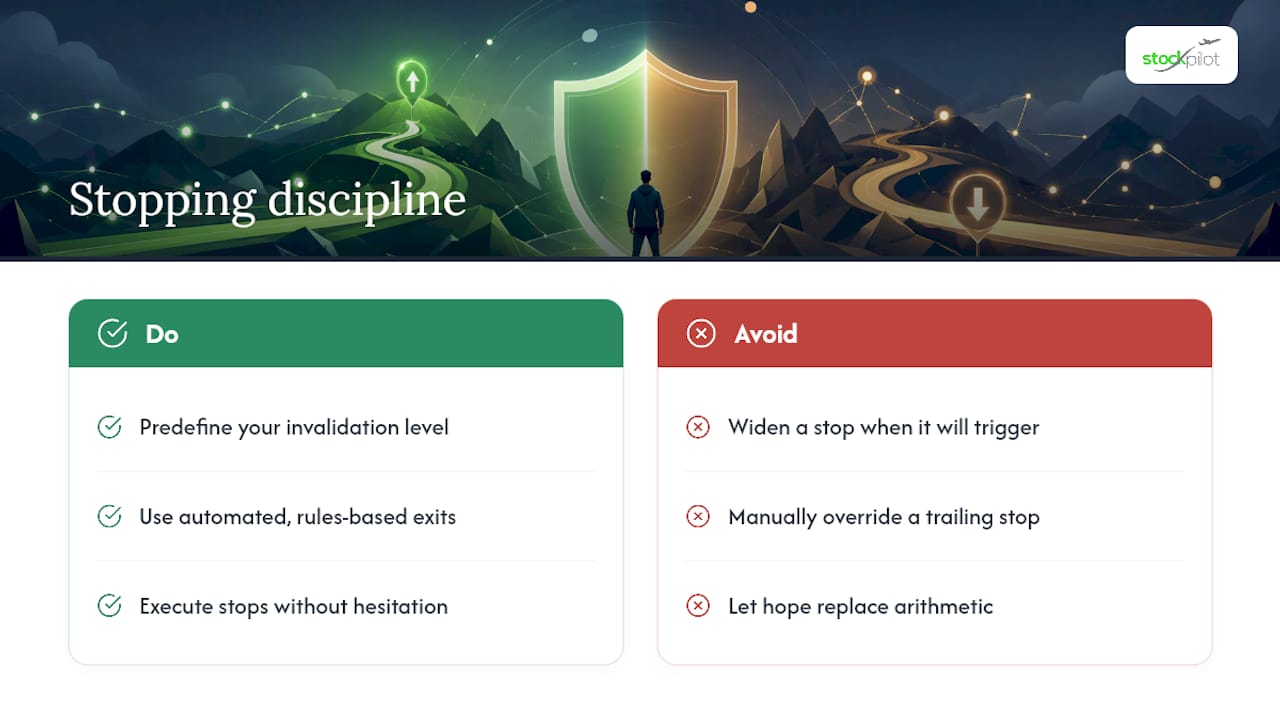
Give ten investors the same stock, the same entry price, and the same volatility profile, and you'll get ten different stop placements, most of them wrong not because the math was bad but because the investor moved the stop after the fact. A stop-loss that gets widened every time it's about to trigger isn't a stop-loss anymore. It's a suggestion. The same goes for a trailing stop that gets manually overridden the first time it would lock in a smaller gain than the investor hoped for.
The honest advantage of automated, rules-based systems isn't that they know a secret percentage nobody else has. It's that they don't flinch. A predefined invalidation level executes whether or not you're watching the screen, and that removes the single biggest failure mode in retail risk management: hope replacing arithmetic at the exact moment arithmetic matters most.
— David Elliot
A Structured Alternative to Managing Every Stop Yourself
This kind of system is built for investors who want the discipline this article describes without personally recalculating trail percentages every time a position moves. It can run a transparent 19-position model portfolio combining income and growth positions, and apply predefined risk rules to decide when a position needs adjusting, when exposure should shift toward Treasury ETFs, and when an alert should go out.

Every alert is issued after hours, based on criteria set in advance rather than reactions to a single bad afternoon, and you keep full control of your brokerage account and every trade you place. Full details on how the risk process works, along with StockPilot's regulatory disclosures and risk disclosure, are posted for anyone evaluating the approach.
If you'd rather follow a structured, rules-based portfolio than manually track fixed and trailing stops across a dozen positions, check the current plan details for StockPilot Premium on the pricing page, or join the waitlist if you want early access to new subscriber offers first.
Sources
For the official mechanics behind these order types, read Investor.gov's bulletin on stop, stop-limit, and trailing stop orders and FINRA's guidance on order types. For execution risk during fast markets, FINRA's notes on volatile-market stop execution cover slippage directly. Always cross-check your own broker's disclosures on trigger conventions before placing either order type.
This article is general information, not a substitute for advice from a qualified financial advisor. Consult a qualified financial professional about your own circumstances before acting on anything here.
- Stop, Stop-Limit, and Trailing Stop Orders – Investor Bulletin
- Trailing stop — Investopedia
- FINRA Rule 5350 — Stop Orders
FAQ
What Is the 7% Rule for Stop Loss?
The 7% rule is a popular guideline, not a regulatory standard, suggesting investors exit a position if it falls 7% below their purchase price to cap losses early. It's a reasonable starting point for volatile growth stocks, but FINRA's order-type guidance confirms there's no universally correct percentage. The right distance depends on the stock's typical volatility and your own risk tolerance.
What Are the Disadvantages of a Trailing Stop?
A trailing stop set too tight can trigger on normal price noise rather than a real trend reversal, exiting a winning position too early. It also offers no protection against gaps, since a triggered trailing stop becomes a market order that can fill well below the trail price during a sudden drop, according to Investor.gov.
What Is a Good Trailing Stop Percentage?
There's no fixed answer, since the right trail depends on the stock's volatility, your timeframe, and how much profit you're willing to give back before exiting. A stock with wide daily swings typically needs a wider trail than a stable blue chip, and testing the percentage against historical price ranges beats guessing.
Can You Give an Example of a Trailing Stop Loss?
If you buy a stock at $100 with an 8% trailing stop, your initial stop sits at $92.
When Should I Use a Stop-Loss Instead of a Trailing Stop?
Use a fixed stop-loss when a specific price would invalidate your reason for owning the stock, since a trailing stop's moving nature doesn't fit a thesis tied to one clear level. Investopedia recommends fixed stops for defined-risk situations and trailing stops for capturing an ongoing trend.