
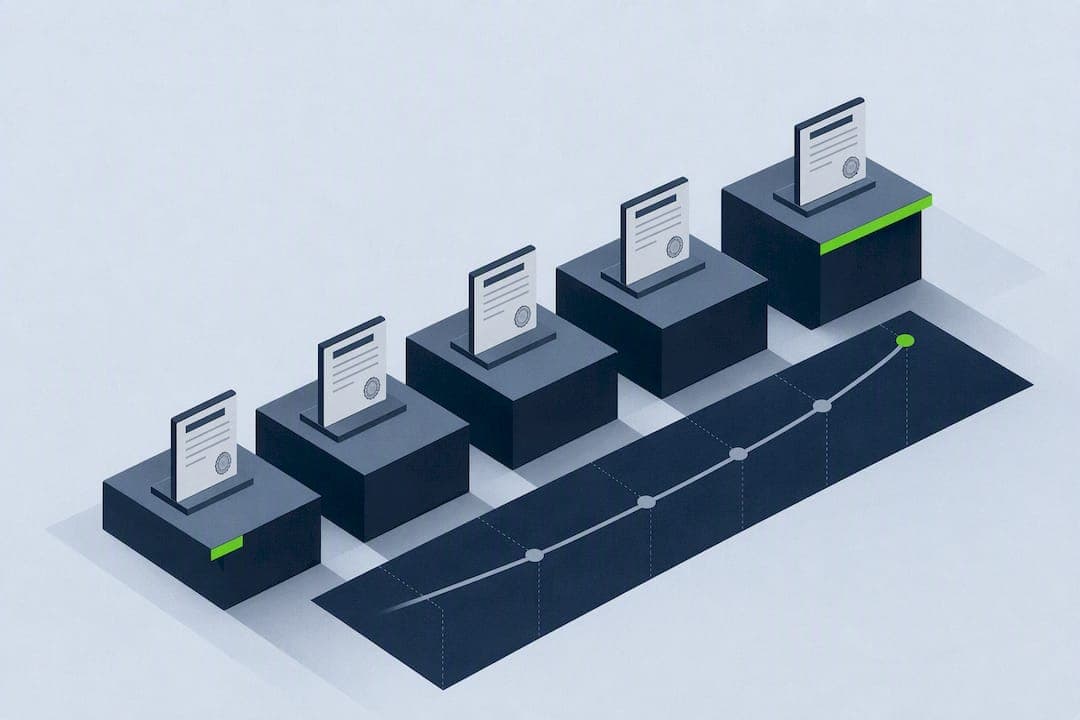
A treasury ladder ETF holds U.S. Treasuries with staggered maturities inside one fund, so a rung comes due on a set schedule instead of you buying and tracking each bond yourself. That structure suits two common goals well: timing cash for known expenses and cutting reinvestment risk when rates swing. It trades some control for convenience, which matters most if you're managing a smaller account or don't want to babysit a bond portfolio.
TL;DR:
- Treasury ladder ETFs track staggered U.S. Treasuries with either calendar maturities or equal-weighted durations, affecting their behavior during rate changes.
- They offer convenience, daily liquidity, and automatic reinvestment but expose investors to market price swings and rate risk, unlike individual bonds held to maturity.
- Key metrics to compare include duration matching your timeline, SEC yield versus yield-to-maturity, expense ratios, and fund methodology for rungs replacement.
- Popular options like LDRT, LLDR, and VGSH differ in maturity focus, structure, and fee levels, catering to various investment horizons and account sizes.
- These ETFs are most suitable for small accounts seeking simplified laddering, but should be evaluated carefully for liquidity, methodology, and expected response to rate shifts.
Table of Contents
- What Is a Treasury Ladder ETF and How Does It Work?
- Ladder ETFs vs. DIY Treasury Ladders and Plain Bond Funds
- How Do You Evaluate a Treasury Ladder ETF Before Buying?
- Which U.S. Treasury Ladder ETFs Should You Know?
- How Stockpilot Uses Laddered Treasury ETFs in a Rules-Based Portfolio
- What Most Investors Get Wrong About Treasury Ladder ETFs
- A Rules-Based Alternative Worth Knowing About
- Where to Verify These Fund Details Yourself
- Sources
What Is a Treasury Ladder ETF and How Does It Work?
Fund issuers build these ETFs around one of two designs, and the difference changes how the fund behaves as rates move.
The first is the calendar-maturity approach, best known through the iBonds family. iShares' iBonds 1-5 Year Treasury Ladder ETF (LDRT) holds a basket of Treasuries with staggered maturities and is built to "streamline bond laddering" for investors who want Treasury exposure without buying five separate bonds, according to iShares' own fund documentation. Individual rungs mature and roll off the ladder over time, similar to how a bond you hold to maturity behaves. That's the "matures like a bond" pitch you'll see in marketing. It's worth understanding as a design characteristic of how the underlying rungs are managed, not a guarantee that the ETF itself pays out a fixed sum at a fixed date the way a single bond does.
The second design is the equal-weight or target-duration ladder, used by funds like the Global X Treasury Ladder ETFs. Global X's long-term version, LLDR, holds Treasuries with remaining maturities between 10 and 30 years, spread across equal-weighted rungs specifically to soften the price swings that come with long-duration bonds, per Global X's fund page. Rather than a ladder that eventually terminates, this structure maintains a rolling maturity profile indefinitely, replacing rungs as they mature.
Either way, the ETF's share price and net asset value reflect the market value of whatever Treasuries currently sit inside it, including the rungs closest to maturity. That means you can still see day-to-day price movement even in a short-duration ladder ETF. The practical outcomes worth noting:
- Coupon and principal cash flows arrive on a more predictable schedule than with a single long bond.
- Reinvestment happens automatically inside the fund, not manually in your brokerage account.
- Shares trade with intraday liquidity, unlike individual Treasuries settled through auction or secondary desks.
- Rate moves still affect the fund's price, even while individual rungs march toward maturity.
Ladder ETFs vs. DIY Treasury Ladders and Plain Bond Funds
Building your own ladder means buying individual notes or bonds at staggered maturities and holding each to term. A ladder ETF automates that same idea, and Morningstar's coverage of bond-ladder ETFs frames the trade-off as operational simplicity in exchange for some loss of control. Here's how the choice usually breaks down:
- Lower operational burden. No individual bond purchases, no tracking of twelve separate CUSIPs, no manual reinvestment when a rung matures.
- Intraday liquidity. You can sell shares any time the market is open, whereas individual Treasuries may require going through a bond desk with wider spreads.
- Diversification across rungs with a small check size. A single share buys exposure across the whole ladder, useful for accounts too small to hold several individual bonds at meaningful size.
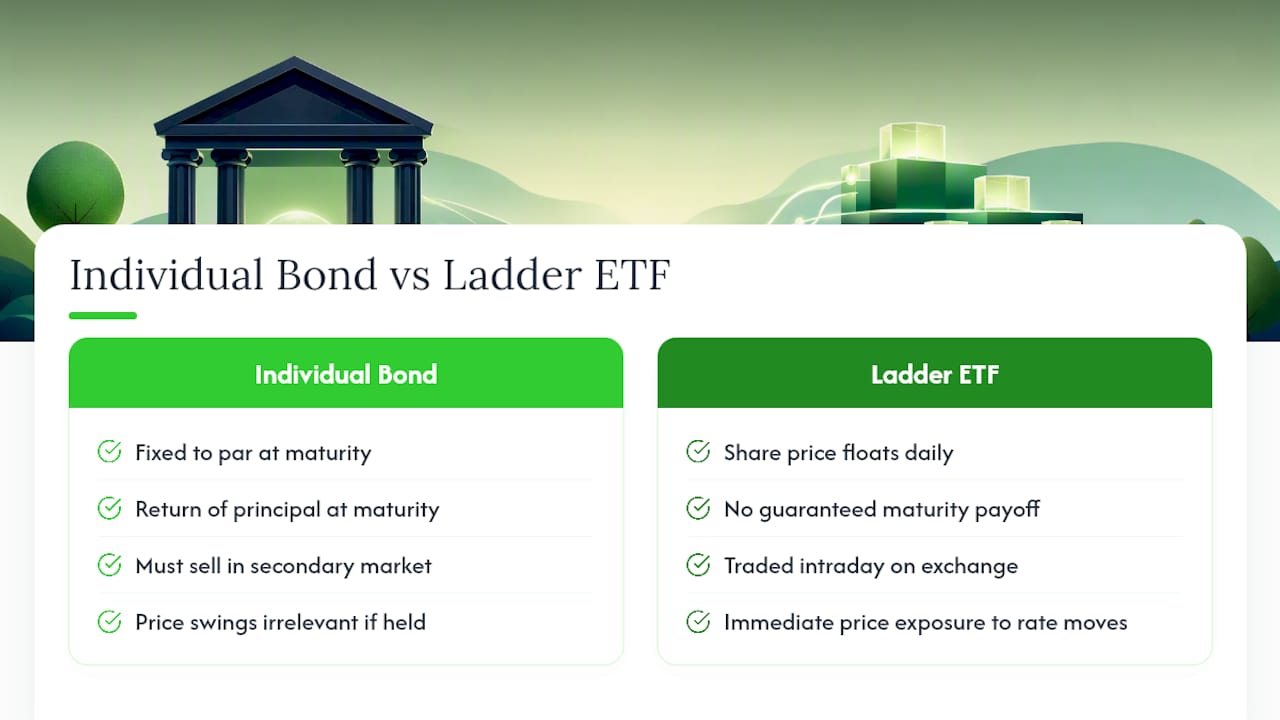
- Market-price volatility that a held-to-maturity bond investor avoids. If you hold a single Treasury to maturity, you get par value regardless of interim price swings. An ETF never "matures" as a whole, so you're always selling at whatever the market says shares are worth that day.
- Fee drag versus full coupon retention. Vanguard notes that Treasury ETFs give investors low-cost, liquid access to specific points on the yield curve, but even a small expense ratio chips away at what you'd otherwise keep from coupon payments on an individually held bond.
A DIY ladder makes more sense if you need an exact maturity date for a known expense, or you're managing tax lots carefully. A ladder ETF wins for smaller accounts, or for anyone who'd rather not manage a spreadsheet of CUSIPs and reinvestment dates.
How Do You Evaluate a Treasury Ladder ETF Before Buying?
Comparing these funds gets easier once you know which four or five numbers actually matter. Money.usnews' rundown of Treasury ETF options points to duration, yield, expense ratio, and liquidity as the recurring factors worth checking before you commit money.
- Match duration to your time horizon. Duration measures how sensitive a bond's price is to rate changes. A fund with a 2-year average duration will move far less on a rate shock than one averaging 20 years, so line the number up with when you'll actually need the cash.
- Compare SEC 30-day yield against yield-to-maturity. SEC yield is a standardized, backward-looking snapshot; yield-to-maturity is a forward-looking estimate assuming you hold and cash flows land as modeled. The two numbers can diverge, and knowing which one a fund publishes changes how you should read it.
- Check the expense ratio and do the math on drag. Expense ratios represent ongoing costs that can add up over time, especially when comparing funds with different fee levels for similar exposure.
- Look at AUM, average daily volume, and bid-ask spreads. Thin liquidity widens the gap between what you pay to buy and what you get to sell, which eats into returns on both ends of a trade.
- Read the holdings and index methodology. Confirm whether the fund uses calendar-maturity rungs, an equal-weight ladder, or a duration-targeting approach, since that shapes how it behaves as rates shift.
- Understand distribution and settlement mechanics. U.S. investors typically receive Treasury ETF distributions as ordinary income for tax purposes, reported on a 1099, and standard T+1 settlement applies to most brokerage trades.
Pro Tip: Pull up the fund's own fact sheet or prospectus before you buy, not a summary site. Issuer pages list current SEC yield, holdings, and expense ratio updated far more often than third-party trackers.
If a fund's AUM looks unusually thin relative to peers, or its index methodology is vague about how rungs get selected and replaced, treat that as a reason to ask your broker or advisor more questions before allocating.
Which U.S. Treasury Ladder ETFs Should You Know?
A handful of funds cover most of what U.S. investors need for laddered Treasury exposure, each targeting a different slice of the yield curve.
iShares iBonds 1-5 Year Treasury Ladder ETF (LDRT) packages Treasuries across five annual maturity rungs from one to five years out. The iBonds structure means individual rungs behave like bonds approaching maturity, and iShares publishes holdings, SEC yield, and expense ratio directly on the fund page. It suits investors who want a short-horizon ladder without picking individual notes themselves.
Global X Treasury Ladder ETFs (SLDR, MLDR, LLDR) cover short, mid, and long segments of the curve respectively, each using equal-weighted rungs. LLDR specifically targets Treasuries with 10 to 30 years remaining to maturity, and Global X built the equal-weight structure to dampen the price sensitivity that comes with holding longer-dated government debt.
Invesco Equal Weight 0-30 Year Treasury ETF takes a broader approach, spreading exposure across an annual maturity ladder that spans the entire Treasury yield curve rather than a narrow window. That makes it a single-fund way to get diversified duration exposure instead of stacking several narrower ladder ETFs.
Vanguard Short-Term Treasury ETF (VGSH) isn't a ladder fund in the strict sense, but it's a staple for the short end of many ladder strategies. It maintains a dollar-weighted average maturity of roughly one to three years, according to Vanguard's fund profile, and pairs well with longer ladder ETFs to round out a full curve strategy.
Schwab Short-Term U.S. Treasury ETF (SCHO) tracks a similar short-duration Treasury index and is known for a notably low expense ratio, listed around 0.03% on Schwab's own product page. It's frequently used as a cash-management sleeve alongside dedicated ladder funds.
WisdomTree 1-3 Year Laddered Treasury Fund (USSH) targets recently issued Treasuries across a one-to-three-year ladder, and WisdomTree's factsheet discloses effective duration, average years to maturity, and SEC yield, giving a clear picture of what you're holding without digging through a full prospectus.
How Stockpilot Uses Laddered Treasury ETFs in a Rules-Based Portfolio
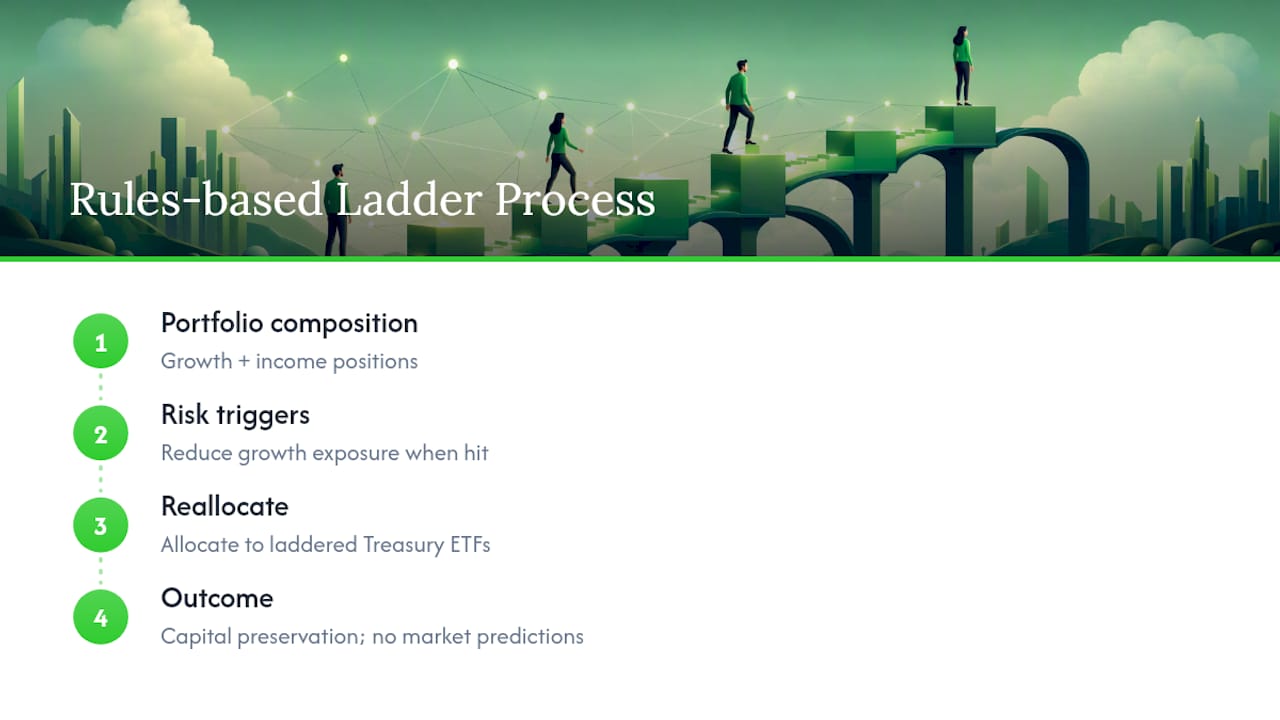
A model portfolio may hold several positions, combining growth names and income-producing positions. Some systems use risk-management rules to reduce growth exposure and shift capital toward Treasury ETFs as part of a defensive process.
A laddered Treasury allocation isn't a market call. It's a mechanical response, triggered when predefined criteria signal that capital preservation should take priority over chasing growth.
The point isn't predicting rate moves. It's having rules that guide decisions when conditions change, preventing decisions made under stress. Such systems typically avoid performance predictions or hype specific outcomes; they apply consistent criteria and issue alerts when changes are needed.
David, Author at Stockpilot
What Most Investors Get Wrong About Treasury Ladder ETFs
The biggest misconception is treating a ladder ETF as functionally identical to holding individual bonds to maturity. It isn't. You get a share price that floats with the market every single day, even inside a short-duration ladder, and that's the trade you're making for convenience.
Conventional advice tends to fixate on yield comparisons and skip past index methodology, which is backwards. Two funds with near-identical SEC yields can behave very differently in a rate shock if one uses calendar-maturity rungs and the other targets a rolling duration. Read the methodology before the yield.
If there's one thing to prioritize first, it's matching duration to your actual timeline, not chasing the highest advertised yield. A fund yielding slightly more but carrying double the duration can lose more in price than the extra yield ever earns back, especially if you need the money before rates settle. Treasury ladder ETFs solve a real problem: they simplify what used to require real spreadsheet work. They don't eliminate rate risk, and no marketing copy should convince you otherwise.
— David
A Rules-Based Alternative Worth Knowing About
If the checklist above felt like a lot to track fund by fund, some portfolio systems handle that kind of decision through predefined rules rather than manual research every time rates shift. These systems may mirror a model portfolio in your own brokerage account, and during unfavorable market signals, automatically shift capital toward Treasury ETFs as a defensive step, without requiring you to decide when or how much.
You keep full control of every trade and your account stays in your name; Stockpilot only issues the after-hours buy and sell alerts. If you want to see how the model portfolio handles growth and defensive positioning together, visit the Stockpilot landing page to learn more, and review the risk disclosure before you decide if it fits your situation.
Where to Verify These Fund Details Yourself
Every metric in this article, from expense ratios to duration figures, comes straight from issuer pages that update far more often than secondhand summaries.
- iShares LDRT fund page: holdings, SEC yield, and expense ratio for the 1-5 year iBonds ladder.
- Global X LLDR fund page: index methodology and maturity range for the long-term ladder.
- Vanguard VGSH profile: average maturity and short-term Treasury characteristics.
- Schwab SCHO product page: expense ratio and index tracking details.
- WisdomTree USSH factsheet: duration, maturity, and SEC yield for the 1-3 year laddered fund.
- Money.usnews Treasury ETF overview: comparative metrics across multiple Treasury ETF options.
This article is general information, not a substitute for advice from a qualified financial advisor. Consult a qualified financial professional about your own circumstances before acting on anything here.