
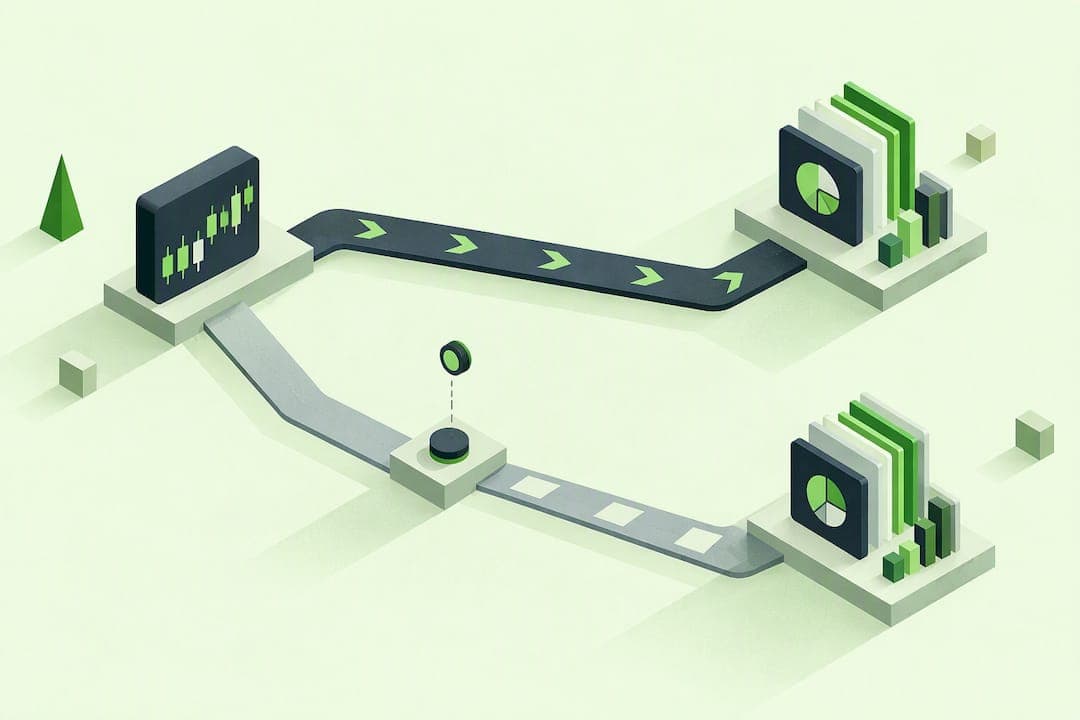
Mirror trading automates a predefined strategy or algorithm across every follower account, while copy trading replicates the live trades of a specific individual you choose to follow. Investors who want systematic, hands-off consistency tend to lean toward mirror trading, while those who want to pick a trader whose style they trust often prefer copy trading. Neither approach guarantees you will match the source performance, so check a platform's controls and disclosures before committing funds.
TL;DR:
- Before choosing a mirror strategy, review its rules, results across market conditions, maximum drawdown, minimum capital, and cancellation terms before committing funds.
- For copy trading, treat public trader histories as unverified, then confirm that you can cap losses, pause copying, reject trades, and close positions independently.
- Both models can produce worse fills than the source account because of latency, liquidity, spreads, or order sequencing; frequent trading adds commissions and tax consequences.
- Start with a small allocation, compare your actual fills and fees with reported results, and keep any single strategy within your broader portfolio's risk limits.
- Before linking an account, verify the platform's registration in your jurisdiction, review its disclosures and requested permissions, and use an API key that cannot withdraw funds.
Table of Contents
- What is mirror trading and how does it work?
- What is copy trading and how does it work?
- Execution, control, transparency, timing, and fees compared
- Which model fits you: a suitability framework and checklist
- Platform controls to verify before you connect an account
- Regulatory considerations for each trading model
- How investors actually use mirror and copy trading
- Protecting your accounts when you link to a trading platform
- Fitting mirror or copy trading into a broader portfolio
- Where a transparent model portfolio fits on this spectrum
- Try a transparent, rules-based model with StockPilot Premium
- FAQ
- Sources
What is mirror trading and how does it work?
Mirror trading links your account to a predefined strategy or algorithm rather than to a specific person. Once you select a strategy, trades fire automatically whenever the underlying signal triggers, and your account mirrors the strategy's position changes without you placing individual orders.
Platforms that offer mirror strategies typically vet them before listing, showing a performance history, drawdown statistics and a description of the rules the strategy follows. According to IOSCO's analysis of imitative trading, mirror trading is typically more highly automated than copy trading and applies the selected strategy's trades with less opportunity to select or modify individual recommendations. That tradeoff is the core of the model: you give up per-trade discretion in exchange for consistency with a rules-based system.
Mirror trading has deep roots in forex, where systematic, algorithm-driven strategies are common, though it also shows up in equities through quantitative or rules-based portfolios. Trades often run on shorter timeframes in currency markets, while equity-based mirror strategies may hold positions for weeks or months depending on the underlying logic.
In practice, once you set your parameters, such as allocation size or risk limits, the system runs the strategy for you. You are not approving each trade; you are approving the rules.
Platforms typically present a few core details before you commit to a mirror strategy:
- A strategy overview describing the logic, asset class and typical holding period.
- Historical return figures covering multiple market conditions, not just a strong period.
- Maximum drawdown data showing the worst historical peak-to-trough decline.
- Disclosure of fees, minimum capital and any lock-up or cancellation terms.
What is copy trading and how does it work?
Copy trading automatically replicates the live trades of one or more lead traders into your own account, in real time or near real time. Instead of following an abstract strategy, you are following a person (or a small group of people) whose trading history and style you have reviewed.
Choosing who to copy usually starts with a trader's public profile: win rate, risk score, maximum drawdown, average holding period and a log of open and closed positions. Because IOSCO's 2024 report notes that lead-trader credibility and historical performance may not be independently verified, the burden of due diligence often falls on the follower rather than the platform.
Most copy-trading platforms give you more granular controls than a typical mirror strategy. You can usually:
- Set a fixed allocation or percentage of capital assigned to each trader you copy.
- Cap losses with a personal stop-loss that overrides the trader's own position sizing.
- Pause copying temporarily without closing existing positions.
- Stop copying a trader entirely and close your mirrored positions independently.
Copy trading tends to concentrate in short-term, active trading styles, including day trading and swing trading, and it shows up heavily in forex, crypto and equities where lead traders post frequent, visible activity. If you want exposure to a specific trader's judgment rather than a fixed rulebook, this is the model built for that.
Execution, control, transparency, timing, and fees compared
The two models diverge in several areas that matter once real money is involved.
Execution in mirror trading follows an algorithm's signals; in copy trading, it follows a human trader's live decisions. Algorithmic execution tends to be more consistent across market conditions, since the rules do not change based on emotion, while a human trader's behavior can shift with confidence, stress or a losing streak.
Control is where copy trading usually wins on flexibility. Copy-trading platforms often let you select among individual recommendations or reject specific trades, while mirror-style models generally automate a broader set of trades with less room to intervene, according to IOSCO's imitative trading report. If per-trade override matters to you, confirm it exists before you fund the account.
Transparency differs in kind rather than degree. Mirror strategies typically disclose backtested performance and stated parameters, while copy-trading platforms show a live trade log and historical account statistics for each trader. Both carry the same caveat: past results do not promise future ones.
Timing and pricing risk affect both models, and understanding the difference between real-time vs delayed quotes can help manage expectations around fills and latency. Followers do not necessarily receive the same fills as the source account, and timing and pricing risk can come from latency, liquidity, spreads and order sequencing, with a large following sometimes moving prices against later followers.
Statistic: the same IOSCO report finds that copy-trading users face timing and pricing risk, operational or cyber risk, and potentially high fees from frequent trading, meaning the cost of imitation is not limited to a visible commission line.
Cost and turnover often get underweighted in the decision. A few points worth checking before you subscribe to either model:
- High-turnover strategies generate more commissions and spreads, which compound against your returns over time.
- Slippage on fast-moving trades can widen the gap between the source account's result and your own.
- Subscription or performance fees charged by the platform sit on top of your brokerage costs.
- Frequent short-term trades can trigger different tax treatment than longer-term positions, depending on your jurisdiction.
Which model fits you: a suitability framework and checklist
Before picking a side, answer a few honest questions about how you actually want to invest. How much time can you realistically spend monitoring positions each week? Do you want the ability to override a single trade, or are you comfortable letting a system run without your input? How much portfolio turnover can you tolerate before the fees start to bother you? Are you trying to learn an investing approach, or simply trying to delegate the decision-making?
A simple sequence can help you decide:
- Decide how often you want to check in on your account, daily, weekly or rarely.
- Decide whether you need the ability to override or reject a single trade before it executes.
- Decide which asset classes and timeframes you actually want exposure to.
- Match that profile against a mirror strategy's rulebook or a lead trader's live history.
- Start with a small allocation and track real fills against the source account for several weeks.
An investor who wants systematic exposure to a quant-driven forex strategy and does not want to think about day-to-day decisions tends to fit mirror trading. An investor who wants to follow a specific, visible trader active in crypto or equities, with the ability to cap losses or pause at will, tends to fit copy trading better.
Pro Tip: Run a small allocation first and compare your actual fills, fees and account behavior against the platform's stated claims before scaling up your position size.
Platform controls to verify before you connect an account
Before linking your brokerage account to any mirror or copy service, confirm the operational basics rather than taking the marketing page at its word.
Look for explicit intervention controls: the ability to pause or stop copying, cap position size, reject a single incoming order, close a position independently of the source account, and adjust your allocation without canceling the whole relationship.
Operational risks deserve equal attention. Latency between the source trade and your own fill can create meaningful price differences, and a large pool of followers copying the same trade can itself move the market and worsen fills for people lower in the queue. Platform outages and cyber risk are not theoretical: a service interruption during a volatile session can leave your positions unmanaged exactly when you need them managed.
On governance, check how a platform validates strategies or traders before listing them, what track record length it requires, and whether it discloses drawdown and risk statistics alongside headline returns. A regulatory advisory on self-directed investors recommends clearer account disclosures and enhanced education specifically for investors using automated tools, which signals that oversight in this space is still catching up to the technology.
Statistic: the SEC's investor alert on social media solicitations warns that unsolicited pitches, promises of guaranteed returns, pressure to buy immediately and heavy reliance on online testimonials are common signs of fraud, a pattern that shows up often in copy-trading promotion on social platforms.
Run the numbers on cost before you commit: trading commissions, spreads, slippage and the tax consequences of frequent trading can quietly erode a strategy that looks strong on a backtest or a trader's public profile.

Regulatory considerations for each trading model
Neither mirror trading nor copy trading operates under a single, unified rulebook, and oversight varies by platform, jurisdiction and the specific products involved. The SEC's guidance for self-directed investors using complex products and strategies recommends clearer account approval standards and stronger disclosures specifically when customers rely on automated tools, which applies directly to both models.
Copy trading often involves highly active strategies in foreign exchange and crypto-assets, categories that frequently draw separate regulatory attention because of leverage and volatility. Mirror trading's more algorithmic structure can obscure how often a strategy actually trades or how much leverage it applies, so disclosure quality becomes the practical substitute for a universal standard.
Be skeptical of AI branding used as a stand-in for due diligence. Guidance on AI-related claims in the brokerage space notes that firms may overstate automated capabilities, and claims about risk controls or profitability deserve specific, verifiable support rather than a testimonial or a vague performance statement. Before trusting a platform's compliance posture, confirm it is registered or regulated in your market and read its actual disclosures rather than its marketing copy.
How investors actually use mirror and copy trading
Consider two illustrative, hypothetical scenarios that reflect how these models get used in practice. Say an investor wants exposure to a systematic forex strategy that trades on technical signals across several currency pairs. They select a mirror strategy with a multi-year backtest, set a fixed allocation, and let the system manage entries and exits without daily input, checking in roughly once a month to confirm the strategy's drawdown remains within their comfort range.
A second, equally illustrative investor wants to follow a specific trader active in short-term equity and crypto positions. They review the trader's public track record, allocate funds with a personal stop-loss sized to their risk tolerance, and pause copying during an earnings season when they want to reduce exposure to volatility.
Both examples show the same underlying lesson: the model that fits depends on whether the investor wants to delegate to a rulebook or to a person, and both still require active monitoring of fees, drawdown and whether the copied approach remains appropriate as market conditions shift.
Protecting your accounts when you link to a trading platform
Connecting your brokerage account to a mirror or copy-trading platform usually requires either direct API access or login credentials shared through a linking service, and that connection point is where your security posture matters most. The SEC's guidance on social media and investment accounts recommends strong, unique passwords, caution around suspicious links, and verifying any investment claim by checking a firm's official channels directly rather than trusting an inbound message.
Before linking an account, confirm what permissions the platform actually requests. A read-only or trade-only API key that cannot withdraw funds limits your exposure if the platform itself is ever compromised. Review the platform's stated data practices for how your trading history and personal information are stored and shared with third parties, since a mirror or copy service often needs to see your account activity to execute trades on your behalf.
Our risk disclosure page outlines the kind of platform-level risks worth understanding before connecting any account to an automated system, a useful reference regardless of which model you choose.
Fitting mirror or copy trading into a broader portfolio
Neither model works well as your entire investment plan in isolation. A mirror or copy-trading allocation functions best as one component of a diversified portfolio, sized so that a single strategy's drawdown or a single trader's losing streak cannot derail your broader financial goals.
A reasonable approach starts with position sizing: cap any one mirrored strategy or copied trader at a percentage of total investable assets you are comfortable losing entirely, then diversify across asset classes and timeframes rather than stacking several highly correlated strategies. Reviewing performance against your own benchmarks on a set schedule, rather than reacting to every daily swing, keeps the automation working the way it was intended.
Our behavioral checklist for DIY investors walks through how to weigh automated tools against your own monitoring habits, a useful companion exercise when deciding how much of your portfolio to hand over to any mirror or copy strategy.
Where a transparent model portfolio fits on this spectrum
We built our own approach closer to the mirror end of the spectrum, but with more disclosure than a typical mirror strategy offers. Our model portfolio combines income-producing positions with AI-selected growth positions, and we issue clear after-hours buy and sell alerts only when our predefined criteria call for a change. You retain full custody and control of every trade in your own brokerage account, and our focus stays on disciplined position sizing rather than following any individual trader's live activity.
— David Elliot
Try a transparent, rules-based model with StockPilot Premium
If the comparison above left you leaning toward systematic, disciplined automation rather than following an individual trader's daily decisions, that is exactly what we built. With StockPilot Premium, you get:

- A transparent 19-position model portfolio blending income and AI-selected growth positions.
- After-hours buy and sell alerts issued only when our criteria call for a change.
- Automated risk management that shifts capital toward Treasury ETFs during unfavorable conditions.
- Full custody of your own brokerage account, with every trade visible before you place it.
We publish our full portfolio composition and reasoning rather than asking you to trust a black box, and you decide whether to place each trade yourself. Check current pricing and plan details to see if our rules-based approach fits how you want to invest.
This article is general information, not a substitute for advice from a qualified financial advisor. Consult a qualified financial professional about your own circumstances before acting on anything here.
FAQ
Is mirror trading a good idea?
Mirror trading can suit investors who want systematic, rules-based exposure without managing individual trades, but it is not inherently safer than other methods. Review the strategy's historical drawdown, fees and the platform's disclosed controls before allocating funds, since IOSCO's report on imitative trading notes that neither mirror nor copy trading guarantees matching performance.
Is copy trading actually profitable?
Profitability depends entirely on the lead trader you choose and the fees, slippage and timing risk you absorb as a follower. The IOSCO analysis points out that lead-trader credibility and historical performance may not be independently verified, so due diligence on your part matters as much as the trader's track record.
Which brokers allow mirror trading?
Availability varies by broker and by jurisdiction, and the asset classes offered for mirror trading differ from platform to platform, with forex and systematic equity strategies among the available options. Confirm directly with a broker whether it supports mirror trading in your account type before assuming the feature is available.
Does mirror trading increase my chances of success?
Mirror trading does not improve your odds on its own; it simply automates a predefined strategy's trades into your account, with the same market risk the strategy itself carries. Checking a strategy's full track record across different market conditions, rather than a recent winning streak, gives a more honest read on what to expect going forward.
What should I check before linking my account to a copy-trading platform?
Confirm the platform's intervention controls, such as pause, stop-loss caps and the ability to close positions independently, along with its fee structure and how it verifies trader track records. The SEC's guidance on social media and investing also recommends verifying any investment claim directly through a firm's official channels before connecting your account.